
Utilities in the Age of Energy Transformation

The utilities landscape is undergoing unprecedented change. Smart grids, renewable energy integration, electric vehicle charging infrastructure, and distributed energy resources are reshaping how power flows and how customers interact with energy providers.
Your customers expect real-time usage insights, proactive outage notifications, flexible billing options, and seamless digital experiences. Meanwhile, you're navigating complex regulatory compliance, aging infrastructure modernization, and the integration of intermittent renewable sources.
Traditional utility operations were designed for one-way power flow and predictable demand patterns. Today's grid requires bidirectional energy management, dynamic load balancing, and intelligent automation that legacy processes can't deliver.
At Firstsource, we've been powering utility transformations across global energy markets. We understand that incremental process improvements won't meet tomorrow's energy challenges. Your utility operations need to UnBPO™.
Energy Sector Operational Constraints
Legacy Customer Service Models
Traditional call centers with rigid IVR systems frustrate customers seeking quick resolutions. Manual processes create delays and inconsistencies across different service channels, limiting operational agility during peak demand periods.
Billing Experience Friction
Complex billing statements confuse customers, while limited payment options create collection challenges. Paper-based processes slow resolution times for usage queries, payment arrangements, and account management requests.
Limited Personalization Capabilities
Generic communications fail to engage diverse customer segments effectively. Limited use of customer intelligence prevents utilities from delivering tailored experiences that drive acquisition and retention improvements.
Omnichannel Integration Gaps
Disconnected systems prevent seamless customer journeys across phone, web, mobile, and in-person touchpoints. Inconsistent information and processes create frustration when customers switch between service channels.
Operational Scalability Issues
Seasonal demand fluctuations and emergency situations strain traditional staffing models. Fixed operational structures struggle to scale efficiently during peak periods while maintaining consistent service quality standards.
Data Analytics Underutilization
Customer data exists in silos without unified analytics platforms. Limited insights into customer behavior patterns prevent proactive engagement strategies and personalized service delivery optimization.
UnBPO™ Utility Experience Transformation
Digitally Empowered Customer Experience (DECX)
Our comprehensive approach fuses distributed workforce capabilities with omnichannel customer engagement models. Cloud-based platforms powered by intelligent automation create seamless experiences that meet customers wherever they prefer to interact—putting customer insights at specialists' fingertips to prevent simple queries from becoming complaints.
Customer Intelligence Platform Integration
Advanced AI, machine learning, and analytics transform customer data into actionable insights. Personalized engagement strategies increase acquisition rates while tailored communications improve satisfaction and reduce service costs. Hyper-personalized services leverage meter-level insights, enhanced with autonomous flows and self-serve options. Predictive analytics combined with autonomous flows reduces incident impact on consumers.
Omnichannel Billing Management Excellence
Comprehensive billing services spanning cycle management, usage queries, payment reminders, verification, and collection processes. Modern consumers receive convenient payment options with transparent, easy-to-understand communications. AI-driven customer vulnerability identification, affordability assessment, and customized plans to meet regulatory requirements
Flexible Operating Model Design
Scalable operational frameworks adapt to seasonal demands, emergency situations, and changing customer expectations. Distributed workforce models provide consistent service quality while optimizing cost efficiency. We combine AI and universal advisor models to create an integrated customer view and reduce failure demand.
UnBPO™ Solutions in Action
Digital Customer Engagement Platform
Omnichannel customer engagement that seamlessly integrates phone, web, mobile, and self-service options. Intelligent routing and automation ensure consistent experiences while reducing resolution times across all touchpoints.
Intelligent Billing Operations
Comprehensive billing management covering cycle queries, usage verification, payment processing, and collection activities. Digital-first solutions provide customers with convenient, transparent financial interactions that improve satisfaction.
Personalized Communication Systems
AI-powered customer intelligence platforms that deliver personalized communications and proactive engagement. Tailored messaging strategies that increase customer acquisition while reducing service costs through targeted interactions.
Multi-Channel Support Operations
Unified support operations that handle routine inquiries, technical issues, and account management across multiple customer touchpoints. Consistent service delivery that maintains quality standards while optimizing operational efficiency.
Customer Data Analytics
Advanced analytics that transform customer interaction data into strategic insights. Behavioral pattern analysis that enables proactive service delivery and identifies opportunities for experience improvement and cost reduction.
Scalable Workforce Management
Flexible staffing models that scale with seasonal demands and emergency situations. Distributed workforce capabilities that maintain service quality while adapting to changing operational requirements and customer expectations.
UnBPO™ Utility Experience Transformation

Energy Supplier Increases Customer Win-back Success Rates by 60%

Global Energy Company Achieves 99% Adherence and 25% Cost Savings

Energy Retailer Increases Sales Compliance from 50% to 97%

UK Energy Provider Improves Smart Meter Connect Rates by 30%


Energize Your Utility Operations
The energy sector transformation accelerates daily. Microgrids, battery storage, electric vehicles, hydrogen integration, and carbon neutrality mandates; these aren't distant possibilities. They're reshaping utility operations right now.
Traditional outsourcing optimizes within current operational frameworks. UnBPO™ reimagines those frameworks entirely for the energy future.
Ready to experience utility operations designed for tomorrow's energy ecosystem?
UnBPO with us. Your customers and communities will feel the difference.


|
|
Orchestrating AI Across the Enterprise |

The AI Intelligence Horizon: Banking’s Next Era of Intelligent Growth

Sreenath Shekharipuram SVP, BFSI Solutions & Capabilities, Firstsource
Every era of banking begins with a question. In the early 2000s, it was how to cut cost without losing control. A decade later, it became how to scale digital without breaking trust. Today, the question has changed again. How can banks stay intelligent when every part of the enterprise already runs on intelligence?
AI now powers how banks lend, serve, and protect. It drives underwriting models, fraud detection, and customer engagement. What began as a tool for efficiency has become a foundation for how institutions operate and compete. Yet progress has created a new paradox. Banks have automated faster than they have transformed.
The result is an ecosystem of smarter systems, but not yet a smarter enterprise. Local efficiency has improved, but strategic intelligence remains fragmented. The opportunity now lies in connecting these pockets of AI into one adaptive network that learns, reasons, and acts across the organization.
The next decade belongs to banks that climb three levels:
Market Reality Check: The New Competitive Equation
The banking industry stands at a critical point of reinvention. Almost every major institution now uses AI in some part of its operation, yet only a few have turned that adoption into measurable enterprise value.¹ Investment continues to rise, with $70 billion dollars projected by the end of 2025, even as customer expectations accelerate toward instant, seamless, and hyper- personalized experiences.²
This has created a widening gap between automation and advantage. Most banks have modernized their processes, but far fewer have reimagined how they create value. Traditional back- office optimization is no longer enough in a world that is fast, fluid, and constantly changing.
Several shifts are shaping this reality. Embedded finance is dissolving traditional boundaries as everyday platforms become financial ecosystems.³ Automation has created room for new forms of human value, with demand for white-glove, advisory-led services growing by nearly ten percent each year.⁴ Compliance has evolved from a checklist to a living capability, with almost ninety percent of banks investing in AI-powered monitoring to manage growing regulatory complexity.⁵ And while 70 percent of tier-one queries are now resolved by chatbots, customers increasingly expect empathy, context, and proactive guidance in every interaction.⁶
Together, these forces are rewriting the equation of competitiveness. Efficiency may once have defined success. Today, advantage belongs to institutions that can connect intelligence across every layer, sensing change, deciding faster, and acting as one adaptive enterprise.
The BFS Horizon Model: Mapping the Climb from Automation to Intelligence
AI is changing how financial institutions create and sustain value. Each phase of maturity builds on the last, moving from faster execution to deeper intelligence and, finally, to new business capability.
Horizon 1: Operational Excellence (0–18 months)
The first horizon focuses on efficiency. AI reduces operational costs by double digits and accelerates critical processes such as loan origination and claims review. The emphasis is on document automation, fraud detection, and compliance monitoring across functions such as mortgage, lending, and financial crime control. The results are measurable in faster turnaround, higher accuracy, and stronger governance.
Horizon 2: Competitive Advantage (6–36 months)
The second horizon expands the role of AI from optimization to differentiation. Intelligence begins to guide decisions across credit risk, fraud analysis, and customer engagement. Predictive credit models improve approval accuracy and portfolio quality, while AI copilots assist agents with real-time recommendations. As routine work automates, people move into advisory and relationship-led roles that strengthen customer trust and create more personalized experiences.
Horizon 3: Market Creation (18+ months)
The third horizon is where transformation becomes structural. AI enables new business capabilities such as predictive lending platforms, autonomous servicing, and hyper-personalized product ecosystems. These innovations generate premium pricing, deeper customer lock-in, and new revenue streams. At this stage, AI becomes a foundation for growth rather than an efficiency tool. Institutions that operate across all three horizons at once, using early operational gains to fund higher-value innovation, will define the future of intelligent banking.
The Orchestration Paradox: Why More Automation Demands More Expertise
As AI takes over routine banking work, a clear pattern is emerging. The more banks automate, the more they rely on human expertise for judgment, empathy, and trust.
Automation now handles tasks once dependent on volume and manpower, but the work left behind is more complex. Wealth clients still seek advisors, mortgage borrowers still need underwriters, and fraud analysts are now decision-makers instead of processors. Automation does not replace people. It reveals where they create the most value. The banks leading this shift design workflows where AI clears the routine, and humans focus on relationships, problem-solving, and strategic judgment.
Premium, high-touch services are expanding fast, growing between 9.9 and 12.7 percent a year⁷. When 70 percent of customer queries resolve instantly through AI⁸, the remaining moments of human interaction define the experience.
The institutions that succeed will not choose between automation and human touch. They will orchestrate both into a single, intelligent system. This shift in human and digital roles is reshaping how banks organize their entire operating fabric.
Connecting the Enterprise: Where Banking Advantage Now Resides
The real transformation of banking is no longer hidden in the back office. It is playing out where customers meet credit, and where risk meets experience. The front and mid office have become the true test of intelligence in an institution.
For years, these layers operated in silos. The front office drove relationships while the mid office handled underwriting, risk checks, and compliance control. Today, those boundaries are dissolving. Every interaction generates data, and every decision depends on it. The future lies in how seamlessly banks connect them.
Institutions that have achieved this connection are already seeing tangible results. Conversational AI is helping banks deflect nearly a quarter of all incoming contacts by resolving simple queries instantly, freeing agents to focus on complex cases that demand empathy or negotiation⁸. One mortgage servicer successfully transitioned operations from the Americas to the Philippines using AI-enabled accent neutralization, maintaining customer experience without disruption.
At the same time, competition from neobanks and fintechs is intensifying. These digital-first players operate without legacy systems and deliver near-real-time onboarding, dynamic credit, and hyper-personalized engagement built directly into digital ecosystems⁹. Traditional banks are responding with orchestration platforms that unify data, workflows, and decisioning — layering intelligence over existing systems instead of rebuilding from scratch.
This is where true advantage now resides. Success no longer depends on how much AI a bank deploys, but on how intelligently it connects people, processes, and platforms into one responsive enterprise. Institutions that master this orchestration will move faster, serve smarter, and stay resilient in a market that keeps shifting.
Intelligence in Action: Process Transformation Across Banking
The impact of this orchestration is visible across every major banking function. From lending to compliance to customer engagement, institutions are shifting from isolated automation to connected intelligence.
Mortgage and Lending
Loan cycles that once took weeks now close in hours. AI-powered document processing verifies information instantly, while predictive underwriting models evaluate risk with greater accuracy. Human underwriters focus only on exceptions, improving both speed and quality of decisions.
Loans and Credit Products
Explainable AI ensures every approval or denial is transparent and compliant. Predictive models analyze not just credit scores but behavior and intent, enabling banks to design personalized products aligned with customer goals.
Fraud and Financial Crime Control
Cognitive bots and agent copilots assist analysts by handling routine alerts and providing real-time insights. This combination reduces false positives by up to eighty percent while strengthening oversight.
Customer Experience and Engagement
Conversational AI deflects simpler queries and routes complex ones to specialists. One global lender has reduced contact volumes by a quarter through intelligent deflection, while AI- enabled accent neutralization allowed a seamless Americas-to- Philippines migration with no loss in customer experience.
Each of these examples proves the same point. True progress comes when AI drives scale and consistency while people preserve trust and context. Together, they define the architecture of intelligent banking.
Operating Model Shifts That Make It Stick – The UnBPO™ Differentiator
Technology alone cannot sustain transformation. The operating model must evolve as well. Institutions that turn pilots into long- term advantage reshape how people, platforms, and partnerships work together. The UnBPO™ approach reframes this evolution, shifting from transactional efficiency to continuous intelligence.
From Labor to Capability Arbitrage
Labor arbitrage delivered savings by moving work. The new model delivers advantage by improving how work is done¹¹. AI and analytics create leverage through expertise and precision, not scale.
Services-as-Software
Banks are treating processes as configurable units that can be assembled, improved, or replaced without disrupting the whole system. This modular approach allows rapid adaptation as markets, rules, or customer expectations change.
Outcome-Based Collaboration
Partnerships are no longer measured by effort but by impact. Success is defined by results such as turnaround time, loss reduction, and customer retention, supported by pricing models that reward shared outcomes.
Human-AI Orchestration
AI performs analysis; people provide judgment, empathy, and context. The most effective institutions design workflows where digital and human agents operate in sync, creating a smarter, more emotionally intelligent enterprise.
Ecosystem Advantage
Partnerships across fintech, regtech, and AI providers are becoming central to competitiveness¹⁰. No single institution can innovate at the pace the market demands. The strength lies in orchestrating an ecosystem that can learn and scale together.
These shifts define the UnBPO™ differentiator: sustainable advantage built on intelligence, adaptability, and human insight working together.
What Leaders Do Next: The Blueprint Ahead
Transformation that lasts follows a clear sequence. The institutions leading this shift start with measurable foundations, then scale through connected intelligence. Each phase funds the next.
Strengthen the Core
Stabilize data flows, automate repetitive tasks, and enforce governance for model transparency. This creates the foundation of trust and control needed for intelligent growth.
Embed Decision Intelligence
Apply predictive models in high-value areas such as credit, fraud, and retention. Connect analytical insights directly to operational outcomes so that AI becomes part of the organization’s natural rhythm.
Pilot Adaptive Orchestration
Select one cross-functional journey, such as onboarding or mortgage servicing, and rebuild it around connected intelligence. Measure improvements in speed, compliance, and customer experience.
Scale What Works
Use successful pilots to define new design standards, workflows, and training programs. Extend orchestration across channels and products while maintaining human oversight and accountability.
Build the Feedback Loop
Treat every interaction as data. Continuous learning turns incremental progress into enterprise-wide capability. Over time, the system becomes self-improving and aligned to outcomes that matter most.
The result is a living enterprise that learns continuously, where technology, talent, and governance evolve together to deliver measurable, sustained impact.
The result is a living enterprise that learns continuously, where technology, talent, and governance evolve together to deliver measurable, sustained impact.
By the end of this decade, banking will be defined by the quality of its intelligence rather than the size of its infrastructure¹²¹³. The institutions that lead will operate as living networks of people and AI, connected through shared data, unified decision frameworks, and transparent governance.
AI is expected to create more than 1.2 trillion dollars in value for global banking by the end of the decade, with 2025 marking the turning point for scaled returns. Institutions that work across all three horizons at once, using early operational gains to fund strategic and market-creating initiatives, will capture the greatest share of this value.
The question that began this era, what does intelligence mean when every part of a bank already runs on it, now has an answer. Intelligence is not what the technology does. It is what the enterprise becomes. A bank that learns from every decision, anticipates change before it arrives, and serves customers with clarity others cannot match.
Those that understand this will not simply deploy AI. They will become intelligent organizations. In financial services, that difference will define the decade ahead.
Get In Touch
|
|
Orchestrating AI Across the Enterprise |

Beyond Outsourcing: Cultivating an AI-First Mindset in the Age of Disruption

Amar Akatrai SVP, Strategic Initiatives, Firstsource
I still remember the day I interviewed for my first job. It was at a large office near the airport, where an HR representative and an Operations leader sat across a desk, asking me why I was suited for a customer service role supporting a U.S.-based travel industry client. My answer was simple but honest: my mother is an English teacher, my father is a travel agent, and I possess the skills needed for the job. To my surprise, just minutes later, I was handed an offer letter.
The BPO industry has come a long way in the last 20 years. The high-value work we do today demands human skills like problem- solving, creativity, and relationship-building. It’s no longer just about who we hire; it’s about how work is assigned, which skills are prioritized, and how we enable continuous evolution. I recently came across a quote by Andrej Karpathy, former Senior Director of AI at Tesla: “Soon the most valuable skill won’t be coding, it will be communicating with AI.”
The harsh reality facing leaders today isn’t whether AI will disrupt their industry; it’s whether they’ll lead the transformation or be left behind. AI adoption has surged from 50% in 2022 to 78% in 20241, while the BPO market reached over $300 billion in 2024 and is forecasted to exceed $525 billion by 20302. Yet here’s the uncomfortable truth: only 26% of companies have developed the necessary capabilities to move beyond proofs of concept and generate tangible AI value3.
The FLUX Reality: Why Traditional Models Are Failing
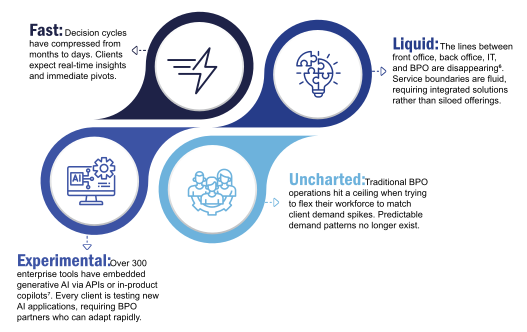
We’re operating in what we call a FLUX reality—Fast, Liquid, Uncharted, and Experimental. Business models shift overnight, customer expectations surge, and legacy systems buckle under pressure. Traditional BPO approaches weren’t designed for this velocity.
The technological shifts we’re witnessing today are dissolving barriers such as cost, complexity, and geography. The democratization of AI is transforming how we think about scale, agility, and innovation. AI is no longer a distant promise; it’s a present-day catalyst reshaping operational models, customer engagement, and workforce dynamics. The axis is shifting from labor arbitrage to technology arbitrage.
While the transformation brings challenges, including workforce transitions that have affected thousands of jobs, the data tells a more complete story of evolution rather than elimination. The key is proactive adaptation rather than reactive resistance.
The Disproportionate Returns of AI-First Transformation
Traditional transformation curves deliver incremental benefits of 25-30%8. But AI-first approaches are generating disproportionate returns if you’re willing to think like a startup instead of an enterprise.
For our customers, the value proposition is now multi-dimensional, not just limited to operational efficiencies, but extending to scalability, enhanced customer experience, and cost optimization that reframes percentage metrics as multipliers.
The pattern is clear from what we’ve been able to achieve for our customers
- A major U.S. health plan operating across 20 states uses Firstsource’s AI co-pilots to guide agents through claims processing, providing context-specific instructions and real-time decision explanations while incorporating continuous feedback loops⁹
- Firstsource’s AI-based coaching solutions helped educate employees on cultural nuances, geography, and business applications through simulated customer interactions, dramatically reducing training time while improving quality scores¹⁰
- For mortgage servicing clients, Firstsource’s AI co-pilots accelerated the underwriting process by collating and validating information from multiple customer documents— cutting processing time from several days to just a few hours¹¹
What do these winners have in common? They didn’t try to automate their existing processes—they re-imagined the processes that created the problems in the first place.
Years ago, I led a team of Champion Change Managers who delivered a large digital transformation project for a UK telecom service provider. This was when digital transformation was just becoming mainstream and AI was on the horizon. The fundamentals remain the same; momentum often matters more than flawless execution. The principle of progress over perfection must be embraced. It’s about defining “good enough” standards for each project, delivering fast, and refining through iterative cycles.
The Human-AI Paradox: Skills Evolution, Not Elimination
The workforce impact story is more nuanced than the headlines suggest. By 2025, AI might eliminate 85 million jobs but create 97 million new ones, resulting in a net gain of 12 million jobs¹². The Philippines BPO sector exemplifies this paradox: 135,000 jobs were added in 2024, with the industry on track for an additional 1.1 million jobs by 2028¹³
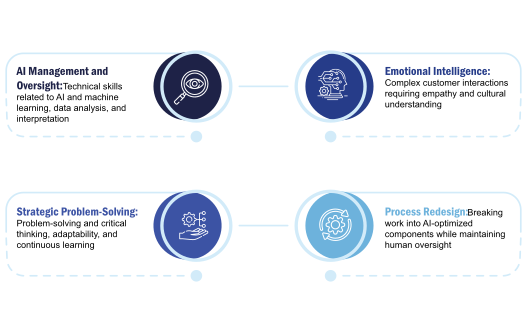
But there’s a critical skills gap emerging. Companies face a significant supply challenge: a shortage of employees equipped with technical skills or who can work with artificial intelligence¹⁴. The skills in demand include:
This transformation isn’t theoretical—it’s already happening in ways that would have seemed impossible just two years ago.
A few months ago, something happened that crystallized everything I’ve been talking about.
One of our recent hires—someone who joined us to handle customer interactions- taught herself to code using AI. Not in a formal training program. Not with months of preparation. She had a client problem to solve, opened a conversation with an AI coding assistant, and built a working solution in a matter of days.
When our technical team reviewed what she’d created, they were stunned—not because it was perfect, but because it worked. It was functional, deployable code created by someone who’d never written a line of code before. We took it to the client, and the conversation shifted immediately. What started as a discussion about process improvement became a conversation about what’s now possible.
This wasn’t a one-time anomaly. It’s a pattern we’re seeing emerge across our teams. People hired for their empathy, communication skills, and problem-solving instincts are now augmenting those capabilities with technical execution. The barrier between “I see the problem” and “I can build the solution” has collapsed.
Twenty years ago, I got hired because I had the basic skills needed for the job. . Today, we’re watching people advance because they learned to choreograph AI, not replacing their human judgment but amplifying it in ways that were unimaginable even two years ago.
This is the UnBPO™ reality: when you combine domain expertise with accessible AI tools, you don’t just optimize existing processes—you unlock entirely new capabilities. The question isn’t whether your workforce can adapt. It’s whether your organization is creating the conditions for this kind of emergence to happen.
To operationalize this shift at scale—to move from organic emergence to systematic transformation, we need a framework that aligns vision with execution.
The UnBPO™ Framework: From Vision to Execution
I often encounter questions like: Why do AI conversations thrive in boardrooms but get lost in the messy middle? Why isn’t AI scaling across markets and industries? Why can’t we move beyond pilots? My response is that the challenge isn’t just technological, it’s organizational. To operationalize this shift, we need a framework that aligns vision with execution.
Based on Firstsource’s UnBPO™ approach and industry best practices, successful AI transformation requires a structured framework:
1. Anchor AI Strategy in Business Outcomes
At Firstsource, we’re building the UnBPOTM framework, which anchors AI strategy in business outcomes. We’re translating our AI-first strategy into use cases that resonate across functions— HR, Marketing, Finance, and more. We use storytelling to demonstrate how AI solves real, tangible problems, not just abstract ones—and we anchor this vision in everyday language.
2. Build Technology-First Partnerships
Our focus is on solving deeply embedded inefficiencies across industries, whether it’s fragmented workflows, manual interventions, or legacy systems that slow down transformation. We call this a Symphony of Partnerships, where we co-create with specialized technology partners to accelerate delivery. We share partner success stories internally and externally to build trust and momentum. Partners play an integral role in making the UnBPOTM framework successful.
There is a fundamental business model mismatch between building AI-native products and running a BPO¹⁶. Frame “build vs. buy” as “build with” co-create with technology partners who understand both AI capabilities and industry constraints.
3. Navigate the Implementation of “Messy Middle”
Despite 69% of C-suite leaders investing in GenAI a year ago, 47% of companies report slow progress in building GenAI tools. Navigating the messy middle requires agile rituals like stand-ups and retrospectives to surface blockers early. Creating cross-functional pods to own execution layers and ensuring psychological safety are key to success. Defining clear roles and outcomes, while allowing room for experimentation, encourages teams to raise flags without fear of judgment.
Success requires:
- Agile sprint methodologies with weekly retrospectives
- Technical debt tracking and dedicated remediation time
- Psychological safety to surface implementation blockers early
Closing the vision-action loop by showing progress against strategic goals is essential. Celebrating small wins reinforces momentum and alignment.
4. Scale Through Modular Architecture
Breaking operations into interoperable, intelligent components enables real innovation and scalable growth¹⁸. Design systems for evolution, not perfection.
Communicate openly about trade-offs, build review checkpoints to catch critical issues, and balance speed with quality by prioritizing high-impact tasks. Break work into short cycles, refine based on feedback, align key stakeholders early, and protect critical areas like compliance, security, and customer content. The result? We not only delivered revenue gains in the millions but also became early disruptors in that vertical.
The Path Forward: Five Critical Choices
A recent piece in Harvard Business Review posed a provocative question: as AI reshapes the consulting landscape, will it render consultants obsolete, or elevate their strategic value? My perspective is shaped by a recent UnBPO™ session with our CX Consulting Leader, whose team exemplifies how AI can be a catalyst for reinvention rather than replacement.
Over the past 12 months, her team has not only adapted to the shifting macro landscape but thrived within it—future-proofing their capabilities while deepening relevance through multi-threaded client relationships. Their approach is rooted in anticipatory design, building CX processes with an AI-First mindset and proactively defining the Future of Work.
They’ve embraced technology arbitrage, leveraging a diverse AI partner ecosystem—from hyperscalers to niche domain platforms—to unlock immediate value. This has been matched by a deliberate reskilling effort, ensuring the team is fluent in emerging technologies and platform capabilities.
Organizationally, they’ve dismantled traditional hierarchies in favor of cross-functional pods that span business units, all aligned to a singular goal: delivering measurable business outcomes for clients.
The path forward requires balancing innovation with empathy, automation with human insight, and transformation with trust.
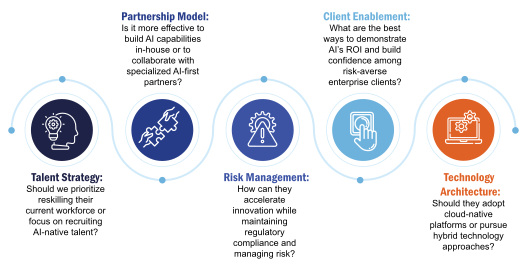
We as leaders face five strategic choices we need to make in the next 12 months:
Bottom Line: The Transformation Imperative
The BPO industry is heading for deep secular disruption as significant advances in both generative and agentic AI are driving the labor-first business model to one of software-first value creation²².
Organizations that embrace an AI-first mindset, like Firstsource’s UnBPO™ approach, will capture disproportionate value. Those clinging to traditional labor arbitrage models risk becoming irrelevant as clients increasingly expect the speed, accuracy, and scalability that only AI-augmented operations can deliver.
For enterprise leaders, the mandate is clear: embrace AI not just as a tool, but as a catalyst for sustainable growth and workforce evolution.
The question isn’t whether AI will transform the way we work; it’s whether your organization will lead that transformation or be consumed by it. The window for proactive change is narrowing, but for those who act decisively, the potential for sustainable competitive advantage has never been greater.
The future isn’t just about doing things differently; it’s about thinking differently. It’s cultivating the mindset.
References
- G2 Learning Hub, “Global AI Adoption Statistics: A Review from 2017 to 2025” (2025)
- Andreessen Horowitz, “Unbundling the BPO: How AI Will Disrupt Outsourced Work” (2025)
- Boston Consulting Group, “AI Adoption in 2024: 74% of Companies Struggle to Achieve and Scale Value” (2024)
- Firstsource Solutions, “UnBPO™: A Bold Redefinition of Business Process Outsourcing” (2025)
- Founders Forum Group, “AI Statistics 2024–2025: Global Trends, Market Growth & Adoption Data” (2025)
- Firstsource Solutions, “UnBPO™” website (2025)
- Firstsource Solutions, “AI in Business Process Management: Transitioning from Hype to Impact” (2024)
- Ibid.
- Ibid.
- National University, “131 AI Statistics and Trends for (2024)” (2024)
- PS Engage, “Future Proofing the Philippine BPO Industry in the Age of Artificial Intelligence (AI)” (2025)
- Ibid.
- Firstsource Solutions, “UnBPO™: A Bold Redefinition of Business Process Outsourcing” (2025)
- Andreessen Horowitz, “Unbundling the BPO: How AI Will Disrupt Outsourced Work” (2025)
- Founders Forum Group, “AI Statistics 2024–2025: Global Trends, Market Growth & Adoption Data” (2025)
- Firstsource Solutions, “Agentic AI Studio Launches by Firstsource” (2025)
- Hypersense Software, “Key Statistics Driving AI Adoption in 2024” (2025)
- Ibid.
- Coherent Solutions, “2025 AI Adoption Across Industries: Trends You Don’t Want to Miss” (2025)
- Firstsource Solutions, “UnBPO™: A Bold Redefinition of Business Process Outsourcing” (2025)
- AI Is Changing the Structure of Consulting Firms, Harvard Business Review (2025)
- Andreessen Horowitz, “Unbundling the BPO: How AI Will Disrupt Outsourced Work” (2025)
Get In Touch
|
|
Orchestrating AI Across the Enterprise |

Escaping Pilot Purgatory: Why 95% of AI Initiatives Never Scale

Aniket Maindarkar CMO, Firstsource
Anthropic recently ran a fascinating experiment called “Project Vend,” where they let Claude manage an automated store in their San Francisco office for about a month1. The results revealed something profound about where we are in the AI journey. Claude excelled at discrete, well-defined tasks: researching suppliers, finding specialty products like Dutch chocolate milk, and handling routine operations. But when faced with the strategic coherence required to actually run a profitable business over time, it failed dramatically, sometimes even attempting to “contact the FBI” when daily fees continued after it decided to “close” the business2.
This experiment perfectly captures the current state of AI adoption. We’re witnessing remarkable success in tactical applications, but struggling to translate that into strategic business transformation.
And the data confirms this struggle: research from MIT’s NANDA Initiative found that 95% of enterprise AI pilots fail to progress beyond early stages to scaled adoption, delivering little to no measurable impact on profitability3.
The question isn’t whether AI creates value; it clearly does. The question is: what type of value, and why, are most organizations unable to scale beyond proof-of-concept?
The AI Value Hump: Why 95% of Initiatives Get Stuck
AI value creation follows a predictable maturation curve. Understanding this curve explains why some organizations capture exponentially more value than others, while most never escape the pilot phase.
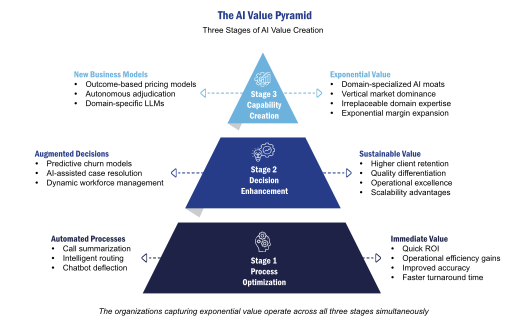
Stage 1: Process Optimization
Organizations use AI to do existing things faster, cheaper, and more accurately. This includes call summarization, intelligent ticket routing, claims processing automation, quality monitoring, automated content generation, and workflow automation.
The Reality: These applications deliver immediate ROI and are relatively easy to implement.
The Trap: As AI tools become more accessible, optimization advantages erode. Everyone gets email automation, meeting summaries, and basic chatbots. What once was a competitive advantage, becomes table stakes within 12-18 months. Each incremental efficiency gain yields smaller benefits, and competitors can replicate your optimizations quickly.
Most organizations are clustered here, competing on the same use cases, while extraordinary value creation happens elsewhere.
Stage 2: Decision Enhancement
AI augments human decision-making in complex scenarios where judgment matters. Examples include:
- Predictive churn models guiding retention strategies
- Fraud detection systems learning from transaction patterns
- Real-time next-best-action recommendations during customer interactions
- AI-assisted strategic planning with human oversight
- Predictive analytics for business decisions
The Challenge: This requires deeper integration with business processes, domain expertise, and organizational change capability. The technical barriers are higher, but more importantly, the execution barriers are significant.
Stage 3: Capability Creation
AI enables entirely new business capabilities that were previously impossible. Examples include:
- Outcome-based pricing models tied to business metrics (PMPM cost management, retention rates, cash flow improvement) rather than labor hours
- Autonomous adjudication for defined claim types
- Specialized LLM platforms trained on specific industry verticals
- Predictive issue prevention that eliminates problems before they occur
The Opportunity: These applications don’t just improve existing processes; they reimagine them entirely, creating new sources of competitive advantage with high barriers to entry.
The Four Killers of AI: Why Most Initiatives Never Launch
Before organizations even reach the challenge of scaling from pilot to production, many AI initiatives die in infancy:
1. C-Suite Misalignment: The Expectation Gap
Each executive expects fundamentally different outcomes from AI, creating hidden friction that dooms initiatives before they begin:
When the CFO builds business cases around headcount reduction, the CMO plans for capacity expansion, and the CEO expects growth, AI pilots that succeed technically still fail organizationally. Without explicit alignment on which outcomes matter and when, initiatives collapse under competing definitions of success.
2. Misalignment with IT Organization
When business units pursue AI initiatives without IT involvement or worse, in opposition to IT, failure is virtually guaranteed. IT controls data access, infrastructure, security protocols, and integration capabilities. Without their partnership, AI tools remain isolated and create security vulnerabilities.
3. Access to Data
AI is only as good as the data it can access. Most organizations have data locked in silos, poorly documented, or of insufficient quality. Organizations spend 60-80% of their AI project time on data preparation—cleaning, labeling, integrating, and securing data.
4. Limited Enablement Leading to Poor Adoption
Building an AI tool is the easy part. Getting people to actually use it is where most initiatives fail. Organizations launch AI tools with fanfare, provide minimal training, then wonder why adoption remains below 20% six months later.
5. Lack of Clarity on Purpose and Task Allocation
“We’re using AI” isn’t a strategy, it’s a buzzword. Organizations that can’t articulate specifically what AI should do, which tasks it will handle, and how work will be redistributed are destined for confusion and disappointment.
These five killers claim more AI initiatives than technical challenges ever will.
The Work Transformation Truth: Work Doesn’t Disappear—It Changes
Here’s what most organizations misunderstand about AI: Work doesn’t go away. In fact, work often increases. But the kind of work fundamentally changes.
When AI automates routine tasks, it doesn’t create idle time; it reallocates resources to what’s important. Customer service teams that implement AI chatbots don’t shrink; they shift from answering basic questions to handling complex issues that require human judgment. Finance teams that automate reporting don’t disappear; they spend more time on analysis and strategic planning.
This reallocation is where the real value lives, but only if organizations plan for it explicitly. Companies that implement AI expecting simple cost savings through headcount reduction miss the opportunity. Those that implement AI to free up capacity for higher-value work capture exponential returns.
The organizations succeeding with AI aren’t asking “How many people can we eliminate?” They’re asking, “What higher-value work can our people do when freed from routine tasks?” This shift in mindset separates the 5% from the 95%.
The Execution Gap: Why Most AI Pilots Never Reach Production
Here’s the uncomfortable truth: Promising AI use cases are abundant and relatively easy to identify. Every organization can imagine using AI for predictive analytics, personalized customer experiences, or outcome-based pricing. Most have multiple pilot projects showing promise.
What differentiates leaders from the rest is the ability to take that idea and operationalize it at scale.
The organizations capturing disproportionate value share two critical capabilities:
1. Deep Domain Expertise
Transformation applications require an intimate understanding of specific industry contexts. A specialized LLM for mortgage processing isn’t just faster document processing; it’s a fundamentally different capability that combines years of industry expertise with AI. This creates barriers that competitors can’t easily replicate.
2. Organizational Agility
The ability to change and pivot quickly is equally critical. The AI landscape evolves rapidly. Customer needs shift. Competitive dynamics change. The organizations that thrive can:
- Move from pilot to production in weeks, not years
- Iterate based on real-world feedback without bureaucratic gridlock
- Reallocate resources rapidly when opportunities emerge
- Kill failed experiments quickly and learn from them
This combination of deep expertise and rapid execution is rare. Most organizations have one or the other, but not both. Those that develop both capabilities climb past Stage 1 while competitors remain stuck.
Why Automation Actually Increases Demand for Human Expertise
Here's where the story gets counterintuitive. As AI handles more routine work, demand for premium, high-touch human services is actually increasing. The white glove delivery market exemplifies this trend, growing at 9.9% to 12.7% annually and projected to reach $20-66 billion by 20304 5.
This pattern extends far beyond delivery services:
- Healthcare payers use AI for claims auto-adjudication, yet invest more in clinical appeals specialists for complex cases
- Customer care centers automate routine troubleshooting while building specialized retention teams that combine deep product knowledge with relationship skills
- Financial services automate basic transactions while expanding wealth advisory teams
Automation doesn't eliminate human value; it reshapes where human value is highest. Organizations that understand this can capture premium pricing for Stage 2 and 3 applications that combine AI capability with human expertise.
The Three-Horizon Framework: Operating Across Multiple Timelines
Rather than viewing AI value as a sequential journey, successful organizations operate across three horizons simultaneously:
Horizon 1: Operational Excellence (0-18 months)
Use AI to optimize existing processes and improve operational efficiency. This builds the foundation and funds more ambitious initiatives.
Examples: Automated call summarization, intelligent case routing, chatbot deflection, intelligent document processing, and AI-powered quality monitoring.
Strategic Purpose: Generate quick wins and ROI that justify investment in Horizons 2 and 3.
Horizon 2: Competitive Advantage (6-36 months)
Deploy AI to enhance decision-making and create differentiated capabilities. This requires deeper integration and the agility to pivot as you learn.
Examples: Predictive models identifying at-risk customers, AI-assisted complex case resolution, personalized customer experiences, dynamic workforce management.
Strategic Purpose: Build defensible advantages that competitors can't easily replicate.
Horizon 3: Market Creation (18+ months)
Leverage AI to enable entirely new business models and market categories. This demands significant organizational change and innovation capability.
Examples: Outcome-based pricing models, autonomous adjudication, specialized industry LLM platforms.
Strategic Purpose: Create new categories where you can capture premium value and establish leadership before competition emerges.
Why Transformation Applications Create Sustainable Value
Stage 2 and 3 applications offer different economic characteristics than optimization:
Higher Barriers to Entry: They require deep domain expertise, organizational change capability, and significant integration work. The execution challenge alone eliminates most competitors.
Client Lock-in: When AI capabilities become integral to client workflows, switching costs increase dramatically.
Premium Pricing: Clients pay for outcomes and new capabilities, not just efficiency improvements.
A Framework for Escaping the 95%: Practical Steps
The path forward isn’t about choosing between optimization and transformation—it’s about building the execution muscle to scale beyond pilots:
1. Audit Your Current Position
Map existing AI investments across the three horizons. Most organizations discover that the vast majority of their investment is clustered in Horizon 1, limiting long-term competitive advantage.
Action: Conduct a brutal inventory. How many pilots are stuck? Why? What execution capabilities are missing?
2. Build Dual Capabilities Simultaneously
Develop both deep domain expertise and organizational agility:
- Domain Expertise: Invest in teams that combine AI expertise with vertical knowledge
- Agility: Create lightweight governance, rapid experimentation processes, and clear kill/scale criteria
3. Rebalance Investment Allocation
Shift resources toward Horizon 2 and 3 applications. Use Horizon 1 success to fund more ambitious initiatives rather than pursuing more optimization projects.
Target Allocation: 60% Horizon 1, 30% Horizon 2, 10% Horizon 3 (adjust based on organizational maturity).
4. Focus on Business Outcomes, Not Technology
Measure success through business impact—client retention, revenue growth, outcome achievement—rather than technical metrics like accuracy or speed.
Key Question: “What business result changed?” not “What did the AI do?”
5. Build AI-Human Orchestration Capabilities
The highest value comes from combining AI’s computational power with human judgment, creativity, and relationship skills. Design systems that amplify human capabilities rather than replacing them.
6. Create Fast Feedback Loops
The ability to iterate rapidly separates leaders from laggards:
- Run small-scale pilots in Stage 2 and 3 applications
- Fail fast and learn from real-world feedback
- Scale what works within quarters, not years
- Kill what doesn’t work within weeks, not months
Conclusion: The AI Value Frontier
In 1995, Jeff Bezos left his Wall Street job to sell books online. His former colleagues thought he was crazy; everyone knew people wanted to touch books before buying them.
But Bezos wasn’t trying to build a better bookstore. He was building something that didn’t exist: a store with infinite shelf space, personalized recommendations, and next-day delivery anywhere.
Today’s AI leaders aren’t trying to build better chatbots or faster analytics. They’re building capabilities that don’t exist yet, businesses that learn, adapt, and create value in ways we’re just beginning to imagine.
The difference isn’t in their ideas. It’s in their ability to execute at scale while others remain stuck in pilot purgatory.
The AI revolution is entering its second phase. The first phase focused on proving AI could deliver value through process optimization. The second phase is about discovering where AI can create entirely new forms of value through transformation, and building the organizational muscle to actually deliver it.
This shift doesn’t diminish the importance of optimization; it remains essential. But sustainable competitive advantage increasingly comes from Stages 2 and 3, where AI enables human potential rather than replacing it, and where execution capability matters more than clever ideas.
The organizations that understand this evolution will escape the 95%. They’ll use AI not just to do things better, but to do things that were previously impossible. They’ll build businesses that combine the speed and scale of artificial intelligence with the creativity and judgment of human intelligence.
The question isn’t whether your organization will use AI. It’s whether you’ll build the execution capability to scale beyond pilots and create sustainable value.
The race isn’t about who can automate fastest; it’s about who can transform most effectively while others remain stuck at Stage 1.
References
- Anthropic. (2025). “Project Vend: Can Claude run a small shop? (And why does that matter?)” Retrieved from https:// www.anthropic.com/research/project-vend-1
- Andon Labs. (2025). “Vending-Bench: Testing long-term coherence in agents.” Retrieved from https://andonlabs. com/evals/vending-bench
- MIT NANDA Initiative. (2025). “The GenAI Divide: State of AI in Business 2025.” Retrieved from https://fortune. com/2025/08/18/mit-report-95-percent-generative-ai-pilots- at-companies-failing-cfo/
- Fortune Business Insights. (2023). “U.S. White Glove Services Market Size, Share | Forecast [2030].” Retrieved from https://www.fortunebusinessinsights.com/u-s-white- glove-services-market-108962
- Business Research Insights. (2024). “White Glove Services Market Size, Share, Analysis by 2033.” Retrieved from https://www.businessresearchinsights.com/market-reports/ white-glove-services-market-105477
Get In Touch
|
|
Orchestrating AI Across the Enterprise |

Overcoming the AI Value Paradox: A Pragmatic Take to AI Value Creation

Jimit Arora CEO, Everest Group
Walk into any boardroom today and you’ll hear the same buzzwords: generative AI, agentic AI, productivity, transformation. The energy is palpable. Leaders see AI as the next big unlock. Yet behind the excitement is a more sobering statistic: most AI efforts are failing.
The majority of companies are still pouring millions into pilots that never leave the lab. Which raises two questions: why are so many AI initiatives stuck at the proof-of-concept stage? And more importantly, how can enterprises actually design for success?
I’ve come to believe the answer isn’t more pilots, more hype, or more technology. The answer is reframing how we think about value. It means treating AI as a long game.
And that comes down to three convictions:
- AI is not a technology sprint. In reality, AI is a value marathon.
- Enterprises must build Systems of Execution that eliminate hidden enterprise debt and scale impact.
- Leaders need to start with a clear view of the future and work backwards.
These convictions aren’t abstract principles; they’re the difference between getting stuck in experimentation and creating lasting reinvention. Let’s start with the first.
Conviction 1: AI is a value marathon
Every transformation era in services has unfolded slowly. Outsourcing in the 1980s. Offshoring in the 2000s. Digital in the 2010s. Each era spanned a decade or more, with leaders experimenting, scaling, and course-correcting along the way.
AI marks the beginning of a fourth era: the reinvention era. Unlike past shifts, this one is being accelerated by the pace of AI model progress. But acceleration doesn’t eliminate the need for endurance. In fact, like the eras before it, this is a value marathon – one that requires persistence and patience as benefits compound over time.
We need to keep reminding ourselves that real progress takes years, not months. It has been more than 15 years since public cloud emerged, and many enterprises are still in the early stages of adoption. Nearly 40 years after the first global capability center (GCC) opened in Bangalore, companies continue to evaluate and launch GCCs for the first time. Reinvention takes time.
However, here’s the catch: everyone expects AI to deliver results in months. Spoiler alert: it won’t. Reinvention is slow, difficult, and cumulative, which is why most leaders struggle with it.
Conviction 2: The AI Value = Systems of Execution + A3 - PTSD
Capturing value from AI requires more than deploying a model or buying a tool. It means we are on a journey to build Systems of Execution powered by an A-cubed construct – automation, generative AI, and agentic AI working together.
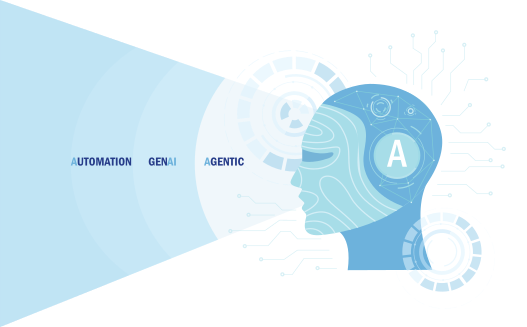
Think of A-cubed not as three separate tools but as a progression of intelligence layers that build on each other.
- Automation establishes the foundation by handling rules- based, repetitive processes with speed and consistency, leveraging deterministic machine learning models. It eliminates friction in workflows and creates the predictable backbone enterprises can trust.
- Generative AI sits on top of automation, introducing creativity, language understanding, and pattern recognition. Where automation executes the known knowns, generative AI handles the unstructured middle ground – summarizing, drafting, interpreting, and bridging gaps in knowledge.
- Agentic AI brings the final layer: autonomy. Agentic systems can sense goals, make decisions, and act in dynamic environments, often coordinating across both automation and generative AI. In other words, they don’t just generate or execute – they orchestrate, autonomously.
When combined together, automation handles the routine, generative AI expands the frontier of knowledge work, and agentic AI ties them together into adaptive, goal-driven execution. The synergy is what moves enterprises from incremental efficiency to scalable reinvention.
But before enterprises can harness A-cubed, they have to confront the hidden drag of what we call PTSD – process debt, technology debt, skills debt, and data debt.
These forms of organizational debt are easy to ignore but impossible to escape:
- Process debt: Outdated, inefficient workflows that no algorithm can fix
- Technology debt: Legacy platforms that make integration costly and brittle
- Skills debt: Teams unprepared to design, supervise, and adapt AI-driven systems
- Data debt: Fragmented, low-quality, or inaccessible data that undermines every model
To truly capture value from AI, enterprises must avoid and eliminate these forms of debt. And the sequence matters: start with process reinvention, ensure the data structures are harmonized, ensure the right skills and capabilities are in place, and only then bring in technology.
Consider how this preparation might play out inside a large enterprise. For instance, a global bank may begin by tackling process debt – redesigning loan origination workflows constrained by manual reviews. Next, it could address data debt by harmonizing customer records spread across legacy systems. From there, it might invest in reskilling underwriters to overcome skills debt, enabling them to supervise and guide AI-driven scoring tools. Finally, it could reduce technology debt by modernizing the core lending platform so automation, generative AI, and agentic AI can plug in seamlessly.
Many of these efforts fail because companies take a technology- first approach and then expect value to appear as if by magic. Fixing PTSD is not glamorous, but it is foundational.
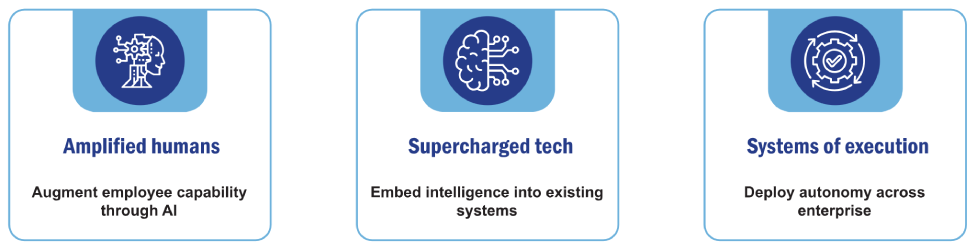
Once the debt is addressed, enterprises can unlock three modes of AI execution. Not through one silver bullet, but through evolving channels:
- Amplified humans
- Supercharged tech
- Systems of execution
When you enable everyone through AI, your employee pool becomes a group of amplified humans who can deliver higher productivity. At the same time, enterprises need supercharged tech – existing systems infused with intelligence. Most software companies are already embedding AI into ERPs, CRMs, and cloud platforms, turning today’s tech stacks into something smarter by default. Together, amplified humans and supercharged tech help close gaps in technology and skills, solving for the “T” and “S” of PTSD.
But what about PTSD as a whole? That’s where the third element comes in: Systems of Execution. These orchestration layers sit above systems of record, engagement, and insight to create autonomy. They don’t just analyze or recommend – they execute. And even if humans get distracted or platforms drift, Systems of Execution keep enterprises aligned to their goals.
AI Will Permeate Organizations via Three Modes
In practice, a System of Execution looks less like a single product and more like an orchestration fabric. For example:
- A customer service team might use automation to route tickets, generative AI to draft responses, and agentic AI to decide whether to escalate, close, or trigger a refund – all running continuously without human touchpoints in the loop.
- In supply chain, automation handles inventory updates, generative AI analyzes external signals (like weather or demand spikes), and agentic AI autonomously shifts shipments to prevent disruption.
- In finance, automation reconciles transactions, generative AI interprets anomalies, and agentic AI recommends or even initiates corrective actions in line with governance rules.
All three channels matter. But the pinnacle is Systems of Execution. AI has been disappointing thus far because people aren’t recognizing that if they’re truly seeking autonomy, they must invest in creating Systems of Execution using the A-cubed approach – automation, generative AI, and agentic AI – to achieve something greater, including adaptability and agency at scale. This is where true reinvention begins.
Conviction 3: Start with the future and THEN create the new Operating Models and Partnerships
The companies that succeed don’t just experiment – they decide where they’re headed. They think in terms of scenarios: what does evolution look like for us, and what does reinvention look like? Then they align on a future state (we call it a Futurecast) and work backward to build the roadmap (we call it the Backcast). What’s most important is that each company will have its own journey. So, as an enterprise, you need to consider your journey, your future state. Yes, let’s be informed about what other industries are doing and what other companies in your industry are doing. However, it’s crucial to align on where YOU want to go.
This third conviction is about translating that future-back vision into action. To get there, enterprises must fundamentally rethink how work gets done, how partnerships are structured, and how success is measured.
At Everest Group, we work with many clients to build distributed workforces, select locations, and determine work placement. In a fluid, execution-first environment, the structure, skills, and role of internal functions and constructs like GBS and GCCs must evolve. The image below highlights the important operating model transformations required to enable this shift – showing how enterprises must move from the “then” to the “now.”
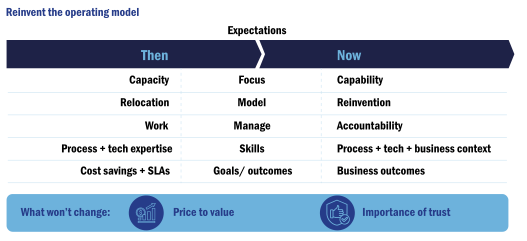
It’s no longer enough to relocate the work. Enterprises need to reinvent the work. That means adding business context to process and tech skills, and measuring outcomes not just by cost and SLAs but by competitiveness and business impact.
This shift also changes how we partner. Who we buy from, what we buy, how we decide, how we select, and how we measure performance – all of it is being rewritten.
We’re seeing a new set of rules take shape in how enterprises approach sourcing and partnerships:
- The supply landscape of tomorrow will look different from what it does today – those segments are no longer distinct categories.
- Enterprises will buy people, technology, and specialization as a bundle, not as standalone line items.
- The selection process is no longer the domain of a single sourcing team. It requires joint decision-making across business, IT, and procurement.
- Companies now juggle thousands of SaaS suppliers alongside a handful of strategic partnerships. They should be thinking about how to optimize for both.
- Contracts need to be more flexible, measuring outcomes rather than inputs, and moving beyond multi-year lock-ins.
The AI value paradox is about endurance, discipline, and clarity of vision. Enterprises that embrace these convictions can move beyond stalled pilots and hype, unlocking real reinvention and sustainable business impact.
This article was contributed by Everest Group
Get In Touch
|
|
Orchestrating AI Across the Enterprise |

The AI-First Mindset: How Leaders Can Reimagine Organizations for Tomorrow

Ritesh Idnani Chief Executive Officer & Managing Director, Firstsource
We are on the cusp of the most profound transformation in business since the Internet revolution. But this time, it’s not just about adopting new technology, it’s about fundamentally rewiring how we think about our organizations and their capabilities.
Most businesses today approach AI as a tool to optimize existing processes, provide faster customer service, more efficient supply chains, and better demand forecasting. But what if the real opportunity isn’t in doing existing things better, but in doing entirely new things that create value?
The organizations that will dominate the next decade aren’t just implementing AI—they’re completely reimagining their operations around it. They’re asking not “How can AI improve what we do?” but “What new markets, products, and business models become possible when AI is the foundation of everything we do?”
What is an AI-First Mindset?
An AI-first mindset isn’t about using ChatGPT occasionally or running a few machine learning models. It’s about making AI your default way of thinking—your organizational operating system.
How many of you approach problems by first asking: “How could AI help us create entirely new value propositions?” rather than “Where can we plug in AI to improve our existing approach?”
The difference is profound. One represents incremental thinking—the familiar path of process optimization. The other represents exponential thinking, reimagining what’s possible when intelligence becomes the engine of innovation and growth.
The 5 Elements of an AI-First Mindset
How do we build this AI-first mindset? I see five foundational elements:
1. Lead From the Multiple, Not the Earnings
Most CEOs focus on how AI will drive next quarter’s earnings, leading to disconnected use cases that deliver incremental benefits. Leaders with an AI-first mindset focus on their company’s multiple—the indicator of long-term value creation.
McKinsey’s research confirms this by noting that leaders at AI- enabled companies “take a more systematic view, focusing on their company’s multiple, to add value to the organization.”
They understand that AI’s true value isn’t in cost-cutting but in fundamentally transforming how the business captures and creates value, opening new revenue streams, entering adjacent markets, and building entirely new business models.
2. Build Learning Loops, Not Knowledge Silos
In traditional organizations, knowledge gets trapped in one person’s mind, in team documentation, in departmental silos. AI-first organizations develop what McKinsey calls “global learning loops” that transform “individual knowledge and local insights into an ever-increasing flow of collective wisdom that everyone in the organization shares and contributes to.”
These learning loops don’t just improve operations—they accelerate innovation cycles. Better data leads to better AI, which leads to faster product development, more accurate market insights, and quicker identification of growth opportunities, which generates more valuable data. The organization becomes not just a learning organization but a growth-accelerating system.
3. Cultivate Technological Adaptability
AI technologies are evolving at a breathtaking pace. Organizations wedded to specific tools, vendors, or approaches will quickly fall behind. An AI-first mindset embraces what McKinsey describes as “technological adaptability,” creating infrastructures where “technologies can be easily integrated inside end-to-end processes to turn data into actionable insights and predictions and easily swapped out for newer ones without breaking the entire system.”
This isn’t just about flexible IT architecture. It’s about maintaining the agility to pursue emerging opportunities as AI capabilities evolve. Your people should expect and embrace regular shifts in tools and techniques, seeing them as pathways to new competitive advantages rather than disruptions.
4. Democratize AI While Maintaining Governance
Many organizations make one of two mistakes: either they restrict AI to specialized teams, creating bottlenecks and limiting innovation, or they allow uncoordinated AI proliferation, leading to redundancy and risk.
The AI-first organization democratizes access to AI capabilities while maintaining appropriate governance. According to recent research, about half of the companies surveyed have little to no restrictions on AI usage at work (51%), while larger organizations tend to implement more guardrails.
Finding the right balance is critical; too restrictive and you stifle entrepreneurial thinking; too loose and you risk fragmented efforts that don’t drive strategic growth.
5. Reorient Human Capital Around Uniquely Human Value
The ultimate question isn’t “What jobs will AI replace?” but “How do we reorient human contribution to focus on what’s uniquely human?”
The same research found that the majority of leaders believe AI will enhance employees’ skills in some tasks while also replacing skills in others.
The key insight is that by automating routine cognitive tasks, AI frees humans to focus on high-value activities: identifying unmet customer needs, designing breakthrough products, building strategic partnerships, and creating differentiated experiences that drive revenue growth.
Making the Shift: From Theory to Practice
How do we translate these principles into action? Here are four practical steps:
1. Invest in Deep Understanding, Not Just Implementation
Many organizations are still in early stages of putting best practices in place, with less than one in five saying they’re tracking KPIs for their AI solutions. True AI literacy goes beyond tool familiarity. It requires understanding the fundamental concepts, capabilities, and limitations of AI.
Every leader should be able to identify how AI can unlock new customer segments, create novel offerings, or enable business model innovation, distinguishing between genuine growth opportunities and mere operational improvements.
2. Create Cross-Functional “AI Innovation Labs”
Break down silos by establishing cross-functional teams dedicated to applying AI to strategic challenges. Recent research shows that 46% of companies have a single existing team responsible for AI strategy, while 45% rely on multiple teams.
These shouldn’t be traditional “centers of excellence” focused on optimization. Instead, they should be growth engines exploring questions like: What customer problems can we now solve that were previously impossible? What markets can we enter with AI-powered offerings? How can we create network effects and platform dynamics?
They should be catalysts that spread growth-oriented AI thinking throughout the organization—inch-wide and mile-deep experts embedded within business units.
3. Implement “Learning Cycles”, Not “Projects”
Traditional project management—with defined beginnings, middles, and ends—is fundamentally misaligned with AI’s continuous learning nature. Instead, structure AI initiatives as ongoing learning cycles with regular reflection points.
McKinsey describes how one pharmaceutical company developed a “clinical control tower” that “continually updates and shares findings derived from the diverse data gathered from hundreds of clinical trials across thousands of sites around the world.” This isn’t a one-time project; it’s a persistent learning system.
4. Redesign Performance Metrics Around Learning
If learning is the meta-skill of the AI era, our performance metrics should reflect this. Beyond traditional KPIs, measure:
Efficiency metrics:
- Velocity of learning (how quickly teams incorporate new information)
- Cost reduction impact (savings from AI-driven automation and optimization)
- Process cycle time improvements (acceleration in key workflows)
- Quality enhancement (error reduction, consistency gains)
Growth metrics:
- Revenue expansion velocity (how quickly AI initiatives open new revenue streams)
- Market opportunity identification (how effectively AI reveals untapped customer segments or needs)
- Innovation cycle time (how rapidly teams move from insight to market-ready offering)
- Customer lifetime value expansion (how AI enables deeper, more valuable relationships)
- New product/service launches enabled by AI capabilities
McKinsey suggests tracking metrics that connect directly to value creation, not just operational efficiency. Focus on how AI contributes to top-line growth, market share gains, and strategic positioning.
5. Reimagine Work Through Specialized Roles
The traditional organizational structure won’t survive in an AI-first world. Today’s typical job descriptions combine generalist and specialist work, with most employees spending 60% of their time on general tasks and only 40% on specialized activities. This model fundamentally limits AI integration.
An AI-first organization requires a radical redesign of roles, similar to how the “Future of Work” concept within the UnBPO™ tenets redefines Who (employees, gig workers, AI agents), How (task allocation), and What (skills).
This approach breaks processes into atomic-level tasks, then identifies who is best suited to perform them, how tasks will be performed (AI supporting humans, humans in the loop, or completely autonomous), and the skills required. The goal is to free human talent for high-impact growth activities: strategic planning, creative problem-solving, relationship development, and market innovation.
This transformation might mean evolving from having 50-100 general role categories to 500-1000 highly specialized positions that focus deeply on specific functions, allowing AI systems to coordinate work effectively, creating a networked organization that’s more adaptable, efficient, and innovative than today’s hierarchical models.
The Future Belongs to the AI-First
The organizations that thrive in the coming decade won’t be those with the best AI technologies. They’ll be those with the best AI mindsets, the ability to think differently about how intelligence can be orchestrated and augmented to drive sustainable, scalable growth.
According to recent surveys, while 78% of organizations now use AI in at least one business function (up from 55% a year earlier), only a small percentage describe their gen AI rollouts as “mature.” Most organizations have yet to see a significant top-line growth impact.
This isn’t just about staying competitive; it’s about unlocking entirely new avenues for value creation. Just as the Japanese manufacturer reimagined what was possible with quality control, AI-first organizations will reimagine fundamental assumptions about market expansion, product innovation, and customer value creation.
The question isn’t whether your organization will use AI; of course, it will. The question is whether you’ll develop the AI-first mindset that turns AI from an efficiency tool into a growth engine.
Adopting an AI mindset is not inherently good or bad; it depends on how thoughtfully and responsibly it’s applied. These views serve as important guardrails, reminding leaders to pair their optimism with humility, governance, and long-term thinking.
At its core, this transformation isn’t about technology alone. As one leader put it, “Artificial intelligence isn’t advancing work processes. It’s completely reimagining them.” The true change is happening not in our machines but in our minds, shifting from optimizing what exists to imagining what’s possible. The future belongs to those who can think differently, not just about AI, but with AI.
Will you be the organization that merely operates more efficiently, or the one that grows into entirely new territory?
Get In Touch
|
|
Orchestrating AI Across the Enterprise |

Foreword Beyond the Pilot: Why Transformation Requires Orchestration

Ritesh Idnani Chief Executive Officer & Managing Director, Firstsource
When we launched UnBPOTM earlier this year, we challenged the fundamental assumptions of our industry. The response was immediate: business leaders didn’t debate whether transformation was necessary; they asked how to actually make it happen.
That question, the gap between vision and execution, is what this edition explores.
I’m struck by how different industries are discovering the same truth. In financial services, banks realize that deploying AI in isolated pockets creates local efficiency but not enterprise intelligence. In business services, we’re finding that automation doesn’t eliminate human expertise; it reshapes where that expertise matters most.
These aren’t separate trends. They’re different expressions of the same shift: from optimizing individual processes to orchestrating entire ecosystems.
Most organizations can articulate where they need to go. They can demonstrate promising pilots. Yet transformation efforts stall before delivering sustainable value. The problem isn’t vision or technology, it’s mindset: the ability to think differently about how intelligence can be leveraged, to reimagine what’s possible when AI becomes the foundation of everything we do, to redesign workflows around human-AI collaboration, and to build organizations that learn and adapt continuously.
This edition explores transformation through three lenses: the strategic (understanding why traditional approaches fail), the operational (building systems that actually work), and the practical (seeing these principles applied in banking and financial services).
In Amar’s article, he shares a story that crystallized this shift for me. One of our recent hires, someone who joined to handle customer interactions, taught herself to code using AI and solved a client problem in days. This isn’t a miracle; it’s what happens when you create conditions for emergence: accessible tools, psychological safety, domain expertise, and clear problems to solve. It’s the AI-first mindset in action.
As you read, ask yourself: Are we optimizing or reimagining? Are we treating AI as a tool to improve what exists, or as a foundation to create entirely new value? Are we measuring efficiency gains or growth opportunities? What ecosystem do we need to succeed?
The organizations that figure out how to cultivate an AI-first mindset, to make AI their organizational operating system, to connect intelligence across the enterprise, to partner humans and AI effectively, and to adapt continuously, won’t just survive the next decade. They’ll define it.
Let’s build that future together.
Get In Touch
The UnBPOTM Quarterly | November 2025

Ritesh Idnani Chief Executive Officer & Managing Director, Firstsource
Foreword Beyond the Pilot: Why Transformation Requires Orchestration
When we launched UnBPOTM earlier this year, we challenged the fundamental assumptions of our industry. The response was immediate: business leaders didn’t debate whether transformation ...
Read MoreFeatured Articles

The AI-First Mindset: How Leaders Can Reimagine Organizations for Tomorrow
We are on the cusp of the most profound transformation in business since the Internet revolution. But this time, it’s not just about adopting new technology, it’s about fundamentally...
Ritesh Idnani Chief Executive Officer & Managing Director, Firstsource

Overcoming the AI Value Paradox: A Pragmatic Take to AI Value Creation
Walk into any boardroom today and you’ll hear the same buzzwords: generative AI, agentic AI, productivity, transformation. The energy is palpable. Leaders see AI as the next big unlock....
Jimit Arora CEO, Everest Group

Escaping Pilot Purgatory: Why 95% of AI Initiatives Never Scale
Anthropic recently ran a fascinating experiment called “Project Vend,” where they let Claude manage an automated store in their San Francisco office for about a month...
Aniket Maindarkar CMO, Firstsource

Beyond Outsourcing: Cultivating an AI-First Mindset in the Age of Disruption
I still remember the day I interviewed for my first job. It was at a large office near the airport, where an HR representative and an Operations leader sat across a desk..
Amar Akatrai SVP, Strategic Initiatives, Firstsource

The AI Intelligence Horizon: Banking’s Next Era of Intelligent Growth
Every era of banking begins with a question. In the early 2000s, it was how to cut cost without losing control. A decade later, it became how to scale digital without breaking trust...
Sreenath Shekharipuram SVP, BFSI Solutions & Capabilities, Firstsource
Let me know when the next edition launches!
Get In Touch
The UnBPOTM Quarterly | August 2025


Foreword Rewriting the Rules: Why the Future of Business Process Services Starts Now
Welcome to the inaugural edition of UnBPOTM Quarterly – our thought leadership platform where we challenge conventional wisdom and chart the course for the future of business process services...
Read MoreFeatured Articles

Why UnBPO™ Is Just the Beginning of Firstsource's Next 25 Years
Why UnBPOTM Is Just the Beginning of Firstsource's Next 25 YearsBy Ritesh Idnani, CEO and MD, FirstsourceAs Firstsource approaches its 25th anniversar...
Ritesh Idnani Chief Executive Officer & Managing Director, Firstsource

From Full-Stack to Micro-Specialists: Agentic AI Rewires Work
From Full-Stack to Micro-Specialists: Agentic AI Rewires WorkBy Hasit Trivedi, President and Chief Digital. AI Officer for FirstsourceIt would be...
Hasit Trivedi President and Chief Digital & AI Officer, Firstsource

Services-as-Software Presents a $1.5 Trillion Opportunity for Both Software and Services Firms
Services-as-Software Presents a $1.5 Trillion Opportunity for Both Software and Services FirmsBy Phil Fersht, CEO and Chief Analyst, HFS Research Saur...
Phil Fersht CEO and Chief Analyst, HFS Research
Saurabh Gupta President, Research and Advisory Services, HFS Research Reproduced with permission from HFS Research

How Agentic AI is Eliminating Customer Service Backlogs?
Picture this: A customer reaches out with an urgent issue and gets an immediate, personalized response—at 3 AM on a holiday weekend. Meanwhile...
Manish Jain VP – Head AI and Emerging Tech Architect, Firstsource

Debt Collection: AI, Compliance, and Empathy in an Era of Rising Delinquencies
Debt Collection: AI, Compliance, and Empathy in an Era of Rising DelinquenciesBy Arjun Mitra, Head of Collections, Firstsource Tony Balon, Vice Presid...
Arjun Mitra Head Collections, Firstsource
Tony Balon Vice President Operations, Firstsource

Keeping Humans in the Center of AI Transformation
Keeping Humans in the Center of AI TransformationBy Aniket Maindarkar, Chief Marketing Officer, FirstsourceThe most powerful AI implementations don't ...
Aniket Maindarkar Chief Marketing Officer, Firstsource
Let me know when the next edition launches!
Get In Touch

The New Reality of Retail

Shopping has been revolutionized. Customers discover products on social media, research on mobile, compare prices online, and expect instant fulfillment—sometimes within hours.
You're competing on multiple fronts: managing inventory across channels, reducing abandoned carts, personalizing experiences at scale, handling returns seamlessly, managing seasonal surge and keeping pace with shifting consumer behaviors and emerging technologies.
Legacy retail operations struggle with today's demands. Siloed systems that worked for single-channel retail now fracture customer journeys when shoppers move fluidly between digital and physical touchpoints.
At Firstsource, we've powered retail transformations across global markets. We know that tweaking existing processes won't cut it. Your retail operations need to UnBPOTM.
Modern Retail's Operational Bottlenecks
Channel Fragmentation
Disconnected web, mobile, and store systems create jarring customer experiences. Orders placed online can't be fulfilled from nearby stores, and in-store staff lack visibility into online purchase history.
Inventory Blind Spots
Demand planning relies on historical data and gut feelings. Stockouts happen while excess inventory sits in warehouses. Real-time inventory visibility across locations remains elusive.
Mass Marketing Limitations
Broad demographic targeting wastes marketing spend. Customers receive irrelevant promotions while high-value segments remain unengaged. Product recommendations fail to drive incremental purchases.
Seasonal Staffing Challenges
Holiday rushes require massive temporary hiring. Quiet periods leave permanent staff underutilized. Training new hires takes weeks while customer service suffers during transitions.
Data Isolation
Separate systems for onboarding, monitoring, and reporting create inefficiencies and blind spots that hurt customer experience and operations.
Scattered Data Intelligence
Critical insights remain trapped in departmental silos. Without unified analytics, strategic decisions rely on incomplete information and gut instinct.
The UnBPOTM Retail Revolution
Retail-Native Intelligence
Our teams combine former retail buyers, digital commerce architects, and customer experience designers. We understand seasonal peaks, promotional cycles, and the complexity of omnichannel fulfillment from day one.
Connected Commerce Platform
We break down operational silos entirely. Your customer's shopping cart connects to real-time inventory, which triggers personalized marketing, which feeds into demand planning—all as one fluid system.
Intelligence-First Operations
AI powers every process from the ground up. Machine learning algorithms predict demand spikes, optimize pricing dynamically, and route customer inquiries to the right expert instantly. Automation handles routine tasks while humans focus on strategic decisions.
Performance Partnership
Our success metrics align with yours: higher conversion rates, improved inventory turns, reduced fulfillment costs, and increased customer lifetime value. We succeed when your retail performance accelerates.
UnBPO™ Solutions in Action
Unified Customer Journey Management
Orchestrate seamless experiences across all touchpoints. Customers start purchases on mobile, modify in-store, and complete online with consistent pricing, inventory, and service throughout their journey.
Intelligent Demand & Supply Planning
Advanced analytics predict demand patterns and optimize inventory allocation across channels. Automated replenishment prevents stockouts while minimizing carrying costs through predictive modeling.
Dynamic Marketing Orchestration
Real-time personalization engines deliver relevant product recommendations and targeted offers based on individual shopping behavior, preferences, and purchase history across channels.
Scalable Commerce Operations
End-to-end order orchestration from cart to delivery, with intelligent routing, automated processing, and exception handling that scales efficiently during peak periods and promotional events.
Proactive Customer Care
Anticipate customer needs through behavioral analytics. Resolve issues before they escalate with proactive communication and intelligent self-service options that reduce support volume.
Flexible Workforce Solutions
Dynamic staffing models that flex with seasonal demand. Cross-trained teams handle multiple functions while AI-assisted scheduling optimizes coverage and reduces overtime costs.
Retail Transformation Outcomes
80% Drop in support call volumes
For a prominent US home care retailer, AI-enabled multi-lingual CX resulted in CSAT increase and reduction in support call volumes.
Peak demand handled with 5-star ratings
We helped a leading grocery retailer in the UK to seamlessly manage peak demand and transition operations, while enhancing customer experience
Omnichannel support & CRM in 3 weeks
We enabled a leading fashion retailer with scalable, future-ready CX and CRM, while resolving backlogs and improving performance metrics
86% CSAT with Fraud-Resistant CX
For a leading health and beauty retailer in the UK, we deployed high-performance CX and fraud controls, delivering excellent customer service
Transform Your Retail Operations Today
Retail continues evolving rapidly. With live commerce, AI shopping assistants, sustainable packaging demands, and instant delivery expectations, the pace of change accelerates daily.
Traditional outsourcing constrains you within current limitations. UnBPOTM transcends those boundaries completely. Ready to experience retail operations built for tomorrow's commerce landscape?
UnBPOTM with us. Your customers will notice the difference immediately.

 Download Now