Financial Services

Transforming Banking and Financial Services for the AI Era

The landscape of banking and financial services has fundamentally changed. Today’s customers demand immediacy—instant transfers, instant approvals, and instant support.

At the same time, institutions are navigating a complex web of evolving regulations, increasingly sophisticated fraud, and the need to deliver hyper-personalized experiences—all while managing risk at scale.

Legacy systems and manual processes, once sufficient in a paper-driven world, now hinder progress in a digital-first era where speed and agility are non-negotiable.

At Firstsource, we've been at the forefront of transforming banking and financial operations for years. We understand that incremental improvements aren't enough anymore. The industry needs a fundamental reimagining of operations—which is why we created UnBPOTM

What's Holding Financial Services Back

01

Siloed Customer Journeys

Despite digital transformation efforts, many institutions still operate with siloed systems across channels. This leads to inconsistent, impersonal, and frustrating customer journeys. Customers now expect custom-level personalization, but legacy systems and disconnected data prevent seamless engagement.

02

Shifting Regulatory Landscape

Regulatory volatility—driven by geopolitical shifts and deregulatory pushes—has made compliance a moving target. Financial institutions must now navigate evolving rules around AI, climate disclosures, crypto assets, and sanctions, often without clear guidance. Reactive compliance models are no longer sustainable.

03

Outdated Risk Detection

Fraudsters are leveraging AI, deepfakes, and synthetic identities to bypass traditional defenses. Rules-based systems and manual underwriting are no longer sufficient.

04

Inflexible Workforce Models

More volume means more people. Less volume means fixed costs. Rigid workforce management can't adapt to market changes.

05

Fragmented Technology Stack

Separate systems for onboarding, monitoring, and reporting create inefficiencies and blind spots that hurt customer experience and operations.

06

Scattered Data Intelligence

Data is abundant but underutilized. Strategic decisions are often made with incomplete insights due to siloed analytics and poor data governance. The lack of unified intelligence hampers risk management, personalization, and innovation.

How UnBPOTM Transforms Financial Services

Deep Domain Expertise

Our teams are built with seasoned professionals — former bank executives, lending experts, compliance officers, and risk managers. This means every solution we design is informed by real-world experience across Mortgage compliance, CFPB guidelines, Basel III requirements, AML compliance, Consumer Duty, FCA SMCR guidelines and customer experience standards.

Integrated Operations

We eliminate artificial boundaries between customer-facing and back-office operations. Onboarding connects seamlessly to risk assessment, which flows into ongoing monitoring and proactive customer engagement.

AI-Powered Intelligence

Our AI reimagines processes entirely. Smart bots provide instant support while learning from every interaction. Intelligent processing handles everything from applications to regulatory filings with human-level accuracy at machine speed.

Outcome-Based Models

We get paid based on the results we deliver, faster onboarding, reduced compliance costs, faster fraud alert resolution, minimized reimbursement impact, reduced first-party fraud, and accelerated point-of-sale issue resolution. When we win, you win bigger.

UnBPOTM Solutions in Action

Banking Customer Experience

Transform every touchpoint into a competitive advantage. Smart bots provide instant answers while seamlessly escalating complex issues to human experts with full context.

Cards and Payment Services

End-to-end payment operations with AI-driven fraud alert management, faster resolution times, reduced reimbursement exposure, and personalized campaigns that increase engagement and reduce churn.

Mortgage Operations

Reimagine the mortgage journey—from application to approval with automated workflows and intelligent underwriting tools simplify the process. Proactive communication keeps customers informed and confident.

Financial Crime Compliance

AI-powered monitoring that catches sophisticated threats while reducing false positives. Stay compliant while making processes faster and more accurate.

Collections and Recovery

Empathetic, intelligent collections that balance compliance, customer experience, and recovery outcomes using behavioral analytics and personalized communication.

Specialist Operations

We’re redesigning key customer journeys to deliver seamless, satisfying experiences for life events - faster ISA transfers, efficient estate management, and hassle-free power of attorney setup. Every interaction is faster, clearer, and built to earn lasting trust

Measurable Impact Across Financial Services

img1
img2

Ready to Transform Your Operations?

The banking industry is changing faster than ever. Open banking, digital currencies, embedded finance, and AI-driven everything, these aren't future trends. They're today's reality.

Traditional BPO asks you to optimize within existing constraints. UnBPOTM eliminates the constraints entirely.

Ready to see what financial services operations look like when they're designed for today's world?

UnBPOTM with us. Your customers, and your bottom line—will thank you.

Back
Volume 01
How AI is Changing the Future of Work
banner image

Keeping Humans in the Center of AI Transformation

Aniket Maindarkar Chief Marketing Officer, Firstsource

The most powerful AI implementations don't eliminate human involvement; they transform it. While many organizations chase pure automation, the real competitive advantage lies in strategic human-AI collaboration.

Research from Gartner reveals a striking truth: organizations implementing human-AI partnerships see 37% higher success rates than those pursuing automation alone. [1] The challenge isn't technology access—it's human factors like trust, understanding, and effective collaboration.

The question has shifted from "Should we automate?" to "How do we create optimal partnerships between our human experts and AI systems?" The answer is reshaping industries and creating unprecedented business value.

What does human-centered AI mean?

Human-in-the-loop represents a model where human expertise and AI capabilities combine to create systems that are greater than the sum of their parts. In this framework, AI systems handle routine tasks, detect patterns, and make initial recommendations, while humans provide oversight, handle exceptions, make complex judgments, and continuously train the system to improve.

This approach fundamentally differs from traditional automation by creating what MIT researchers call "collaborative intelligence"—systems where humans and AI each do what they do best [2] . Rather than replacing human judgment, it creates partnerships where technology amplifies the best of human capability while humans guide AI toward meaningful, impactful outcomes.

The tasks where AI excels—processing vast datasets, identifying patterns, maintaining consistency—are fundamentally different from human strengths: navigating ambiguity, applying ethical judgment, contextual understanding, and empathizing with customers. When properly combined, these complementary capabilities create exponential rather than additive value.

Core elements of human-centered AI

Three foundational capabilities are emerging as essential for effective human-AI collaboration:

  1. Strategic task division
    Organizations must thoughtfully allocate work between humans and AI based on their respective strengths. This isn't simply about humans checking AI work—it's about identifying which tasks benefit most from automation versus human judgment. AI handles pattern detection and repetitive decision-making, while humans focus on navigating ambiguity, applying contextual judgment, and driving organizational change.
  2. Continuous learning mechanisms
    Systems must improve through structured human feedback loops. These mechanisms allow AI to learn from human decisions in exception cases, creating a virtuous cycle of improvement. The most successful implementations create clear pathways for capturing human corrections and incorporating them into system training.
  3. Transparency and trust
    AI tools must explain their reasoning to human operators. Without explainability, humans can't effectively provide oversight or improve the system. Organizations must build confidence in AI recommendations while maintaining healthy skepticism—developing critical evaluation skills and the ability to validate AI-generated content.

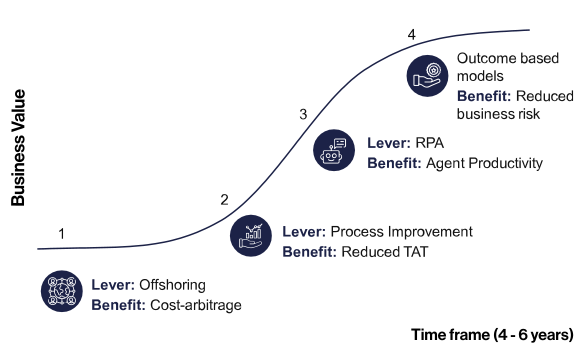
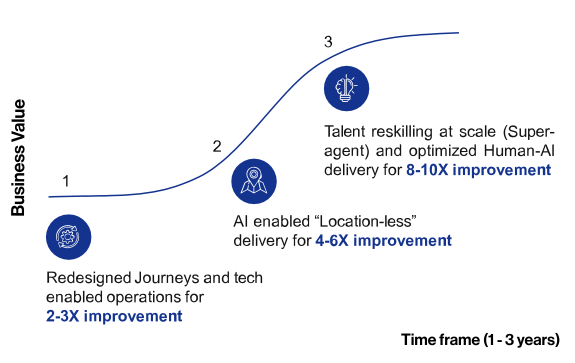
This alignment with industry-leading thinking is evident in forward-looking approaches like Firstsource's UnBPOTM which emphasizes "unlocking human potential through AI partnership" rather than mere cost reduction. By focusing on outcomes instead of effort, organizations can achieve what we call the "new S-curve" of transformation that delivers disproportionate returns.

Successful implementation: Building effective partnerships

Successful implementation requires addressing four critical areas:

Start with process reimagination

Rather than automating existing processes, successful organizations reimagine them with human-AI collaboration in mind. This requires detailed task analysis to identify which aspects of work suit machines versus humans, process redesign that considers both technical capabilities and human psychology, and new metrics that capture collaboration quality rather than just production volume. McKinsey research shows that organizations redesigning processes for human-AI collaboration achieve 3-5x greater productivity improvements than those simply automating existing processes [3] .

Invest in augmentation tools

The most successful implementations provide humans with tools that enhance their capabilities: AI assistants that provide real-time guidance, decision support systems that explain recommendations transparently, and unified workbenches that bring together human and AI contributions. MIT-BCG research found that companies focusing on augmentation tools saw 61% improvement in worker productivity compared to 45% for those focusing primarily on automation [4] .

Create structured feedback loops

Effective systems continuously improve through regular review of AI recommendations by human experts, mechanisms for capturing and incorporating human corrections, and systematic analysis of exception cases. Stanford research shows that organizations with structured feedback loops improved model performance 3x faster than those with standard training approaches [5] .

Develop new human capabilities

As AI handles routine tasks, humans must develop new skills: pattern recognition at the system level, exception handling expertise, and AI oversight capabilities. The World Economic Forum reports that 85% of organizations accelerating AI adoption plan to expand task-specific reskilling of their workforce [6] .

Metrics: Measuring human-centered success

Traditional AI metrics focus on technical performance—accuracy, speed, and efficiency. Human-centered AI requires broader success measures that capture the true value of collaboration:

Quality-adjusted productivity

Measuring not just output volume but accuracy and complexity. AI-human teams often handle cases of increasing complexity over time as simpler cases become fully automated.

Exception learning rate

How quickly the system improves at handling previously problematic cases. According to IBM Research, organizations that systematically track exception handling improvements see 27% faster model performance gains [7] .

Augmented decision quality

Comparing decisions made by human-AI teams to those made by either alone. This helps identify which decisions should be automated versus augmented. Stanford's Human AI initiative found that structured measurement of augmented decision quality led to 42% more accurate prediction of which decisions should be automated versus augmented [8] .

Employee elevation metrics

Tracking the movement of human workers to higher-value activities. Research from MIT Sloan shows that organizations measuring employee elevation see 31% higher retention among workers whose roles are augmented by AI [9] .

Business impact measures

  • Adoption and engagement rates across the organization
  • Trust and transparency in AI recommendations
  • Customer satisfaction and employee experience improvements
  • Return on AI investment beyond pure cost reduction

These metrics should evolve as AI capabilities mature and human-AI partnerships deepen, always focusing on outcomes that matter to the business.

Conclusion: The future of Work is collaborative

Organizations that master human-AI integration will achieve exponential value creation, not incremental improvement. This isn't about replacing people, it's about unlocking the full potential of both human talent and technological investment.

The winners will be those who put humans at the center of their AI transformation: creating partnerships where technology amplifies human capability while humans guide AI toward meaningful outcomes. The result is not incremental improvement but exponential value creation as a sustainable competitor advantage - the difference between traditional transformation curves and the new S-curve that delivers disproportionate returns.

Get In Touch

Back
Volume 01
How AI is Changing the Future of Work
banner image

Debt Collection: AI, Compliance, and Empathy in an Era of Rising Delinquencies

Arjun Mitra Head Collections, Firstsource

Tony Balon Vice President Operations, Firstsource

As long as currency has existed, debts have been collected. At its core, debt collection is the process of navigating complex waters: managing the ebbs and flows of financial obligations without getting swept away. As we enter 2025, rising consumer debt and evolving regulatory tides are reshaping the industry’s horizon, making AI-driven empathy and proactive compliance paramount.

US consumer debt has soared to $18.2 trillion (Source: Federal Reserve), with credit card balances alone have reached $1.18 trillion thanks to rising costs, stagnant wages, and depleted savings. The Fed's report on Household Debt and Credit revealed that 7.04% of credit card debt was delinquent for 90 days or more, with the share of severely delinquent accounts (90+ days) increasing by 8.5% quarter-over-quarter to reach 12.3% of all delinquent accounts. This signals a sharp rise in delinquency severity among a significant portion of borrowers.

Similar trends are evident around the world: 44% of adults in the UK are living in financially strained conditions, while record numbers of Australian households are seeking financial help.

At the same time, regulators are tightening their regulations to protect consumers, meaning that compliance is taking center stage for financial organizations. The Consumer Financial Protection Bureau (CFPB), for example, has introduced new rules capping overdraft fees at $5 and targeting excessive "junk fees." State-specific laws like California's Rosenthal Fair Debt Collection Practices Act and New York's Consumer Credit Fairness Act add another layer of complexity for agencies navigating compliance. For more details on these regulations, refer to the CFPB website .

In the financial ecosystem, non-performing loans account for significant losses every year, making collections a non-negotiable aspect of business. But the industry has struggled with a reputation for being, at best, impersonal, and at worst, aggressive. Poor debtor engagement practices are costly: a large number of defaults and dispute rates have created stressed balance sheets for many collection organizations.

The stakes are high, but 2025 could mark a transformative year for the industry. Generative AI and advanced smart technologies are becoming cornerstones of operations, driving more personalized, outcome-focused strategies and better consumer engagement. Successful debt collection hinges on organizations — and their debt collection agencies — adopting the right tools to become more effective, compliant, empathetic, and consumer-centric.

Industry trends for 2025: AI, compliance, and consumer-centric collections

It's time to reimagine collections not as a cost center but as an opportunity to build stronger customer relationships, enhance brand reputation, and drive sustainable growth. Organizations should watch these trends closely in 2025:

  1. Hyper-Personalization: Personalization has become the cornerstone of successful debt collection, with 71% of customers expecting personalized experiences and 76% expressing frustration when they don't receive them. Modern AI-powered debt collection systems, particularly those leveraging AI are transforming engagement by meeting consumers where they are—in their preferred channel, at their optimal time, using language and tone that resonates with their specific situation.
  2. More informed consumers with higher expectations: Consumers today want to work with collections teams that are transparent, flexible, and trustworthy. They expect clear, straightforward information about their debts and repayment options and look for flexibility in repayment plans—like adjustable payment schedules or temporary relief options. Consumers also prioritize trust when collectors approach borrowers with empathy and respect, it leads to better cooperation and higher repayment rates, benefiting everyone.
  3. AI-first operations: Beyond basic automation: AI is making collections operations smarter and more efficient. From initial contact to final repayment, AI can automate every step, analyzing data to personalize each interaction and forecast which accounts are likely to default and which are ready to pay.
  4. Sustainability: Companies are not just aiming for profitability, but are embracing green practices and social responsibility. Leading companies understand that balancing profitability with responsible practices ensures long-term success.
  5. Enhanced security and privacy: With increasing digital interactions, security and privacy are critical. The industry is starting to implement more robust cybersecurity protocols to protect sensitive data from breaches and unauthorized access.
  6. Empathy and ethical collection practices: Collections are vital to a financial institution's bottom line, but they shouldn't cost you the customer. That's where empathy comes in.

Empathetic collections go beyond just handling calls. Agents need negotiation skills, emotional intelligence, and the autonomy to act. Every consumer's story is different—job loss, medical emergencies, or simply trying to make ends meet. Giving agents the authority to offer flexible terms can turn conflict into collaboration.

By shifting the approach from demanding payments to offering real support, collections teams become trusted allies, helping consumers get back on track while strengthening long-term loyalty.

Modern collections today is no longer defined solely by recovering funds. It's defined by innovative, empathetic, and tech-powered solutions that bring positive outcomes both for stressed debtors and the lending agencies.

Strategic priorities for collections in 2025

These shifts in consumer behavior, technology, and regulation demand a new approach to debt collection. The key isn't just reacting to change, but shaping the future of collections. Here are the strategic imperatives that will separate the leaders from the rest in 2025:

  1. AI-driven omni-channel experiences: deliver value through personalized & effective communication

    The why: In a world of digital noise, effectively reaching consumers in debt requires personalization and respecting preferences. AI-driven omni-channel experiences allow you to communicate with each consumer in the way they prefer, at the time they're most receptive.

    The outcomes:

    According to McKinsey, organizations using advanced AI in collections are already seeing big results.

    40% reduction in operational costs: AI-powered self-service options, like web portals, chatbots, digital dashboards with debt information, and easy online payment options, can help drive down operational costs.

    10% boost in recoveries: AI insights detect consumers' preferred communication channel and communication time, which can dramatically improve collection rates. Instead of calling during working hours, a text at 7 pm might generate better responses from a Gen-Z demographic.

    30% jump in consumer satisfaction: AI can offer real-time strategies based on ongoing consumer responses, for example, suggesting more empathetic language for consumers expressing frustration. This helps build an empathetic engagement strategy for more positive outcomes.

    Seamless experiences: True omnichannel CX means every interaction—call, email, SMS—is connected. When a consumer calls after emailing, the agent should already have full context. One unified record ensures seamless handoffs and a consistent, frictionless experience across all touchpoints.

    Data-driven precision: AI can move collections calls from a rule-based system (based on the consumer's risk segment and the number of late days) to a reinforcement learning-based system (based on consumer information, consumer behaviors, and previous collection actions) to make better decisions on when to call.

    Hyper-personalization: AI powered by deep consumer data enables hyper-personalized outreach, tailoring messages in real time based on behavior. A likely payer might just need a reminder, while a high-risk consumer may need a call and a flexible plan.

    Proactive support: AI can detect willingness to pay early and confirm intent through sentiment analysis, giving collections teams the opportunity to identify consumer profiles with a higher propensity to pay and target them with offers.

  2. Mobile-centric E2E payment solutions

    The why: Today's consumers live on their phones. Making repayment easy and convenient on mobile is no longer a "nice to have"—it's essential for maximizing recovery rates. If your end-to-end (E2E) payment journey isn't optimized for mobile, you risk lower engagement, delayed payments, and lost opportunities.

    The outcomes:

    A successful mobile-optimized E2E payment solution can enable:

    Accelerated collections: AI-powered smart payment reminders, like push notifications and SMS reminders with personalized payment links, reduce friction and drive faster settlements.

    Higher borrower satisfaction: A user-friendly mobile experience demonstrates respect for the debtor's time and preferences.

    Increased engagement: Give borrowers an easy, mobile-first way to manage accounts, make payments, and resolve disputes, with real-time access to balances, plans, and support tools.

    Reduced manual intervention: Automate the payment process, freeing up staff to focus on more complex cases.

    Secure transactions: Give consumers peace of mind with biometric login (Face ID, fingerprint) and encrypted transactions to ensure both security and user confidence.

  3. Predictive analytics-based triaging: smarter, more effective debt collection

    The why: Not all debt is equal. Predictive analytics help you prioritize high-risk accounts, enabling smarter outreach and more efficient collections, especially when managing large volumes. Focus where it counts, act when it matters most.

    The outcomes:

    Improved resource allocation: AI analyzes payment history, credit behavior, and real-time data to rank accounts by repayment risk, enabling collectors to prioritize high-risk cases and automate low-touch outreach for the rest.

    Personalized engagement: AI tailors outreach using behavioral signals—sending a simple SMS reminder to first-time defaulters, offering structured plans to habitual late payers, and directing those in distress to a dedicated hardship team.

    Increased recovery rates: Thanks to predictive analytics, behavioral AI, and generative AI, collections teams can shift from reactive, one-size-fits-all outreach to proactive, hyper-personalized engagement strategies. Intervening early in high-risk cases improves the chances of recovery.

    Enhanced compliance: AI tools can flag high-risk conversations for compliance monitoring, reducing regulatory exposure.

    Better risk assessment: AI offers integrated payment scoring that goes beyond past-due balances. Tools can incorporate payment patterns, external economic signals, and digital behavior analysis to offer an accurate risk assessment.

    Smarter conversations: Real-time AI nudges guide collectors with empathy and precision, suggesting tailored scripts or the best channel based on consumer behavior and engagement history.

  4. AI-driven compliance: minimizing risk

    The why: Compliance is non-negotiable. As regulations shift, AI can help you stay ahead of the curve.

    The outcomes:

    Reduced regulatory exposure: AI-driven automated compliance checks that flag certain conversations can reduce the risk of violations.

    Simplified audits: Comprehensive logs of all interactions (text, email, SMS, and more) make audits easier and more efficient.

    Automatic rule updates: Tools can stay up to date with the latest state and federal guidelines.

  5. Data integration and consolidation

    The why: Siloed data drives inefficient and ineffective collections. With integrated and consolidated information, you'll find a 360-degree view of every consumer to tailor your collections approach.

    The outcomes:

    Faster decision-making: Data integration tools can consolidate credit reports, payment histories, and account details into a single platform. Teams can access all relevant information seamlessly, speeding up decision-making.

    Personalization: 360-degree consumer views help you develop targeted outreach strategies.

    Improved efficiency and effectiveness: Eliminate manual data reconciliation so your team can focus on what counts—achieving better collections and recovery rates, improved customer satisfaction scores, and higher Net Promoter Scores.

  6. Efficient cloud solutions

    The why: When the financial world can change this quickly, flexibility is key. Cloud-based solutions can scale your operations up or down as needed and stay focused on the future.

    The outcomes:

    Reduced IT costs: Automatic updates and streamlined operations reduce IT overhead and the need for expensive hardware and software.

    Disaster recovery and data security: Cloud platforms have advanced security features, such as encryption, firewalls, and multi-factor authentication, that protect your sensitive information. They also offer robust disaster recovery capabilities, protecting information from natural disasters, cyberattacks, and other events.

    Increased scalability: Handle a surge in accounts or expand your operations without significant infrastructure changes.

    For large and small organizations: Small collections teams benefit hugely from cloud solutions, but large financial institutions should consider them as well. An advanced and layered enterprise-grade platform can integrate with legacy systems, handle large amounts of data, provide detailed analytics, and support multi-channel communication strategies.

Product-specific approaches for better collections

Every debt type—credit cards, loans, mortgages—has unique challenges and borrower behavior. Effective collections require tailored strategies for each to improve outcomes and the consumer experience. That's where a flexible, modular Collections-as-a-Service model comes in, offering scalable solutions built around each debt type and customer segment. How can you get started?

  • Standardized processes: Create uniform procedures for different debt types. This consistency makes training new team members easier and puts everyone on the same page.
  • Expert teams: Have dedicated teams for each financial product. Specialized knowledge leads to better negotiations, better strategies, and better outcomes.
  • Technology integration: Advanced technologies like AI and machine learning can standardize and scale personalized collection strategies across multiple portfolios. Automated systems can handle more accounts without needing more resources.
Type of loanFeatures of the loanPotential specialized approachOf Special Note
Credit CardsHigh volume, smaller balances, revolving credit
  • Quick outreach, short repayment plans, digital-first nudges
  • Offering options like lower interest rates or longer payment periods can reduce delinquencies
  • Using AI-driven insights to sort accounts based on risk level
Personal loansUnsecured debt, varied loan amounts
  • Tailored negotiation, flexible settlement options
  • Regular reminders and early interventions (like friendly texts or emails)
  • Teaching borrowers budgeting tips
 
MortgagesLarge balances, secured by property, longer terms
  • Detailed consultative approach, refinancing solutions
  • Periodic check-ins, options for loan modification, and transparent communication.
  • Mortgages are highly regulated under federal laws like the FDCPA and CFPB rules. States may have extra requirements through laws, like California's Rosenthal Fair Debt Collection Practices Act.
Auto loansSecured by vehicle, depreciation factors, mid-range
  • Early-stage reminders, asset recovery strategies keeping communication open and offering refinancing options
  • Auto loan defaults can be affected by economic downturns or seasonal job changes. Tailoring your collection efforts to these cycles can lead to better results.
 

The future of collections: an empathetic approach powered by AI

Empathetic collections bring transformative results. By combining smart technology with a personalized, empathy-driven approach, organizations can enhance collection results for 2025 and beyond. A modern, efficient debt collection strategy follows a three-phase framework:

  1. Empower – Design personalized, frictionless consumer journeys with an empathy-first mindset.
  2. Evolve – Leverage AI-powered, digital-first solutions, including chatbots and real-time analytics.
  3. Endure – Establish robust compliance frameworks and adopt sustainable collection practices.

To stay ahead, collections organizations must prioritize specialized engagement strategies, regulatory compliance, and advanced technology—and that's where Firstsource comes in. We're focused on your success, so you can focus on what matters to your customers.

How Firstsource transforms debt collection:

  • Compliance, made simple – Stay audit-ready with solutions built for evolving CFPB and state regulations. Our experts combine deep regulatory and industry know-how to focus on what your business needs most.
  • Smarter, personalized outreach – AI-driven insights decode consumer behavior to tailor engagement across the customer journey, boosting repayment rates with precision.
  • Self-service that empowers – Give borrowers control with intuitive tools and flexible payment options through a secure, easy-to-use portal.

AI, automation, and empathy, Firstsource helps you boost recoveries, build trust, and future-proof collections. Connect with us to learn how.

Get In Touch

Back
Volume 01
How AI is Changing the Future of Work
banner image

How Agentic AI is Eliminating Customer Service Backlogs?

Manish Jain VP – Head AI and Emerging Tech Architect, Firstsource

Picture this: A customer reaches out with an urgent issue and gets an immediate, personalized response—at 3 AM on a holiday weekend. Meanwhile, your support team arrives Monday morning to find zero backlog and customer satisfaction scores climbing steadily upward.

This isn’t fantasy—it’s the new reality for businesses embracing Agentic AI.

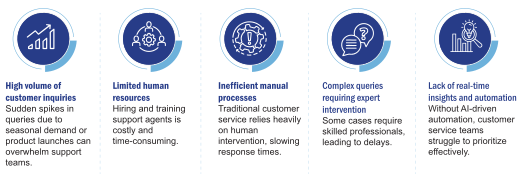
Traditional customer service is drowning. Support tickets pile up faster than teams can handle them. Frustrated customers abandon carts, cancel subscriptions, and share their disappointment across social media. All while your support agents burn out trying to keep pace with an ever-growing queue of inquiries.

Enter Agentic AI—a revolutionary approach that’s transforming customer support from a reactive scramble into a proactive powerhouse. Unlike basic chatbots that follow rigid scripts, Agentic AI systems think, learn, and make decisions autonomously. They don’t just respond to customer issues; they anticipate needs, personalize solutions, and continuously improve with every interaction.

For businesses struggling with support backlogs, Agentic AI isn’t just another tool—it’s a game-changing strategy that delivers lightning-fast responses, slashes operational costs, and turns customer service from a business burden into a competitive advantage.

Understanding Customer Service Backlogs

Customer service backlogs occur when a company accumulates more support requests than its team can handle within a reasonable time frame. Several factors contribute to these backlogs:

When backlogs increase, response times lengthen, leading to negative customer experiences and potential loss of business. Traditional methods, such as increasing human agents, may provide temporary relief but are not scalable or cost-effective. This is where Agentic AI steps in.

What is Agentic AI?

Agentic AI refers to AI-driven autonomous systems that act independently to achieve specific goals. Unlike traditional chatbots, which follow scripted responses, Agentic AI:

  • Understands intent through advanced Natural Language Processing (NLP).
  • Learns from past interactions using Machine Learning (ML).
  • Makes real-time decisions based on customer context.
  • Adapts to new challenges through Reinforcement Learning (RL).
  • Collaborates with human agents to optimize solutions.

This AI-driven autonomy allows businesses to manage and resolve large volumes of customer service requests without overwhelming human teams.

The Agentic AI Framework

The Agentic AI framework consists of multiple components that work together to provide autonomous, intelligent customer support:

  • Perception Layer – Gathers data from customer interactions via chat, voice, email, and social media.
  • Decision-Making Layer – Uses ML models to understand, classify, and prioritize customer queries.
  • Action Layer – Executes automated responses or routes queries to human agents when necessary.
  • Learning Mechanism – Continuously improves responses based on customer feedback and historical interactions.
  • Integration Layer – Connects AI with CRM, knowledge bases, and third-party applications for seamless support.

By leveraging this framework, businesses can enhance their support systems, reduce human workload, and deliver faster responses to customer inquiries.

Use Cases of Agentic AI in Customer Service

Automated Ticket Handling and Resolution

Categorization and Prioritization

Agentic AI analyzes incoming customer queries using natural language processing (NLP) to:

  • Extract key topics, sentiments, and urgency indicators
  • Classify tickets into predefined categories (billing, technical, product information)
  • Assign priority levels based on impact, customer tier, and time sensitivity
  • Tag tickets with relevant metadata for tracking and analytics

For example, an email containing phrases like “system down” or “can’t access” along with negative sentiment would be categorized as a technical issue with high priority.

Addressing FAQs

The system maintains a knowledge base of common questions and their answers:

  • Password resets: Guides users through secure verification and password creation processes
  • Order tracking: Connects to order management systems to provide real-time updates
  • Account management: Helps with basic account modifications
  • Product information: Provides specifications, compatibility details, and usage instructions

Unlike static FAQ pages, agentic systems can customize responses based on the user’s specific context and account details.

Self-Service Troubleshooting

For technical issues, agentic AI can:

  • Generate step-by-step troubleshooting workflows tailored to the customer’s device, software version, and reported symptoms
  • Request additional diagnostic information when needed
  • Guide users through common resolution pathways with clear instructions and visual aids
  • Evaluate the success of each step before proceeding to more complex solutions

The system might ask a customer reporting slow software performance to check their memory usage, close unnecessary applications, and perform specific optimization steps, evaluating results at each stage.

Automated Response Generation

Agentic AI leverages historical resolution data to:

  • Identify patterns in successful resolutions for similar issues
  • Adapt previous solutions to fit the current context
  • Generate personalized responses that match the customer’s communication style
  • Include relevant resources and follow-up information

These responses are not merely templates, but dynamically generated solutions based on the system’s understanding of what has worked previously for similar situations.

Continuous Learning and Improvement

The system improves over time by:

  • Monitoring resolution success rates
  • Identifying patterns in escalated tickets
  • Incorporating feedback from both customers and support agents
  • Expanding its knowledge base with new solutions

Intelligent query routing

Intelligent Query Routing represents a sophisticated approach to directing customer inquiries through support systems, leveraging agentic AI to optimize the entire process. Unlike traditional rule-based routing systems, agentic AI-powered routing makes dynamic, context-aware decisions that continuously improve over time.

This process involves:

  • Analyzing query content to determine topic, complexity, and urgency
  • Matching queries to available support personnel based on expertise and capacity
  • Balancing workloads across support teams

Potential Benefits

When implemented effectively, this technology can offer:

  • More efficient allocation of support resources
  • Reduced wait times for customers with specialized needs
  • Better matching between complex problems and appropriate expertise
  • Workload balancing that prevents agent burnout

Future Evolution

Intelligent query routing continues to advance through:

  • Multimodal analysis incorporating visual and audio inputs
  • Integration with ambient computing and IoT device diagnostics
  • Personality-based matching between customers and agents
  • Emotion-adaptive routing adjustments in real-time
  • Cross-organization routing networks spanning partner ecosystems

Key Features of Agentic AI in Customer Service

  1. 24/7 Availability
    Agentic AI operates around the clock, addressing queries even during peak hours and holidays, ensuring uninterrupted support and faster resolution times.
  2. Context-Aware Conversations
    Unlike traditional bots, Agentic AI retains memory of past interactions and personalizes responses based on customer history.
  3. Multilingual and Omni-Channel Support
    Seamlessly integrates across email, chat, phone, and social media platforms, providing consistent support in multiple languages.
  4. Real-Time Sentiment Analysis
    Uses NLP to gauge customer emotions and prioritize urgent cases, escalating serious issues to human agents.
  5. Proactive Issue Resolution
    Analyze customer requests and guide customer support agents by providing support documents and steps relevant to the customer query.

Advantages of Agentic AI in Customer Support

  • Scalability – Handles an unlimited number of queries simultaneously.
  • Cost Efficiency – Reduces operational costs by minimizing the need for human agents.
  • Improved Customer Satisfaction – Faster and more accurate responses enhance customer experience.
  • Data-Driven Insights – Provides valuable analytics on customer interactions and support trends.
  • Continuous Learning – Improves over time through machine learning and customer feedback.

Disadvantages of Agentic AI in Customer Support

  • Lack of Human Empathy – AI may not fully understand nuanced customer emotions.
  • Complex Setup and Integration – Requires significant investment in AI infrastructure.
  • Dependence on Data Quality – Performance depends on the availability of clean, structured data.
  • Potential Bias in AI Models – AI decisions may be influenced by biased training data.

Conclusion

Agentic AI is t ransforming the customer service landscape by eliminating backlogs, improving efficiency, and enhancing customer experiences. Businesses that embrace AI-driven automation will not only reduce operational costs but also gain a competitive edge in delivering exceptional customer support.

As technology advances, the potential for Agentic AI in customer service will continue to expand, making it a vital tool for modern businesses.

Get In Touch

Back
Volume 01
How AI is Changing the Future of Work
banner image

Services-as-Software Presents a $1.5 Trillion Opportunity for Both Software and Services Firms

Phil Fersht CEO and Chief Analyst, HFS Research

Saurabh Gupta President, Research and Advisory Services, HFS Research Reproduced with permission from HFS Research

Have you been taking your FOBO pills? Because without a healthy Fear Of Becoming Obsolete, you will likely end up in a dark place, desperately searching for someone to buy what you're selling.

Cutting to the chase, if you think enterprise software and services will look anything like they do today in the future, you're delusional.

  • SaaS is a bloated, overpriced mess that forces companies to pay for features they don't need.
  • IT Services and Consulting are a glorified human labor business masquerading as innovation.
  • CIOs are still spending billions on static tools and labor- heavy services when AI-first solutions can do far more for a lot less.

Talk to any C-Suite leader worth their salt, and they will tell you they are sick of spending more and more every single year on the same old software licenses and hiring more and more services people to make them work. This world cannot continue spending on low-value technology in perpetuity.

Why and How Service-as-Software will Rewrite the Enterprise Tech Playbook

Traditionally, software vendors have dominated the strategic sale of outcomes, while service providers have sold the tactical rollout of the software to reach these outcomes. The big challenge is for software firms to focus more on the tactical "how to "and services firms to be more relevant with the strategic "why." This is an unprecedented time in technology history where outcomes, dreams, and tactical delivery are becoming one, and we don't yet know who the clear winner will be.

Enter Services-as-Software—an AI-first, automated service layer that's coming to obliterate everything in its path. No more billable hours. No more clunky SaaS.

That's the HFS 2030 Vision—where we first coined the term Services-as-Software. A world where enterprises stop buying static technology and people-intensive services and instead consume AI-powered, outcome-driven solutions that continuously evolve and adapt to changing business requirements.

This isn't a subtle shift. It's a full-scale re-invention of enterprise technology as we know it. We're already experiencing a secular change in how we buy, deploy, and consume technology, both in our professional and personal lives. The key is to stop clinging hold of the way we used to engage with tech and embrace the new before we become obsolete in the workplace. The old world of bloated spending on bad SaaS and bloated labor-based support deals is firmly in the past.

To reiterate this trend, HFS's pulse survey of over 600 enterprise decision-makers reveals more than two-thirds of enterprises are frustrated with both their software and services investments and are primed to renegotiate their current contracts as they search for alternatives:

Software is broken—static, bloated, and dumb

Enterprise software promised efficiency but delivered clutter for decades. Packed with unnecessary features, it overwhelms users instead of empowering them. Pre-configured workflows assume businesses operate in predictable, linear ways, yet real-world challenges demand adaptability and agility. And despite the never-ending hype of automation, most software still relies on expensive consultants to stitch it together—turning “plug-and- play” into “pay-and-pray.”

Services are a scam—overpriced, slow, and labor-heavy

Consulting firms claim to sell expertise, but too often, they peddle generic templates disguised as bespoke solutions. The game is simple: create complexity, then charge clients to navigate it. Efficiency isn't in their business model—hours billed are the real product. Organizations don't pay for results; they pay for human effort, endless PowerPoints, and the illusion of transformation. In short, complexity has kept consultants and C-suite executives in jobs for decades as they tacked decade-long ERP rollouts, cloud migrations, and data transformation initiatives.

In a world that demands agility, both software and services are holding businesses back. It's time for something better.

A brand new category of “Services-as-Software” is emerging

Services-as-Software eliminates this current BS—blending automation, AI-driven decision-making, and outcome-based pricing to finally deliver what enterprises need.

  • Like services, it delivers expertise and decision-making.
  • Like software, it is automated, scalable, and subscription- based.
  • But unlike traditional SaaS and Services, it is adaptive, continuously learning from data to optimize processes in real time.

No wonder 6 out of 10 enterprises expect to replace at least some of their professional services with AI-driven solutions:

Forget configuring software. Forget hiring a bunch of consultants. Services-as-Software is the new model. It's AI-first, service-led, and autonomous:

SaaS versus Services versus Services-as-Software

Feature / AspectSaaS (Software as a Service)Services (People-driven)Services as Software (AI-driven, Autonomous)
Delivery modelStatic softwarePeople-drivenAI-driven, autonomous
ScalabilityLimitedLabor-intensiveInfinite (AI-led)
PricingPer-seat, feature-basedBillable hours, FTE-basedOutcome-based, Consumption-driven
AdaptabilityPre-set workflowsCustom consultingDynamic, real-time

Services-as-Software will become a $1.5 trillion market by 2035, absorbing revenue from both traditional IT services and SaaS

By 2035, HFS projects Services-as-Software to grow into a $1.5 trillion market, absorbing revenue from both traditional IT services (which will shrink) and Software & SaaS (which will evolve and grow but at a slower rate):

These are our high-level projections based on several critical assumptions about enterprise technology adoption, AI progress, and industry transformation:

  • Services-as-Software will erode traditional IT services revenue. IT services revenue (around $1.5T in 2024) will decline as AI-driven services replace traditional labor-intensive work in areas like IT outsourcing, BPO, and consulting. Many traditional services will become productized and subscription-based, leading to fewer billable hours and lower revenue from human-led services.
  • SaaS growth will continue but at a much slower pace. SaaS growth (from around $1T in 2024 to $1.5T in 2035) will not just be from traditional SaaS licensing but from AI-powered, adaptive services. Software vendors will increasingly monetize AI-powered service layers instead of static software licenses.
  • Services-as-Software will become a $1.5T category. New spending will not be incremental but will come at the expense of traditional services and software markets. Enterprises will stop hiring as many IT consultants and will move away from feature-based SaaS toward outcome- based AI solutions.
  • AI innovation will drive down costs, increasing adoption. The cost of AI will continue to decline, making AI-driven services cheaper and more accessible for enterprises of all sizes. Open-source AI models will accelerate adoption of Services-as-Software by reducing development and implementation costs.

Agentic AI and “DeepSeek” inspired AI innovations will accelerate the shift to Services-as-Software

Agentic AI is emerging as the backbone of Services-as- Software. AI systems that autonomously take action make decisions, and continuously learn will drive the transformation of software and services into intelligent, self-operating solutions.

Unlike traditional SaaS, which relies on pre-defined workflows and manual configurations, agentic AI learns, optimizes, and executes in real-time, eliminating the need for enterprise software licenses. Businesses will no longer need to buy and configure ERP, CRM, or other SaaS platforms; instead, AI agents will autonomously manage processes, analyze data, and take proactive actions (at least the easy ones) without human intervention.

The same shift will disrupt traditional service models like IT consulting, BPO, and professional services. Rather than hiring consultants to analyze data or outsourcing tasks to human workers, agentic AI will monitor operations, self-optimize workflows, and make business decisions in real-time—reducing dependency on billable hours and manual labor. The future of enterprise technology isn't about AI-assisted work; it's about AI- led execution. A future is emerging where businesses won't need to buy software or hire service providers for everything—they will consume fully autonomous AI-driven solutions.

If you leave aside the geopolitics and the “AI cold war” between the US and China, DeepSeek's recent AI advancements will also accelerate the movement toward Services-as-Software. DeepSeek's underlying engineering innovations promise to make AI-powered solutions cheaper, more efficient, and widely accessible, accelerating the shift toward Services-as-Software. AI at lower costs enables cutting-edge capabilities at a fraction of traditional development expenses. Open-source AI is also democratizing access, allowing enterprises of all sizes to integrate powerful AI-driven solutions without prohibitive costs. Meanwhile, real-time expert reasoning is revolutionizing decision-making as AI increasingly replicates the expertise of human consultants, reducing the need for traditional advisory services. This shift levels the playing field, enabling even small businesses to harness AI-driven intelligence, accelerating adoption, and driving industry- wide disruption.

CIOs: It's time to completely rethink your IT budget

A large enterprise typically allocates its technology budget across multiple categories, including IT infrastructure, software, services, innovation, and compliance. However, with the rise of Services-as-Software, this spending will shift from fixed investments in software licenses and human-driven services to AI-powered, outcome-based models (See Exhibit 4). AI-driven services will replace traditional workflows, dynamically adapting to business needs and optimizing processes in real-time:

Key Areas of IT Budget Growth:

  • Services-as-Software becomes a major IT spend. Nearly a third of IT budgets will shift toward AI-powered service layers that replace static workflows with real- time intelligence. Spending on AI-as-a-Service will grow, covering automated advisory, compliance, and decision- making. Investments in AI-native process automation will replace traditional SaaS workflows, with outcome-based pricing models replacing per-seat software licensing.
  • Increased investment in security, compliance, and governance. AI-enabled cybersecurity and automated compliance will become critical budget priorities. Regulatory technology (RegTech) spending will surge as businesses strengthen AI governance to meet evolving compliance requirements.
  • Growing budget for emerging technology & innovation, Enterprises will increase spending on cutting-edge technologies beyond AI, including quantum computing, edge computing, blockchain, IoT, digital twins, and who knows what else! The focus will be on integrating these technologies into AI-powered platforms to drive competitive advantage.

Key Areas of IT Budget Decline:

  • Shrinking IT services & outsourcing spend. AI-driven automation will significantly reduce reliance on traditional IT support, consulting, and application development. The demand for outsourcing contracts will decline as no- code/low-code AI solutions take over maintenance and customization.
  • Declining enterprise SaaS spending. Businesses will move away from large, rigid SaaS contracts (e.g., Salesforce, SAP, Oracle) in favor of AI-driven, flexible, outcome-based platforms that continuously adapt to business needs.
  • Infrastructure costs shift to AI-optimized cloud consumption. Traditional cloud spending will give way to AI-optimized compute environments, allowing enterprises to dynamically adjust workloads for greater efficiency and cost savings.

As AI and other emerging technologies reshape the enterprise landscape, IT budgets will prioritize intelligence over infrastructure, automation over manual processes, and outcomes over effort— accelerating the shift toward a fully AI-powered and innovation- driven operating model.

Who Will Win? The Providers Who Can Master People, Products and Ecosystems

Traditional IT services firms don't know how to build scalable products. Traditional SaaS vendors don't know how to deliver real-world services. Ecosystem building is not considered a core competency by either. The winners in the Services-as-Software era will be those who master all three core competencies:

People ManagementProduct ManagementEcosystem Management

The Bottom line: Services-as-Software is not a death knell for service providers and software vendors. It's the $1.5 trillion opportunity of our lifetime

As the lines between software and services blur, traditional tech providers can finally crack open the $1.5 trillion services market, while service firms can escape the FTE trap and regain hockey-stick growth. But the winners won't be those who cling to outdated models—they'll be the ones who fuse AI, automation, and expertise into scalable, outcome-based solutions.

This isn't the end. It's the biggest revenue shift in enterprise technology history. A brand new category is on the horizon. The big question is—who will seize it? That is yet to be seen…

Get In Touch

Back
Volume 01
How AI is Changing the Future of Work
banner image

From Full-Stack to Micro-Specialists: Agentic AI Rewires Work

Hasit Trivedi President and Chief Digital & AI Officer, Firstsource

It would be a missed opportunity for enterprises if Agentic AI is seen as a technology and tool for automation. Agentic AI is more than just the next step in automation—it’s a transformative shift in how organizations are structured, how work is done, and how goals are achieved.

Unlike earlier automation waves such as BPM, RPA, traditional ML, or even Gen AI, Agentic AI lays the groundwork for building networked and autonomous organizations. These aren’t just systems that do more; they’re systems that think, adapt, and collaborate—mirroring the behavior of high-performing human teams.

Enterprises that treat Agentic AI as a tactical implementation risk missing the point. This technology isn’t a checkbox—it’s a foundational capability for long-term organizational agility, intelligent workflows, and dynamic workforce structures.

From Workflows to Networks: The Technological Leap

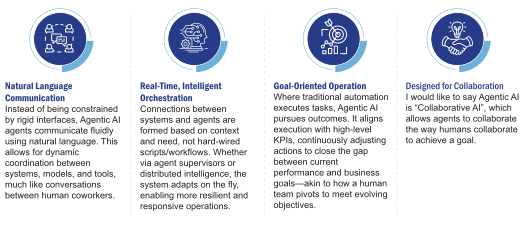
Traditional automation tools are rooted in rigidity. They operate through predefined logic, linear workflows, and tight API contracts. Agentic AI flips this paradigm. It enables autonomous agents to communicate using natural language, adapt to context in real time, and dynamically orchestrate processes based on goals rather than fixed rules.

Four core differentiators make Agentic AI the backbone of autonomous organizations:

Reimagining Organizational Roles and Structures

Almost all enterprises today have full-stack roles. Let me explain what I mean by that. Take an example of a role called "Sales Executive". This role does many tasks as per job description (JD), for example: identify target accounts, search for connections in those target accounts, research on account priorities, figure out which offering/product may appeal to the prospect account, find out the competition landscape in the account, schedule an appointment and finally meet the client.

You can imagine the amount of orchestration this role needs to meet the objective of meeting a client. The goal is to meet the client, maybe 10 such meetings per week. When I say, full-stack role, I mean that a given role needs to do too many micro-specialist tasks and orchestrate them to eventually achieve a specific goal. In the process, the specialization of the given role is lost.

Agentic AI principles allow enterprises to re-look at roles/JDs and see if it’s possible to have multiple specialist roles, instead of a few full-stack roles? This can be a massive exercise for any enterprise, as this will break the decade-old convention of the way work is defined and the way it’s broken into a few JDs and roles.

But imagine if an organization is able to create multiple specialist roles and break away from the conventional full-stack role. In the example of "Sales Executive" role, instead of one role, we will have specialist roles like Account researcher, Pre-sales fact finder, Pre-sales content synthesizer, Target executive finder, Meeting scheduler, and so on. Now, each of these specialist roles can be an AI agent and/or a Human agent, which is orchestrated by Agentic Orchestrator with the goal being "Schedule 10 meetings per week".

Once roles get broken into specialist roles, it is within the realm of possibility to convert them into AI Agent Roles mapped to the right skills, which allows an agentic orchestrator to manage tasks with clearly defined goals, i.e. schedule 10 meetings per week (in the given example).

If enterprises are able to do this, the number of roles in enterprises multiplies with majority being specialist roles, which interact in a network manner and not necessarily in a hierarchical manner. This will give birth to a real network organization, which in reality stays on paper today.

To build truly networked organizations, we must fragment broad job roles into specialized micro-roles. Think less in terms of hierarchical pyramids and more like interconnected constellations of highly specialized units. Instead of 50 general roles, envision 500 micro-roles collaborating to achieve strategic outcomes.

This structural redesign parallels the shift in software from monolithic applications to microservices. Just as microservices enable modular, scalable, and adaptable software, Agentic AI enables modular, scalable, and intelligent organizations—each "micro-role" powered by either a person, an AI agent, or a hybrid team.

Agentic AI as the Foundation for Autonomy

At the heart of this transformation is the move from top-down command structures to goal-driven ecosystems. Autonomous organizations don’t just deploy agents, they orchestrate them intelligently, allowing for constant reconfiguration based on performance, need, or market dynamics.

This creates a new kind of workforce, blend of human specialists, AI agents, and task-specific microservices, all operating as a cohesive, adaptive network. The outcome: faster response times, continuous optimization, and a system designed for resilience and innovation.

Governance in an Agentic World

As organizations delegate more intelligence and autonomy to machines, the challenge of governance becomes exponentially more complex. Unlike static systems, Agentic AI agents evolve, learn, and interact dynamically raising pressing questions about transparency, data usage, and ethical alignment.

To navigate this, enterprises must:

  • Define clear governance frameworks for AI agents.
  • Ensure responsible access to data and secure interactions. This becomes critical when agents need to be given a little more open access to a specific data set, than what the enterprise would have given to a specific API, when access was for a specific well-defined input signature for a well-defined output. The agility of prompt- based, intelligent data access brings additional data governance needs.
  • Balance adaptability with strong oversight, especially as natural language interfaces expose broader data scopes.
  • Acknowledge the lack of standardization across vendors and align internally on what “Agentic AI” means for their organization.

Responsible AI isn’t just a compliance concern, it’s a strategic enabler for trust and longevity in autonomous systems.

A Strategic, Long-Term Journey Principles for the Future of Work

Building a networked and autonomous organization with Agentic AI is a multi-stage journey, not a one-off project. The path typically involves:

  1. Experiments: Agentic AI as a principle is powerful, however, its standard definition is missing. In fact, the promise of technology versus the realization of the same through the existing toolset is still far away. Every automation tool vendor, as well as a System of Transaction (CRM, ERP, CBS, etc.) vendor, has come up with their own agentic tooling. It’s important for enterprises to experiment, a new phase before you get into POC, just to understand how tech works, what works, or what doesn’t work. Agentic AI will be a long journey, and a successful adoption will require experience in doing such experiments.
  2. Proofs of Concept: Building and Testing AI agents in isolated domains for a specific use case with specific tools.
  3. Pilot Programs: Deploying them in production on a limited scale.
  4. Workforce Redesign: Breaking down traditional roles into micro-specializations.
  5. Scaling Autonomy: Evolving into a distributed, self-optimizing system.

Success depends on a mindset shift—from thinking about automation as efficiency, to viewing Agentic AI as a new organizational operating system.

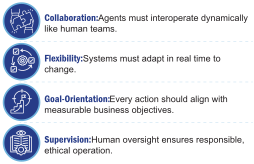
Principles for the Future of Work

To realize the full promise of Agentic AI, enterprises should anchor their strategies in four core principles:

Conclusion: Architecting the Intelligent Enterprise

Agentic AI is not just about machines getting smarter, it’s about organizations becoming more intelligent. By blending AI agents, dynamic workflows, and specialized human roles into a cohesive network, enterprises can build the foundations of truly autonomous organizations.

Those who start early, embrace structural change, and approach Agentic AI as a long-term strategic capability will lead the next wave of business innovation—defining not just how we work, but what organizations can become.

Get In Touch

Back
Volume 01
How AI is Changing the Future of Work
banner image

Why UnBPO™ Is Just the Beginning of Firstsource's Next 25 Years

Ritesh Idnani Chief Executive Officer & Managing Director, Firstsource

As Firstsource approaches its 25th anniversary, I find myself reflecting on the remarkable journey that has brought us here—and the even more extraordinary path that lies ahead. The BPO industry is now about 35 years old, and we’ve been part of this evolution for nearly 25 of those years.

Our industry has undergone seismic shifts, evolving from its origins in the early 1990s through multiple transformative phases.

But what we’re experiencing today isn’t just another incremental change. We’re witnessing a convergence of forces unlike anything we’ve seen before.

Look around you. Geopolitical tensions span the globe. Five generations in the workforce. Resurgent economic nationalism.

Inflation pressures. And a technological revolution in AI that makes even recent innovations seem antiquated. These forces aren't hitting us sequentially—they're hammering us concurrently. The degree of "unknown unknown" is unprecedented.

This is why we launched UnBPOTM.

But as I look to the next 25 years, I’m asking an even bigger question: How do we build organizations that don’t just survive these disruptions but thrive because of them? How do we create businesses with the potential to last not decades, but centuries?

Lessons From the Shinise: Companies Built to Last

The answers may lie in an unexpected place: Japan.

Japan houses over 52,000 companies that have survived more than a century. They have a word for these businesses: shinise. The oldest company in the world, Kongō Gumi, has operated for an astonishing 1,445 years since constructing its first Buddhist temple in 578.

What’s even more remarkable is that Japan faces natural disasters with staggering frequency—about 1,500 earthquakes every year.

Yet these businesses have endured through centuries of disruption, through wars, natural disasters, technological revolutions, and economic upheavals.

While we in the business services industry celebrate survival across decades, these Japanese firms measure their journeys in centuries. What can we learn from them?

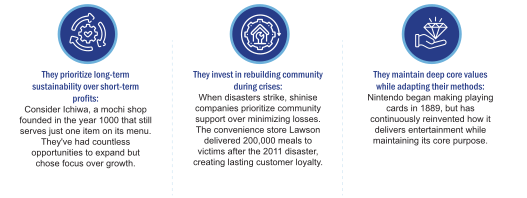
The shinise operate on fundamentally different principles than most modern businesses:

These principles offer profound lessons for organizations aiming to build lasting value in a rapidly changing world.

Building Your Business for the Next 25 Years – and Beyond

As your business moves beyond its first few decades, you must fundamentally reimagine what your organization can be. This means challenging every assumption about how your industry operates.

For us at Firstsource, the traditional labor arbitrage model is no longer sufficient. Location dispersion creates unnecessary complexity. Traditional metrics of success—headcount, revenue control, hierarchical position—are yesterday’s proxies of power.

Drawing from both innovative industry approaches and the longevity secrets of the shinise, here’s a vision for building organizations for the next century:

1. Deep Domain Expertise as Our Core Identity

The shinise teach us that businesses that last centuries don’t try to be everything to everyone. They focus on being “an inch wide and a mile deep.” For today’s business services providers, this means moving beyond generic process execution to develop true domain mastery in select industries.

This isn’t just about specialization – it’s about building institutional knowledge that compounds over decades rather than quarters. When AI can replicate generic processes in seconds, the competitive advantage becomes deep domain expertise that can’t be automated.

For businesses, this means engaging with partners who truly understand their business context, who can anticipate needs and identify opportunities that generic service providers would miss entirely.

2. Technology Arbitrage with Human Purpose

Labor arbitrage is now table stakes. The new frontier is technology arbitrage. But unlike the shinise of Japan, which maintained traditional craftsmanship, your industry must embrace technological revolution.

The mistake would be viewing technology as merely a cost- saving tool. Instead, we must see it as a means to elevate human potential. Advanced AI platforms aren’t just automating processes—they’re enabling people to deliver outcomes that were previously impossible, such as helping healthcare organizations identify high-risk claims before they incur penalties or enabling communications companies to resolve customer issues before they’re even reported.

The future isn’t AI or humans. It’s AI plus humans. But that plus is multiplicative, not additive.

Technology is also leveling the playing field globally. Today, we support European clients from Asia with near-zero language barriers thanks to real-time translation technologies. The boundaries that once dictated location decisions are disappearing, creating new possibilities for where and how services are delivered.

For businesses, this creates opportunities to access expertise regardless of geography and to benefit from technologies that might otherwise be out of reach for their organizations.

3. Breaking the Hierarchical Structure

The shinise have maintained family structures for centuries, but our future demands network organizations that can adapt rapidly to change. This means dismantling deep-rooted hierarchies and creating organizations where value creation—not headcount or budget—determines influence.

Businesses must focus on what I call “the messy middle”—those mid-level managers who translate strategy into execution. They’re the most consequential group in any transformation, yet often the most neglected. Organizations must equip them with new skills, new tools, and a new mindset that prioritizes speed over perfection.

For businesses, this means rethinking their internal organizational structure and working with partners who can move quickly, adapt to changing requirements, and deliver results without unnecessary bureaucracy.

4. Building Resilience Through Community Investment

The most powerful lesson from the shinise is how they invest in their communities during crises. They understand that business resilience doesn’t come from cutting costs when disaster strikes—it comes from strengthening the ecosystem in which you operate.

When the 2011 tsunami hit Japan, the convenience store Lawson delivered nearly 200,000 meals to victims, not because it was profitable, but because it was right. When those same communities recovered, they remembered who had supported them when it mattered most.

For businesses, this means rethinking relationships with customers, employees, partners and communities. It means proactively evolving business models before they become obsolete. It means adopting commercial models that align success directly with customer outcomes.

Most importantly, it means treating employees not as resources but as partners in building multi-generational institutions. Businesses that invest in community impact create a workforce that’s more engaged, more loyal, and more motivated to deliver exceptional client experiences.

5. Orchestrating a Symphony of Partnerships 

No organization can navigate today’s complex environment alone. The shinise survived for centuries because they were embedded in their communities, forming networks of mutual support that could weather any crisis.

Similarly, the most effective organizations must see themselves as orchestrators of a symphony of partnerships. This means cultivating relationships with startups, technology providers, academic institutions, and even competitors to create an ecosystem that’s more resilient than any single organization could be.

This isn’t just about filling capability gaps—it’s about creating businesses that are antifragile, that actually strengthen under stress rather than merely surviving it.

For businesses, this provides access to an entire ecosystem of innovation and expertise that no single provider could deliver alone.

The Trust Imperative: Lessons From See’s Candies

As we consider building an enduring organization, perhaps the most powerful lesson comes from Warren Buffett’s favorite investment—a small California chocolate company called See’s Candies.

Founded in 1921, See’s faced an existential challenge during the Great Depression and World War II when butter, sugar, and cream were severely rationed. The company had two choices: use inferior ingredients to maintain sales volume, or stick to high- quality ingredients and sell much smaller batches.

See's chose quality over quantity. They closed their stores each day when inventory ran out rather than compromise on their standards.

This decision seems counterintuitive from a short-term business perspective. But it created something far more valuable than quarterly profits: unshakeable trust.

By focusing on consistent quality rather than rapid expansion, See’s generated billions in profits for Berkshire Hathaway—a remarkable return on investment.

The parallel to our industry is striking. In a world where short- term cost-cutting is standard practice, how many businesses would choose to deliver fewer products or services rather than compromise on quality? This is exactly the paradigm shift your business must make.

The Next 25 Years Begin Today

The question every leader must ask today isn’t "How do I optimize for the next quarter?"" It’s "How do I build for the next quarter-century?"

This new approach to business isn’t just a response to current market conditions—this is about laying the foundation for the next century and beyond. While your business may not achieve the 1,445-year history of Kongō Gumi, you can certainly build organizations designed to thrive across generations.

The convergence of forces we’re experiencing—geopolitical, economic, social, technological—creates discontinuities. Discontinuities create imperfections in the marketplace. And imperfections create opportunities for those bold enough to seize them.

Every organization today has a choice: Will you play defense, clinging to traditional models as they crumble? Or will you play offense, reimagining what your industry can become?

The question facing us isn’t whether your industry will transform— it’s who will lead that transformation. At Firstsource, we’re reimagining our industry with UnBPOTM, challenging every traditional process and focusing on outcomes rather than inputs.

As any industry continues to evolve, the most successful companies will be those founded on the same principles that have sustained the world’s most enduring enterprises—an unwavering commitment to quality, a focus on deep expertise, and the courage to prioritize long-term value over short-term convenience.

This is the future we must build. Not just for ourselves, but for generations to come.

Get In Touch

Back
Volume 01
How AI is Changing the Future of Work
banner image

Foreword Rewriting the Rules: Why the Future of Business Process Services Starts Now

Ritesh Idnani Chief Executive Officer & Managing Director, Firstsource

Welcome to the inaugural edition of UnBPO™ Quarterly – our thought leadership platform where we challenge conventional wisdom and chart the course for the future of business process services.

For over three decades, I’ve witnessed the evolution of our industry firsthand. From my early days as a management trainee at Citibank in the late ‘90s, helping write standard operating procedures for what would become one of the first captive BPO units, to leading Firstsource today as we fundamentally reshape how work gets done in the AI era.

The BPO industry has evolved through distinct phases – from the early outsourcing experiments of the 1990s, through the labor arbitrage boom of the 2000s, to the process improvement focus of the late 2000s, and the automation wave that began in 2015. But today, we stand at an inflection point unlike any before.

We live in a world of unprecedented complexity. With 72 conflicts raging globally, five generations in the workforce, economic nationalism on the rise, and AI fundamentally altering how we think about work itself, the old playbooks simply don’t apply. The traditional BPO model – built on labor arbitrage, location dispersion, and hierarchical structures – is not just outdated; it’s counterproductive.

That’s why we’re introducing UnBPO™ – our bold reimagining of what business process services can and should be. This isn’t about incremental improvement; it’s about complete transformation. We’re moving from shared services to deep domain expertise, from labor arbitrage to technology arbitrage, from rigid hierarchies to agile, network-based organizations.

At Firstsource, we’re not just adapting to change, we’re architecting the future of work. Our ten design principles challenge every assumption about how our industry operates, from who does the work (humans, AI agents, gig workers in seamless collaboration) to how we measure success (outcomes, not headcount).

This magazine will be your window into this transformation. Here, you’ll find our latest thinking on AI-first strategies, outcome-based commercial models, and the fundamental shifts reshaping client expectations. You’ll discover how we’re breaking down silos between front office, back office, IT, and BPO to create truly integrated “Services as Software” solutions.

The question isn’t whether our industry will evolve, it’s who will lead that evolution. At Firstsource, we’re ensuring the answer is us. And through UnBPO™ Quarterly, we invite you to be part of this journey.

The future of work is being written today. Let’s write it together.

Get In Touch

Across Industries

Submitted by admin on
Banner Image
Banner Image
Banner Image Text

See how UnBPOTM meets your world — and changes it.

Banner Image Description

UnBPOTM across Industries

UnBPO Quarterly Content

UnBPOTM Quarterly

Lorem ipsum dolor sit amet, consectetur adipiscing elit. Curabitur ut finibus leo. Quisque faucibus dapibus neque at dapibus. Duis pharetra nisi sit amet facilisis porttitor. Cras in aliquet velit. Curabitur consequat est turpis

Vertical
Title
Healthcare
Description

Make care faster, smarter, and more human.

Title
Banking and Financial Services
Description

Shift from compliance-led to customer-led transformation

Title
Retail
Description

Turn transactions into intelligent, always-on experiences.

Title
Telecom
Description

Not just faster networks — smarter growth

Title
EdTech
Description

Accelerating Learning Through Operational Excellence

Title
Utilities
Description

Powering Next-Generation Utility Operations

Bottom Page Content

Why now

The traditional BPO transformation curve can only provide incremental benefits in the region of 25-30%, but the UnBPOTM led transformation curve will provide disproportionate returns in much shorter time frames.

Traditional BPO Transformation Curve

graph image

UnBPOTM Transformation Curve

graph image
Testimonial
Testimonial Image
phil
Testimonial Content

The time to unlearn the old BPO model and relearn these new thresholds of value creation has arrived, and I laud Firstsource’s bold approach to staying ahead of secular change.

Phil Fersht
CEO and Chief Analyst at HFS Research

Testimonial Image
kendra
Testimonial Content

I applaud Firstsource as a forward-thinking partner whose approach creates agility in today’s fast-changing, AI-driven world.

Kendra Tucker
CEO of Truckstop

Testimonial Image
dennis
Testimonial Content

The UnBPO™ approach accelerates transformation and puts AI first in reimagining strategies around people, processes, and technologies.

Dennis Stetzel
SVP & Head of Operations at ETS

Get In Touch

Get In Touch

 
UnBPO™ Across Industries | Firstsource AI-Led Transformation
UnBPO across industries, AI-driven business operations, Industry-specific AI solutions
Explore how Firstsource’s UnBPO™ model transforms telecom, banking, healthcare and retail with AI-first, outcome-driven solutions designed for scalable enterprise impact.

Home Page

Submitted by admin on
Banner Text

“ We’re not here to make your old system cheaper.
We’re here to help you build a better one”

Bottom Content

Firstsource is transforming & reshaping the industry by leveraging deep domain expertise, advanced technology, and a redefined approach to talent and partnerships, setting a new benchmark for value creation

Vertical
Title
Healthcare
Description

Make care faster, smarter, and more human.

Title
Banking and Financial Services
Description

Shift from compliance-led to customer-led transformation

Title
Retail
Description

Make care faster, smarter, and more human.

Title
Telecom
Description

Not just faster networks — smarter growth

Title
Utilities
Description

Powering Next-Generation Utility Operations

Title
EdTech
Description

Accelerating Learning Through Operational Excellence

Testimonial
Testimonial Image
phil
Testimonial Content

The time to unlearn the old BPO model and relearn these new thresholds of value creation has arrived, and I laud Firstsource’s bold approach to staying ahead of secular change.

Phil Fersht
CEO and Chief Analyst at HFS Research

Testimonial Image
kendra
Testimonial Content

I applaud Firstsource as a forward-thinking partner whose approach creates agility in today’s fast-changing, AI-driven world.

Kendra Tucker
CEO of Truckstop

Testimonial Image
dennis
Testimonial Content

The UnBPO™ approach accelerates transformation and puts AI first in reimagining strategies around people, processes, and technologies.

Dennis Stetzel
SVP & Head of Operations at ETS

Tenets
Provider Performance

Re-imagining Operations

  • 1. Location dispersion leads to “location debt.” –AI Centers of excellencewith rich talent pools will be the new standard.
  • 2. Deep domain expertise – being an inch wide & mile deep – is needed for competitive differentiation & to understand customer needs.
  • 3. Traditional commercial models are outdated & it’s time to embrace non-linear, outcome-driven approaches.
Provider Performance

Re-engineering Talent

  • 4. The future of work is evolving. Redefining Who (employees, gig workers, AI agents), How (task allocation), & What (skills) is crucial.
  • 5. Hierarchies are outdated. Organizations must identify roles that create outsized value and foster collaboration over silos.
  • 6. Hyper-personalized skilling is the future & middle management must adapt, shed outdated power structures & embrace new skills.
Provider Performance

Re-building Technology

  • 7. The lines between front office, back office, IT, and BPO are blurring and enter services as software.
  • 8. Labor arbitrage is table stakes. The next frontier will be Technology arbitrage – not just for cost, but for leverage.
  • 9. AI isn’t just technology – it’s a mindset. Integrating AI into everything and democratizing access is key to staying ahead.
  • 10. Partnerships are critical. We see ourselves as orchestrators of a symphony of partners delivering maximum customer value.
Firstsource's UnBPO™ – Transforming BPO Landscape with AI
Firstsource UnBPO, AI-driven business process services, AI-enabled BPO, AI-powered workflows, digital transformation services
Firstsource UnBPO™ shifts BPO from headcount models to AI-first, services-as-software delivery, redefining value through automation, auditability and measurable outcomes.
Testimonial Title

Industry Endorsement for UnBPOTM

Subscribe to