

|
|
Exclusive Feature on Building the Tech Stack for the Future of Work |

Beyond Content: The Media Company as Community Platform

Tij Nerurkar SVP - Global Head - Education Technology
The media industry is facing its most profound transformation since the invention of the printing press. Traditional content distribution models are crumbling as AI reshapes how people discover and consume information. In 2024, about 58.5% of U.S. searches and 59.7% of EU searches ended without any click to another site [1], meaning users increasingly get their information directly from search results without ever visiting publisher websites.
But here's what most people miss: this disruption isn't just a threat. It's the clearest signal yet that the future belongs to publishers who understand they're not really in the content business anymore. They're in the community business.
The End of Content as King
For decades, media companies operated on a simple premise: create compelling content, attract eyeballs, sell those eyeballs to advertisers, or convert them to subscribers. That model is breaking down faster than expected.
The math is brutal. Zero-click searches now make up almost 60% of Google searches in 2024 [1]. When people encounter paywalls, just 1% actually pay for access. Meanwhile, 53% look for the same information elsewhere for free [2] . Even for publishers with millions of monthly visitors, conversion rates hover around 0.5% to 2% at best [3] .
This is where most publishers panic and start frantically optimizing for featured snippets or fighting legal battles against AI companies. Both approaches miss the point entirely.
The Taylor Swift Blueprint
During a recent roundtable with media executives, one participant posed what initially seemed like an offhand comment: "How do we replicate the financial success of Taylor Swift?" Everyone chuckled, but that question contains the entire playbook for the media's future.
Swift didn't just become the world's biggest musical artist by making great songs. She became a billionaire by understanding something most media companies still don't: her real product isn't music, it's community.
The Eras Tour is projected to generate close to $5 billion in consumer spending in the United States alone [4]. The average secondary market ticket price for Swift's final U.S. show in Indianapolis was $1,273, more expensive than her first show in Glendale at less than $500 [5]. That's not inflation. That's cultural staying power built through community.
Consider what Swift actually built: an ecosystem where fans don't just consume content, they participate in a living, breathing community. They decode hidden messages in her lyrics, create elaborate theories about upcoming releases, exchange friendship bracelets at concerts (so many that businesses have reported bead and sequin shortages [6]), and treat each tour stop like a pilgrimage.
The lesson isn't that news publishers should start hosting concerts. It's that successful media companies must stop thinking like content factories and start thinking like community builders.
Event-Driven Community Building
The smartest publishers are already figuring this out. The Wall Street Journal has built thriving communities through its CEO Council, CMO Network, and CFO Network. These aren't just conferences. They're exclusive membership communities where business leaders convene regularly to share insights, build relationships, and shape industry conversations. The WSJ CEO Council Summit draws hundreds of C-suite executives annually, creating spaces where journalism facilitates business relationships.
The Atlantic has similarly transformed its approach. In 2025, The Atlantic Festival held its first event in New York City, bringing nearly 2,000 in-person attendees and over 10,000 virtual participants together. Year-over-year festival revenue grew 36% compared to 2024. Live events now comprise 25% of The Atlantic's business [7]. These gatherings feature three-day festivals with 30-plus events covering everything from AI's future to exclusive film screenings, creating experiences that can't be digitized, scraped, or replicated by AI.
Physical experiences create value that transcends content. Events solve multiple problems simultaneously: they generate direct revenue through ticket sales and sponsorships, create deeper engagement through face-to-face interaction, become content for multiple formats, and provide market research that no analytics dashboard can match.
Editorial Courage Builds Trust
Another critical element of community building that often goes unmentioned: standing up for what's right despite political pressures. The Washington Post's coverage of Watergate during Nixon's presidency demonstrated that unwavering journalistic integrity creates lasting community bonds. When Bob Woodward and Carl Bernstein continued investigating the scandal despite White House denials and threats [8], they weren't just breaking news. They were demonstrating the kind of editorial courage that transforms casual readers into lifelong supporters.
More recently, publications that have maintained rigorous investigative standards on sensitive topics, from political scandals to corporate malfeasance, have found that their communities rally around them. People pay for journalism they trust, and trust is built when publishers demonstrate they'll pursue truth regardless of pressure.
This editorial backbone becomes a community rallying point. When members know their publication won't compromise on principles, they don't just subscribe. They defend it, promote it, and identify with it.
From Product to People: A Business Transformation Parallel
This transformation from product-centricity to community-centricity mirrors shifts happening across industries. Consider the evolution of customer experience operations. Traditional business process outsourcing focused on delivering services, managing transactions, handling calls. The product was the service itself.
Forward-thinking organizations have recognized that this approach misses what actually drives business outcomes. It's not about processing transactions efficiently. It's about understanding the complete customer journey, designing experiences around human needs, and building relationships that extend far beyond individual touchpoints.
Take Firstsource's approach with its Gigsourcing Platform. Rather than simply providing outsourced labor, the platform builds a community of skilled professionals, connecting businesses with on-demand global talent through an AI-powered ecosystem. The platform doesn't just match workers to jobs. It creates a community where freelancers can build reputations, develop their expertise, and grow their careers on their own terms while organizations access the exact talent they need when they need it.
This represents the same shift publishers are experiencing. The traditional model said: here's our product (service or content), take it or leave it. The community model says: we're building an ecosystem where members both contribute and benefit, where relationships matter more than transactions, where belonging creates value that transcends any single interaction.
The shift from viewing customers as transaction sources to viewing them as community members requiring holistic support represents the same fundamental change publishers face. Success comes not from optimizing isolated interactions but from creating ecosystems where every touchpoint reinforces belonging and value.
Media companies are making an identical pivot. The article is no longer the product. The community experience surrounding that journalism is what creates value. Publications that recognize this build platforms where readers don't just consume content but participate in conversations, attend events, influence coverage priorities, and form connections with other community members.
Beyond Subscriptions: The Membership Evolution
Traditional subscription models treat readers like customers buying a product. They pay money, they get access, and end of relationship. This transactional approach becomes increasingly difficult to justify when free alternatives exist for basic information.
Membership models flip this equation. Instead of selling access to content, you're selling belonging to a community. The content becomes a tool for community building rather than the end product itself.
Publishers like The Guardian have moved from short-term newsletter campaigns to always-on offerings. Their "Reclaim Your Brain" email course attracted 146,000 global subscribers, then converted them to their "Well Actually" weekly newsletter with 30,000 subscribers [9]. Axios launched its first paid membership tier for $1,000 annually, not because their content is worth $1,000, but because access to their community of communications professionals provides that value through networking and professional development [10].
Successful membership programs offer exclusive access not just to content, but to journalists, experts, and other members with shared interests. They provide educational resources, networking opportunities, and impact participation that involves members in the journalism process itself.
The Adjacent Business Problem
One of the most insightful comments from our media roundtable came from a participant who noted their company's expansion into automotive dealerships to fund their journalism mission. At first, this sounds absurd. But it's actually brilliant.
Movie theaters figured this out decades ago. They don't make money selling movie tickets. They make money selling overpriced popcorn and soda. The movies are loss leaders that get people in the door for higher-margin purchases.
Media companies need to think the same way. The journalism might not be profitable on its own, but it can be the foundation for adjacent businesses: educational services, consulting and advisory work, technology licensing, events and experiences, merchandise and publishing. The key is ensuring these adjacent businesses enhance rather than compromise editorial independence.
Why This Matters Now
With social referral traffic declining, third-party cookies being deprecated, and generative AI reshaping search, media organizations must reclaim their communities from third-party platforms. The window for building direct relationships with audiences is closing as AI intermediaries become more sophisticated.
But the real urgency comes from audience expectations. Younger, digitally native audiences skip over full articles and head straight to comment sections to gauge the conversation. For them, community interaction isn't a nice-to-have feature. It's the primary draw.
Publishers who continue treating their audience as passive consumers of content will find themselves competing with AI that can deliver information faster, cheaper, and often more comprehensively than human journalists. Publishers who build genuine communities around shared interests and values create something AI cannot replicate: belonging.
The Path Forward
The transformation from content producer to community platform isn't optional. It's inevitable. The publishers who survive and thrive will be those who recognize this shift early and adapt their entire operation around community building rather than just content creation.
This doesn't mean abandoning journalism. It means recognizing that journalism's highest purpose has always been creating informed communities capable of democratic participation. The tools and methods are changing, but the mission remains the same.
The average Eras Tour attendee spent approximately $1,300 on travel, hotels, food, and merchandise according to the U.S. Travel Association [11]. That's the power of community. People will invest heavily for genuine belonging and shared experiences with people who understand them.
The media companies that figure out how to create that same sense of belonging around the issues and topics they cover won't just survive the AI disruption. They'll emerge stronger, more essential, and more profitable than they ever were in the old content-consumption model.
The future belongs to publishers who understand they're not in the information business. They're in the community business. The information is just the excuse people use to join.
References:
- Fishkin, R., & MacDonald, M. (2024, July 1). 2024 zero-click search study: For every 1,000 US Google searches, only 374 clicks go to the open web. In the EU, it's 360. SparkToro. https://sparktoro.com/blog/2024-zero-click-search-study-for-every-1000-us-google-searches-only-374-clicks-go-to-the-open-web-in-the-eu-its-360/
- Pew Research Center. (2025, June 24). Few Americans pay for news when they encounter paywalls. https://www.pewresearch.org/short-reads/2025/06/24/few-americans-pay-for-news-when-they-encounter-paywalls/
- Speciall Media. (2022, April 20). Benchmarks for digital subscription paywalls. https://speciall.media/2022/04/20/benchmarks-for-digital-subscription-paywalls/
- QuestionPro. (2023, June 8). Generating $5 billion, the Taylor Swift The Eras Tour has an economic impact more than the gross domestic product of 50 countries [Press release]. https://www.globenewswire.com/news-release/2023/06/08/2684710/0/en/Generating-5-billion-the-Taylor-Swift-The-Eras-Tour-has-an-Economic-Impact-more-than-the-GDP-of-50-countries.htm
- Victory Live. (2024, December 7). Where did Taylor Swift tickets cost the most? See which city cracked $3,000 per seat. USA Today. https://www.usatoday.com/story/entertainment/music/2024/12/07/where-taylor-swift-tickets-highest-cost/76829276007/
- Blistein, J. (2023, August 22). The staggering economic impact of Taylor Swift's Eras Tour. TIME. https://time.com/6307420/taylor-swift-eras-tour-money-economy/
- Baczewski, G. (2025, September 17). For The Atlantic, a New York Festival delivers a record year. Adweek. https://www.adweek.com/media/atlantic-festival-events-new-york/
- Washington Post (First Story): Shepard, M. (2022, June 13). The first Woodward and Bernstein story on the Watergate scandal. https://www.washingtonpost.com/history/2022/06/13/first-woodward-bernstein-watergate-scandal/
- Spangler, T. (2024, April 22). Publishers revamp their newsletter offerings to engage audiences amid threat of AI and declining referrals. Digiday. https://digiday.com/media/publishers-revamp-their-newsletter-offerings-to-engage-audiences-amid-threat-of-ai-and-declining-referrals/
- Axios. (2025, October 7). Axios partners with Mixing Board to launch new community for modern communications and corporate affairs professionals. Axios. https://www.axios.com/2025/10/07/mixing-board-axios-communications-membership
- U.S. Travel Association. (2023, September 18). The Taylor Swift impact – 5 months and $5+ billion. https://www.ustravel.org/news/taylor-swift-impact-5-months-and-5-billion
Get In Touch
|
|
Exclusive Feature on Building the Tech Stack for the Future of Work |

Enabling AI Innovation at Scale Needs an Innovation Value-Chain

Professor Shonali Krishnaswamy Director, Monash AI Institute and Associate Dean Innovation, Faculty of Information Technology
In October 2016, I followed Robert Frost’s advice of “The Road Not Taken” and left my familiar and comfortable universe of academic and public sector/government-funded R&D, and co-founded an AI/ML tech start-up called AiDA Technologies.
I had spent many years working with and leading R&D teams, demonstrating the power and potential of AI and Machine Learning to several industry partners, including Banking, Insurance, Payments, Healthcare, Transportation, Telco, and Aerospace. In my mind, I thought, well, we know what problems these sectors face, we are research experts in Machine Learning and Data Science, how hard can it be to take all that knowledge and make a difference in the real-world?
It turned out to be a much, much harder task than I ever could have imagined. I had to unlearn, learn, and re-learn several things in my journey from research and development of methods/algorithms with demonstration prototypes, to building highly scalable, reusable AI/ML products that worked 24x7 for several clients.
Along the way, with a strong dose of reality checks, AiDA developed a disruptive AI product for health insurance claims processing and real-time Fraud, Waste, and Abuse (FWA) detection that processes approximately 75% of Singapore’s individual Health Insurance Claims today.
In 2023, we were acquired by Asia’s largest Life and Health Insurer, AIA. One of the most important learnings for me was that the challenge to take AI research and innovation to the real world required sustained and significant software engineering effort.
Universities are recognized as foundational pillars of innovation systems—generating new knowledge, building advanced skills, and underpinning long-term economic and societal progress. Most research creates value indirectly and cumulatively, typically through workforce capability building and subsequent innovation flowing into enterprises, and gradual development of new technologies, standards, regulations, and policies.
Yet OECD (Organisation for Economic Co-operation and Development) evidence consistently shows that while research excellence is widespread, there remains a gap in that only a relatively small percentage of innovation gets translated to create direct commercial and/or societal impact within typical evaluation timeframes [1, 2, 3]. AI and deep-tech research are thriving, but translational impact is not keeping pace.
Universities are producing breakthrough algorithms, models, and systems at unprecedented speed (in 2025, top-tier AI conferences such as NeurIPS published around 3,000 research papers, having received an astonishing 30,000 plus papers) [4], yet only a fraction of this work ever reaches real-world deployment at scale.
The result is a widening gap between what our research systems are capable of producing and what economies and societies are actually getting used to. This is why innovation at scale has become the defining challenge for AI and deep tech.
For every dollar of university AI research that fails to commercialize, there's both the direct loss (due to the research funding gap) and the massive opportunity cost (the innovations that could have transformed industries). Thus, AI breakthroughs that don't translate represent enormous lost acceleration.
The question is no longer whether we can invent powerful technologies, but whether we can repeatedly and responsibly deploy them in organizations at scale. In other words, how can AI and deep tech innovations create impact at scale, and how can the journey from “lab to market” be seamlessly facilitated? These questions have now emerged as institutional challenges.
The approach that we have taken at the Monash University AI Institute to address this serious challenge is to first understand why high-quality AI research is not having the immediate impact that it should in the real world.
The Translation Gap: Where AI Research Gets Stuck
Even if the innovation addresses a critical organizational need/challenge, translation is inhibited by on-the-ground challenges of adoption of the innovation in enterprises due to several reasons detailed below.
- Lack of Engineering Capacity: The problem is not a science or innovation problem; it is an engineering/systems problem. The journey from a cutting-edge, innovative AI algorithm/model to an AI solution that works 24x7 in the real world requires significant engineering. A simple analogy is that the AI innovation is like a car engine, but that engine can only be used if there are seats, a gearbox, a steering wheel, and the list goes on. The engine is critical, but it is not the car! Monash University AI research focuses on the long and arduous process of building state-of-the-art engines but lacks experience as well as the engineering skills/resources to develop the car.
- Enterprise Integration is non-trivial: Following the development of even a sophisticated AI solution (that encompasses the core AI innovation), there is still a further step to integrate the solution into an organizational workflow through complex and non-trivial software integration (involving, in many cases, core legacy systems). This is well and truly beyond the remit of academic research, and in fact, there are no incentives for executing delivery through enterprise integration.
- Model Testing is not Systems Testing: AI research focuses on testing the model performance in terms of typical AI metrics for efficacy. Typically, research papers will publish results from out-of-time/out-of-sample testing of the model. However, in a fully functioning system, it is essential to go beyond to perform system integration and user acceptance testing as well as other non-functional testing, such as pen-tests, performance tests, application/code scans for vulnerabilities, etc.
Maintenance and Support: Beyond various levels of maintenance and support that would be expected for a production-deployed system, for AI systems, further MLOps functionalities will be required to continuously auto-tune the model based on new data as well as user feedback, while also ensuring that the model meets business metrics for the specific application/solution.
The challenges of adoption are not merely technical, as listed above.There is a clear need to recognize the need for distribution channels to create large-scale adoption beyond a limited number of deployments. Academic institutions are geared towards creating innovations but are not sales organizations with access to markets. In fact, this is clearly not the remit of academic institutions and researchers.
The Innovation Value Chain: A Framework for Scale
Creating commercial and real-world impact lies in creating an innovation value chain, as shown below. The innovation value chain recognizes that academic institutions must focus on the core science and innovation of AI methods/algorithms, while partnering with organizations that have strong software engineering/solution delivery capabilities and access to the market.
The impossible-to-cross bridge between the producers of knowledge/innovation, and the enterprise receptacles that need this innovation is overcome through the innovation value chain.
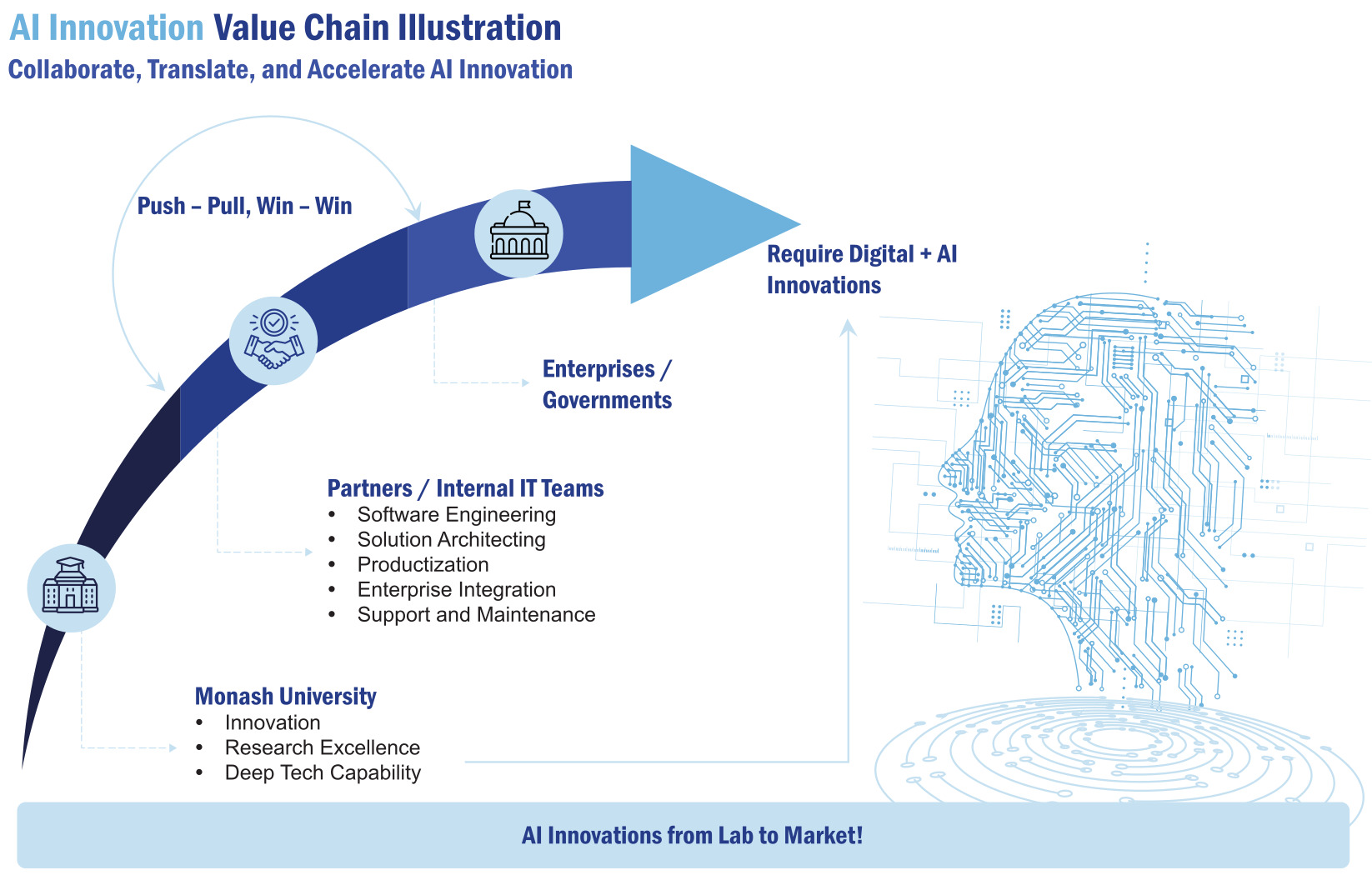
The innovation value chain leverages the mutual strengths of university research as a bedrock of research and development of breakthrough innovations. Scientists and academics focus on their core competence of working developing novel AI/ML techniques/algorithms/systems. For example, researchers at Monash University’s Centre for Learning Analytics have developed, evaluated, and published award-winning techniques/systems for early identification of “at-risk” students in university subjects [5]. However, adoption of these methods at scale across the university requires pilot testing at scale across multiple subjects, beyond research validation.
Furthermore, successful pilot testing needs to be followed by deployment through a traditional IT integration process. Finally, while these steps enable the research to move from lab to one real-world use, the true benefits of innovation at scale happen when the successfully tested and deployed techniques can be taken to market, beyond a single institution. Thus, the innovation value chain needs researchers, working with domain/application experts, working with IT architects and software/data engineers, and finally a go-to-market channel partner who can help to truly scale the innovation.
The innovation value chain is but a high-level construct that addresses some of the challenges of enabling AI innovations to flow from lab to market at scale. There are always significant challenges in specific use cases and details. While this illustration assumes a linear directionality, in many cases, it can start from the solution partner identifying a sector-level need for innovation, and in some cases, the research algorithms/methods may need some customization and configuration to address the actual requirements. Nevertheless, establishing the innovation value chain through trusted partnerships that are mutually beneficial is a critical step in creating translation pathways that integrate research and scientific innovation, with deployment and delivery capabilities.
Moving from Isolated Excellence to Coordinated Ecosystems
The evidence is clear. Despite unprecedented AI research output, 30,000+ papers submitted to NeurIPS alone, we face a widening gap between innovation and impact. Fewer than 5% of university AI technologies reach commercial deployment, representing billions in lost economic value and societal impact [6]
DeepMind's prediction of 2.2 million new materials has resulted in fewer than 800 synthesized materials [7]. The pattern repeats across every domain: brilliant research, limited deployment.
The innovation value chain offers a practical framework for addressing this challenge. By explicitly connecting three critical components, academic research, engineering delivery, and market access, it acknowledges what individual institutions cannot achieve alone while creating pathways for what partnerships can accomplish together.
Implementation Requires Institutional Change
Academic institutions must extend their mission beyond knowledge creation to include knowledge deployment. This does not mean abandoning fundamental research but rather establishing formal translation partnerships as core institutional practice.
Industry organizations must recognize that innovation increasingly originates outside their walls. Rather than viewing universities as competitors or service providers, successful firms will position themselves as deployment engines—transforming academic breakthroughs into scalable solutions.
Government funding bodies need evaluation frameworks that reward translation alongside discovery. Current metrics incentivize publications over deployments, creating misaligned incentives throughout the innovation pipeline.
Solution delivery partners represent the critical middle layer. Organizations that master both technical understanding and enterprise integration can build sustainable businesses by bridging the gap between academic innovation and market deployment.
The innovation value chain is not a complete solution; no single framework could be. Specific implementations will vary by domain, institution, and geography. Challenges around intellectual property, incentive alignment, and resource allocation remain substantial.
The fundamental insight stands that translation at scale requires coordinated ecosystems, not isolated excellence. Mission-oriented collaboration between academia, industry (and potentially government) can help to bring about a shift in innovation, creating real-world impact at scale, moving from isolated excellence to coordinated ecosystems. The institutions that build these partnerships first, connecting research brilliance with delivery capacity and market access, will define the next era of technological advancement. The choice is not whether to act, but how quickly to begin.
References:
- Paunov, C., Borowiecki, M., & El-Mallakh, N. (2019, September). Cross-country evidence on the contributions of research institutions to innovation (OECD Science, Technology and Industry Policy Papers, No. 77). OECD Publishing. https://www.oecd.org/content/dam/oecd/en/publications/reports/2019/09/cross-country-evidence-on-the-contributions-of-research-institutions-to-innovation_7caf2fbf/d52d6176-en.pdf
- OECD. (2010). The OECD innovation strategy: Getting a head start on tomorrow. OECD Publishing. https://wbc-rti.info/object/document/7380/attach/Innovation_Strategy_-_Getting_a_Head_Start_on_Tomorrow_en1.pdf
- Kumpf, B., & Jhunjhunwala, P. (2023). The adoption of innovation in international development organizations: Lessons for development co-operation (OECD Development Co-operation Working Papers, No. 112). OECD Publishing. https://www.oecd.org/content/dam/oecd/en/publications/reports/2023/06/the-adoption-of-innovation-in-international-development-organizations_cbb5e055/21f63c69-en.pdf
- NeurIPS Program Committee Chairs. (2025, September 30). Reflections on the 2025 review process from the program committee chairs. NeurIPS Blog. https://blog.neurips.cc/2025/09/30/reflections-on-the-2025-review-process-from-the-program-committee-chairs/
- Gašević, D., Jovanović, J., Pardo, A., & Dawson, S. (2018). Early warning system as a predictor for student performance in higher education blended courses. Studies in Higher Education, 44(11), 1900–1911. https://research.monash.edu/en/publications/early-warning-system-as-a-predictor-for-student-performance-in-hi/
- Njoroge, J. (2025, August 15). The university AI commercialization gap. Insights by Dr. Jean. https://insightsbydrjean.com/the-university-ai-commercialization-gap/
- Google DeepMind. (2023, November 29). Millions of new materials discovered with deep learning. https://deepmind.google/blog/millions-of-new-materials-discovered-with-deep-learning/
Get In Touch
|
|
Exclusive Feature on Building the Tech Stack for the Future of Work |

When a Beam of Light Changed My Marketing Mindset

Harry Jose SVP, Marketing, Firstsource
The Moment in Room 32
I wasn’t expecting a marketing insight that evening.
We had successfully concluded the UK leg of Emergence, our annual CXO Summit. Aniket (our CMO) and I were spending the evening at the National Gallery in London. We had just come from the serenity and atmospheric mystery of Leonardo da Vinci’s Virgin of the Rocks when we turned the corner into Room 32 and found ourselves staring at Caravaggio’s Supper at Emmaus.

There it was—luminous, explosive, dramatically alive in a way that felt almost out of place among the polite Renaissance order around it. A beam of light cut through the darkness in a way I’d never truly appreciated before. The table seemed to push out of the canvas. The disciples looked like real men reacting to a revelation, not idealized figures posing for philosophical contemplation. And in that moment—standing before a painting made in 1601—I suddenly saw a perfect analogy for the challenge I’ve been wrestling with as a modern marketer.
This, I realized,is how marketing must evolve if we truly embrace the UnBPOTM mindset.
It was a strange moment of recognition, a painting created 400 years ago illuminating something about where our industry is headed today. A gesture frozen in oil paint suddenly reveals the shortcomings of our own marketing constructs, our inherited operating models, our legacy hierarchies, and our comfortable thinking.
Caravaggio was not just making art. He was breaking a paradigm. And UnBPOTM, at its heart, asks us to do exactly the same.
This article is my attempt to connect that moment of insight to the broader transformation unfolding across industries and to show why a 400-year-old painting may hold valuable lessons for the next chapter of marketing.
What Caravaggio Broke Away From — And Why It Matters
To understand why Supper at Emmaus hit me so hard, you have to appreciate what Caravaggio was reacting to.
He arrived in Rome at a time when the High Renaissance had reached near-perfection. Artists like Raphael and Michelangelo had mastered ideal anatomy, harmonious composition, intellectual narrative structure, and serene balance. Painting had become a kind of visual philosophy—beautiful, instructive, mathematically precise.
But it had also become predictable.
It assumed a certain type of viewer, a stable environment, and an audience trained to appreciate complexity and symbolism. It was designed for the court and high society, not the common man in a crowded church or marketplace. High Renaissance art lived in the world of ideals, not in the world of lived experience.
Into this world walked Caravaggio—unruly, streetwise, impatient with the rules. He didn’t just improve Renaissance painting; he changed the very rule book it was built on.
Caravaggio painted real people with dirty feet and pushed scenes to the edge of the frame. He used light not to model form but to reveal truth so that ordinary viewers standing in dim chapels could experience it. He democratized art.
And standing in front of the Supper at Emmaus, I suddenly realized: Marketing today faces a Caravaggio moment.We must evolve from idealized constructs to lived realities. From campaigns to encounters. From process to revelation. From silos to orchestration. From labor arbitrage to technology leverage. From knowing our customers “in theory” to meeting them in their moment.
UnBPOTM is the mindset shift that allows this transformation to happen.
The UnBPOTM Mindset
Before we bridge the analogy, let me set the stage.
UnBPOTM is the idea that the traditional Business Process Outsourcing model—built on linear tasks, labor cost optimization, and rigid process—no longer matches the world we operate in.
UnBPOTM proposes a tech-driven, intelligence-led, outcome-focused approach to work.
It sits on three big pillars:
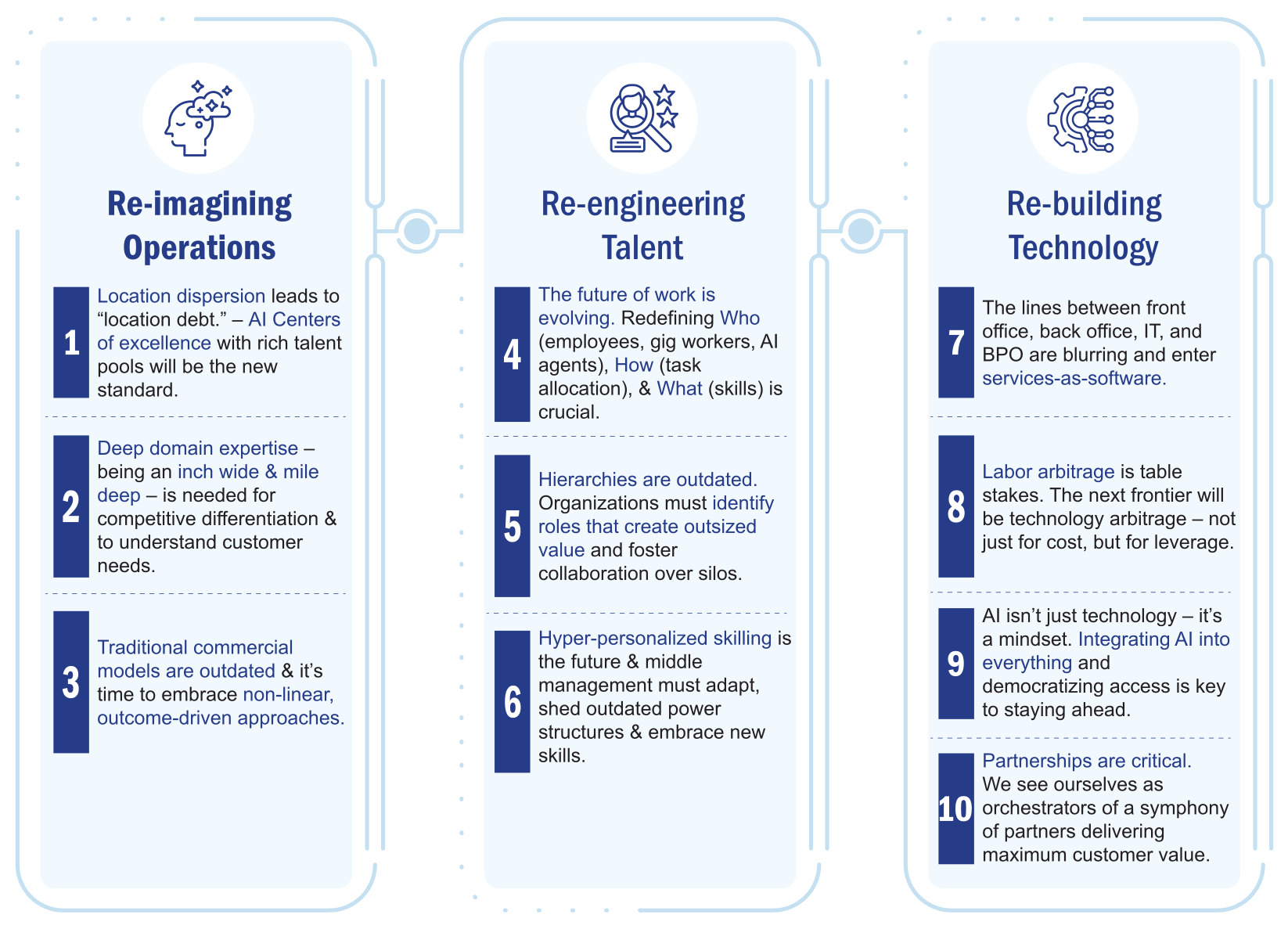
These ten tenets apply across industries—from banking to healthcare to retail to logistics. And, crucially for me, they also apply to marketing.
Yet we often treat marketing as if it exists outside the wider transformation happening in operations and talent. Many marketing teams continue to run on old assumptions:
Campaign calendars. Rigid processes. Functional silos. Manual content production. Hierarchical approval chains. “Labor-first” production models. Technology is treated as tools, not ecosystems.
In short, marketing still behaves like Renaissance art just before Caravaggio, a system optimized for a world that no longer exists. Let me share how Supper at Emmaus illuminates, quite literally, what UnBPOTM marketing can become.
The Table in Emmaus - Where Revelation Happens
When you stand before Caravaggio’s Supper at Emmaus, you notice something immediately: the table is too close.
It juts into your space. The basket of fruit is about to fall into your hands. One disciple’s elbow seems to push toward your chest. The scene is not framed politely; it erupts from the canvas.
Caravaggio does this because his paintings were designed not for private palaces but for crowded churches where passersby might only glance for a few seconds. He needed a visual language that grabs the viewer instantly. And pulls the viewer in.
This is exactly what marketing must do in an UnBPOTM world.
We operate in noisy environments. Our audiences are distracted, overwhelmed, and skeptical. The channels we use are crowded. Attention is scarce. Linear campaigns no longer cut through.
Marketing must move from messaging alphabet soup to moments of recognition - the Caravaggio strategy.
Just as the disciples recognize Christ in the breaking of bread, our audiences must recognize value, relevance, and truth in an instant.
And this realization began to open a larger analogy in my mind.
I. RE-IMAGINING OPERATIONS
Tenet 1: Location dispersion leads to “location debt.” –AI Centers of excellence with rich talent pools will be the new standard.
Caravaggio painted for real-world conditions—dim chapels, uneven lighting, diverse viewers. He created a visual language optimized for its environment.
Similarly, marketing today is fragmented: different teams, regions, agencies, content repositories, and tech stacks. We suffer from location debt—work scattered, inconsistent, disconnected. For a simple marketing campaign to happen, multiple teams need to come together – field marketing, campaign team, content team, design team, website team, and social media team.
The asset exists in different forms – Word documents, Photoshop files, HTMLs, and videos. Communication happens disjointedly across multiple mediums, such as emails, Teams calls, and calls. And there is no single system or platform where all relevant information about the campaign is available.
UnBPOTM marketing consolidates intelligence in AI Centers of Excellence:
- Unified data
- Unified content engines
- Unified tech stacks
- Unified audience intelligence
- Unified experimentation
Like Caravaggio’s single beam of light, these hubs focus attention where it matters. Platforms on which all aspects of marketing asset creation happen in the same place, at the same time—aided by AI. Enabling marketing to move from chaotic production to cohesive orchestration.
Tenet 2: Deep Domain Expertise → Competitive Differentiation
Caravaggio mastered a narrow set of truths—light, gesture, emotion, immediacy. He didn’t try to be universal; he tried to be specific, and that specificity made him unforgettable. Marketing must do the same.
Deep domain expertise allows marketers to:
- Understand customers at a granular level
- Craft narratives that resonate
- Anticipate friction points
- Interpret signals correctly
Generalist marketing creates generic outcomes. Focused expertise creates impact.
Tenet 3: Moving Beyond Traditional Commercial Models
Renaissance artists produced artifacts. Caravaggio produced results—impact, transformation, emotional recognition.
Marketing must also move beyond activities:
- Deliverables
- Campaigns
- Calendars
- Impressions
toward:
- Revenue outcomes
- Velocity influence
- Experience lift
- Customer lifetime value
Caravaggio didn’t paint for decoration; he painted for revelation. UnBPOTM marketing must deliver outcomes, not just assets.
II. RE-ENGINEERING TALENT
Tenet 4: The Future of Work - Who, How, What
Caravaggio overturned the traditional studio model. He didn’t rely on armies of apprentices or elaborate sketches. He painted from life, quickly, directly. He replaced hierarchy with immediacy.
UnBPOTM marketing does something similar.
The future marketing team includes:
- Human strategists
- Gig creators and specialists
- AI agents generating content, insights, and workflows
- Automation copilots
- Data interpreters
The “who” and the “how” are shifting dramatically. We are no longer artisans producing one piece at a time. We are orchestrators managing a hybrid intelligent workforce.
Tenet 5: Hierarchies Must Evolve
Caravaggio broke artistic hierarchies: he became influential through impact, not titles.
Marketing hierarchies—approval chains, rigid processes, over-layered management—slow us down. They keep us in the Renaissance when the industry around us is shifting to the Baroque.
In UnBPOTM marketing:
- Roles are defined by value creation
- Collaboration outranks control
- Speed is a strategic weapon
- Intelligence flows horizontally, not vertically
This is not chaos—it’s intentional flattening.
Tenet 6: Hyper-Personalized Skilling
Caravaggio’s assistants learned not to imitate but to adapt - observing how he used light, gesture, and realism to evoke emotion.
Today, marketing talent must upskill in areas that didn’t exist five years ago:
- Prompt craft
- AI content QA
- Signal interpretation
- Automated workflow design
- Multi-format storytelling
- Data-informed creativity
To enable this transformation, middle management in marketing must evolve from controllers to coaches, facilitating continuous learning rather than gatekeeping expertise.
Upskilling is not optional. It is survival.
III. RE-BUILDING TECHNOLOGY
Tenet 7: Blurring Front Office, Back Office, IT, and BPO
Caravaggio blurred boundaries:
- Painting + theater
- Surface + space
- Realism + symbolism
In Supper at Emmaus, the table spills into our world; the boundary collapses.
Similarly, UnBPOTM marketing doesn’t treat:
- Demand gen
- Content
- Brand
- Analytics
- Sales enablement
- Marketing ops
as separate silos.
The tech stack becomes the canvas. Workflows become the composition.
Data becomes the light source.
We no longer “do” marketing. We run a marketing system.
Tenet 8: Technology Arbitrage as the New Frontier
Renaissance workshops relied on labor scale. Caravaggio relied on leverage-one beam of light, one moment, one truth. Marketing can no longer win on labor-driven production. Technology-driven leverage is the only competitive edge.
- AI-assisted content generation
- Automated personalization
- Predictive analytics
- Real-time optimization
- Modular content systems
- Orchestration platforms
Tech arbitrage is not about saving costs. It’s about amplifying impact.
Tenet 9: AI as Mindset, Not Tool
Caravaggio didn’t use realism as a technique; it was his worldview. Similarly, AI is not a tool we plug in. It is amindset:
- Everything is data
- Everything can be personalized
- Everything can be accelerated
- Everything can be orchestrated
- Everything can be democratized
Marketing becomes fluid, adaptive, and intelligent. AI isn’t here to help us work faster. It’s here to help us work differently.
Tenet 10: Partnership as Symphonic Orchestration
Caravaggio’s influence spread rapidly because his work was part of a network—patrons, painters, chapels, assistants, rivals. He wasn’t isolated; he was amplified.
UnBPOTM marketing works the same way.
Partners in:
- Data
- Platforms
- Creative production
- Distribution
- AI ecosystems
must be orchestrated deliberately to create customer value.
Marketing becomes the conductor of the symphony, orchestrating diverse partners to create harmonious customer value.
Bringing It All Together: Marketing’s Caravaggio Moment
Standing in front of Supper at Emmaus, I saw a moment frozen in time —one of recognition, one of revelation. And I realized that marketing is standing at a similar threshold. We can continue polishing the old Renaissance model — campaign calendars, functional silos, manual production, legacy KPIs — or we can embrace a new way of seeing.
Caravaggio teaches us that innovation doesn’t come from improving the old system.
It comes from changing the context in which the system operates.
UnBPOTM marketing is that context shift.
It asks us to:
- Reimagine operations,
- Reengineer talent,
- Rebuild technology,
- Reorient toward outcomes,
- Orchestrate partnerships,
- and embrace intelligence as our new light source.
The beam cutting across Caravaggio’s canvas is the same beam cutting across our industry today - the light of AI, data, insight, automation, and new talent models.
We can either squint and admire the past or step into the illumination of what’s possible.
Even if you’re not a marketer, Caravaggio’s lesson applies to you:
- Your operations must be redesigned for where work happens now.
- Your talent must evolve into hybrid, flexible, intelligent systems.
- Your technology must shift from utility to architecture.
- Your outcomes must anchor your investments.
- Your partnerships must be orchestrated, not accumulated.
- Your organization must embrace revelation - truth made visible over complexity.
Every industry is experiencing a Caravaggio moment. The only question is whether we recognize it.
The Elbow That Reaches Toward Us
As I finally stepped away from Supper at Emmaus, I kept looking at that disciple’s elbow, jutting out, defying the frame, breaking into my space.
It felt like a metaphor for the moment we’re in.
The world is pushing into our frame - new technology, new expectations, new behaviors, new competitors. We cannot stand at a respectful distance anymore. We must meet the moment. We must reach forward. We must break the frame of how we’ve always done things.
Caravaggio did this with paint. UnBPOTM does this with technology, talent, and mindset.
Marketing must now do the same. Because just like in Emmaus, the moment of recognition changes everything.
Get In Touch
|
|
Exclusive Feature on Building the Tech Stack for the Future of Work |

3 Myths About Scaling CX with AI

Sudha Bhat SVP, Customer Experience, Firstsource
Why Most CX Transformations Stall After Early Success
AI is now deeply embedded in customer experience. Chatbots handle scale, agent assist tools support frontline teams, and analytics increasingly guide operational decisions. For most organizations, the question is no longer whether AI belongs in CX.
Yet many CX transformations stall soon after early success.
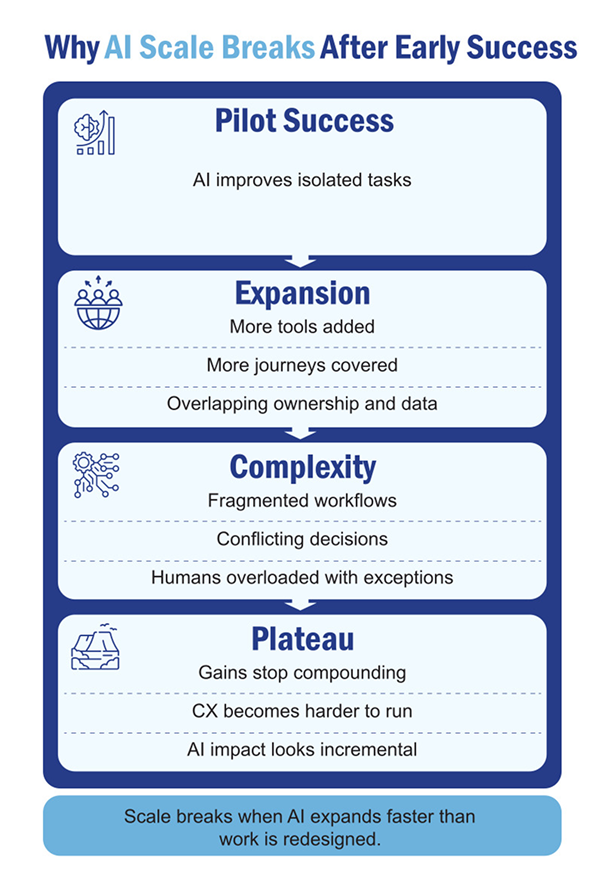
Early pilots deliver results. Leaders expand coverage. More use cases go live. Then momentum slows. Complexity rises. The gains that once felt transformative begin to look incremental.
This slowdown is often mistaken for a technology problem. It is not.
AI works. What breaks down is how organizations attempt to scale it. CX leaders often see strong early gains, such as improved digital containment or agent productivity, but those gains diminish as AI expands faster than operating models evolve. What looks impressive at the pilot stage quietly plateaus as journeys become interconnected and decisions begin to cascade across the system.
This shift mirrors changes playing out across industries, where value is moving away from transactions and toward systems designed around people, participation, and outcomes.
Before examining the myths that shape this behavior, it is important to understand where most CX scaling efforts go off track.
When Growth Becomes the Wrong Goal
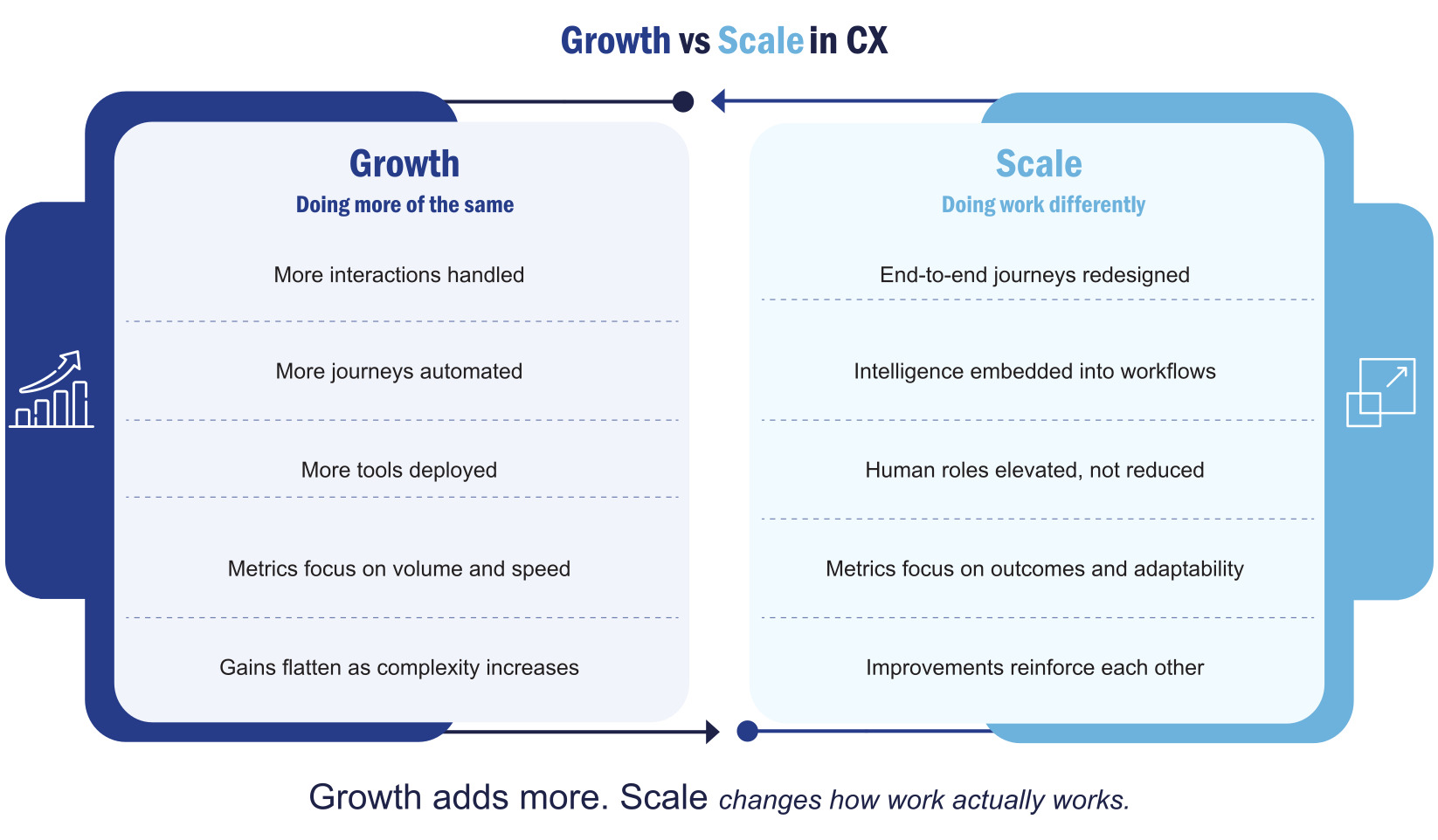
Many CX organizations treat growth and scale as the same thing. They are not.
Growth is about doing more. More interactions handled. More journeys covered. More automation deployed. Scale is about doing differently. It shows up when improvements in one part of the system reinforce others instead of creating friction elsewhere.
AI exposes this difference very quickly. Used narrowly, it accelerates tasks. Used systemically, it forces changes in how work flows, how decisions are made, and how accountability is distributed across CX.
Industry research consistently reflects this gap. While most CX leaders report strong ambition around AI adoption, only a small percentage succeed in scaling AI meaningfully across the enterprise. The issue is rarely access to tools. It is the absence of redesign at the level of work, roles, and governance.
Most CX transformations stall because they pursue growth while avoiding that redesign. In several CX programs, conversational automation scales well initially, but costs and handle time rise elsewhere as exception handling, ownership, and decision-making across journeys remain unchanged. Growth looks strong, but scale breaks because the underlying work was never redesigned.
Myth 1: Scaling Means Adding More Tools
When organizations think about scale, the instinct is expansion. More bots. Broader automation. Additional features rolled out across channels. This approach delivers quick wins, but it rarely sustains momentum.
Tool-led scaling improves individual tasks rather than the system as a whole. One AI improves containment. Another speeds up agents. A third scores quality. Each creates value in isolation, but the gains do not reinforce one another. Over time, complexity increases faster than impact, leaving teams managing more technology without seeing proportional improvement.
The earliest signal that tool-led scaling has reached its limit is not performance decline, but rising decision friction, where teams spend more time aligning tools, metrics, ownership, and hand-offs than changing how work actually flows.
What actually scales is work design.
When AI is embedded into end-to-end CX workflows rather than layered on top, intelligence travels with the interaction itself. Decisions move closer to the moment they matter. Hand-offs reduce. Outcomes improve without adding friction. Scale comes from redesigning how work flows across CX, not from stacking capabilities.
Myth 2: AI-Led Growth Comes from Replacing Humans
Another limiting assumption is that AI-driven CX success is primarily about reduction. Fewer agents. Leaner teams. Lower cost per interaction.
The most scalable CX models do not remove humans. They keep them in the loop and move them closer to decisions that matter. In more mature CX environments, roles such as journey owners and real-time operations leaders become critical, ensuring AI-driven actions align with experience outcomes rather than isolated efficiency gains.
As AI absorbs repetitive work, human roles move up the value chain. Agents focus on exceptions, complex conversations, and moments that directly influence retention or revenue. Team leaders rely less on backward-looking reports and more on predictive signals. Analysts spend less time producing dashboards and more time shaping decisions.
This shift matters because scale introduces volatility. Demand spikes. Policy changes. Customer behavior evolves. CX organizations that rely purely on automation struggle to adapt. Those that elevate human judgment alongside AI absorb change more effectively.
AI scales CX fastest when it amplifies human judgment rather than attempting to replace it.
Myth 3: If AI Works in One Process, It Works Everywhere
A solution that performs well in one CX journey is often expected to extend smoothly into others. What works in billing should work just as well in onboarding, retention, or claims. When it does not, teams assume the technology has reached its limits.
More often, the constraint is orchestration.
Scaling AI across CX requires shared data foundations, clear decision boundaries between humans and AI, and governance that spans journeys rather than individual tools. Without this, AI remains locally successful but structurally fragile. Pilots do not fail because AI cannot scale. They fail because the organization around them does not evolve fast enough to support scale.
AI does not scale itself. Enterprises scale around it.
What Real Scale Looks Like in CX
When AI truly scales in CX, the shift is visible well before metrics are reported. Work is organized differently. Journeys are designed end to end rather than optimized in fragments. Intelligence is embedded directly into workflows instead of being pushed into dashboards after the fact. Ownership becomes clearer, with humans accountable for outcomes rather than activity.
Success is no longer measured by how much work AI absorbs, but by what the CX organization can now do differently. Faster adaptation. More consistent experiences. Better alignment between cost, experience, and growth. This is where scale stops being linear and begins reinforcing itself.
The UnBPO™ View: Scaling Outcomes, Not Effort
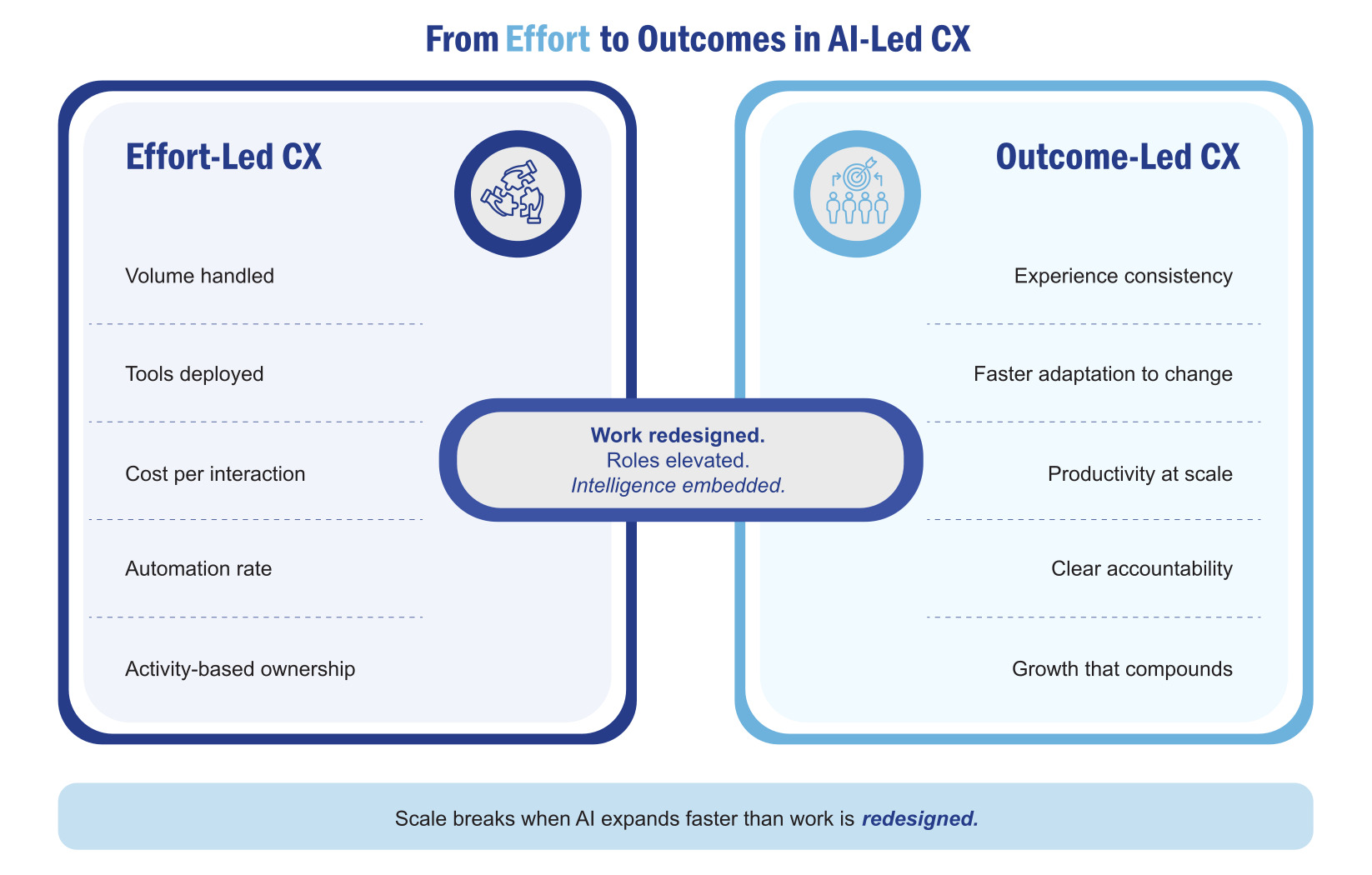
From an UnBPO™ perspective, this shift is fundamental. AI-led CX only scales when the focus moves from effort to outcomes.
That means moving beyond metrics such as volumes handled or tools deployed and toward value created across customer journeys. In one large benefits administration transformation, this required rethinking multiple member journeys together rather than optimizing isolated touchpoints. AI was embedded across conversational IVR, chat, agent assist, and quality within redesigned workflows and clear ownership models.
The impact showed up where it mattered most. Productivity improved meaningfully, cost-to-serve reduced, and experience consistency increased as escalations and hand-offs came down across journeys.
The organizations that scale are not the ones with the most AI deployments. They are the ones that redesign work, elevate decision-making, and build intelligence into the fabric of CX operations. That is where growth stops being incremental and AI begins delivering real leverage.
Scaling the Right Thing
AI will continue to improve. Tools will get smarter, and capabilities will expand. But CX growth will remain limited unless organizations change what they are actually scaling.
The leaders who succeed will not be the ones who deploy the most AI, but the ones who redesign work, elevate human judgment, and align intelligence to outcomes. That is when AI stops being an efficiency lever and starts becoming a growth engine for CX.
Get In Touch
|
|
Exclusive Feature on Building the Tech Stack for the Future of Work |

Why Scaling AI in Operations Without a Control Plane is a Risk, Not a Strategy

Kumaran Shanmuhan Chief Strategy Officer, Firstsource
Here is the uncomfortable truth about AI in enterprise operations: the technology isn't the bottleneck. Governance is.
LLM-powered copilots, chatbots, and autonomous agents have proliferated at a remarkable speed. What hasn't kept pace is the infrastructure to govern them, “the control plane,” as I call it.
The control plane is a governance and execution layer that determines where decision authority lives, what evidence exists when something goes wrong, and how accountability is traced at the moment of execution rather than reconstructed afterward.
Without this layer, scaling AI doesn't accelerate operations. It scales risk.
This explains why a quieter sentiment keeps surfacing among operations leaders: "We like what we see in pilots. We're just not sure we trust it enough to scale."
The hesitation is rational. Deploying AI without a control plane isn't a strategy, but a liability.
A Pilot That Worked—Until It Didn't
I saw this dynamic play out recently in a review of an AI pilot that everyone agreed had "worked." The metrics looked promising, handle time was down, and agents found the tool helpful. Leadership was discussing rollout.
Then someone asked: "What happens when it gives the wrong answer?"
The room went quiet. Not because the question was unexpected, but because the answer revealed how little had changed. The fallback was the same one operations teams have relied on for decades: coaching, retraining, and quality checks after the fact.
We were evaluating AI as a productivity tool when the real requirement was governance.
This pattern is endemic. MIT researchers found that most AI pilots—by some estimates, north of 90 percent—never translate into measurable business impact [1]. The technology works; the governance infrastructure to support it doesn't exist.
This revelation is also changing what enterprises expect from their business process services partners: not just operational support, but the expertise to design and operate the governance layer that makes AI safe to scale.
Why Software Engineering Succeeded Where Operations Stalled
I’ve seen generative AI work exceptionally well in software engineering, well before copilots became a default talking point.
In one environment I was close to, teams used AI to accelerate iteration across the development lifecycle. Feature velocity increased, quality improved, and delivery timelines compressed. Not because standards were relaxed, but because feedback cycles became dramatically tighter.
That distinction matters. Software engineering didn’t succeed with AI because it adopted more intelligent models. It succeeded because it already had an operating system that governed execution.
When I look at operations, the contrast is stark. The work is no less complex, and the stakes are often higher, but the equivalent scaffolding rarely exists.
We ask AI to reason about policies and exceptions using documentation and training designed for humans, not systems—and then act surprised when trust becomes the limiting factor. This isn’t a failure of AI. It’s the absence of a control plane.
That absence explains why today’s most popular AI approaches, despite their strengths, stall when applied in the world of operations.
Why Today’s AI Approaches Share the Same Blind Spot
Enterprises typically adopt AI capabilities in sequence: first improving access, then grounding, then adding structure, and finally automating execution. Through that lens, the shared failure mode becomes obvious. None of these, by themselves, determine what is authorized at the moment of execution.
Each delivers clear value, yet none is sufficient for safely scaling AI in operations.
The pattern becomes clearer when viewed side by side:
What unites them is a shared failure mode: each asks tools to perform the work of an operating system. Reliability doesn't emerge from intelligence alone. It emerges from the governance infrastructure that determines how intelligence gets used.
For most enterprises, the control plane won’t emerge from technology alone. It depends on operational judgment, exception-handling experience, and systems thinking that partners embedded in day-to-day workflows have cultivated over the years.
Where Governance Gaps Hurt Most
The governance gap carries its greatest consequences in trust-critical operations—work where being wrong is costly, heavily regulated, or difficult to reverse.
Consider just a few examples across industries:
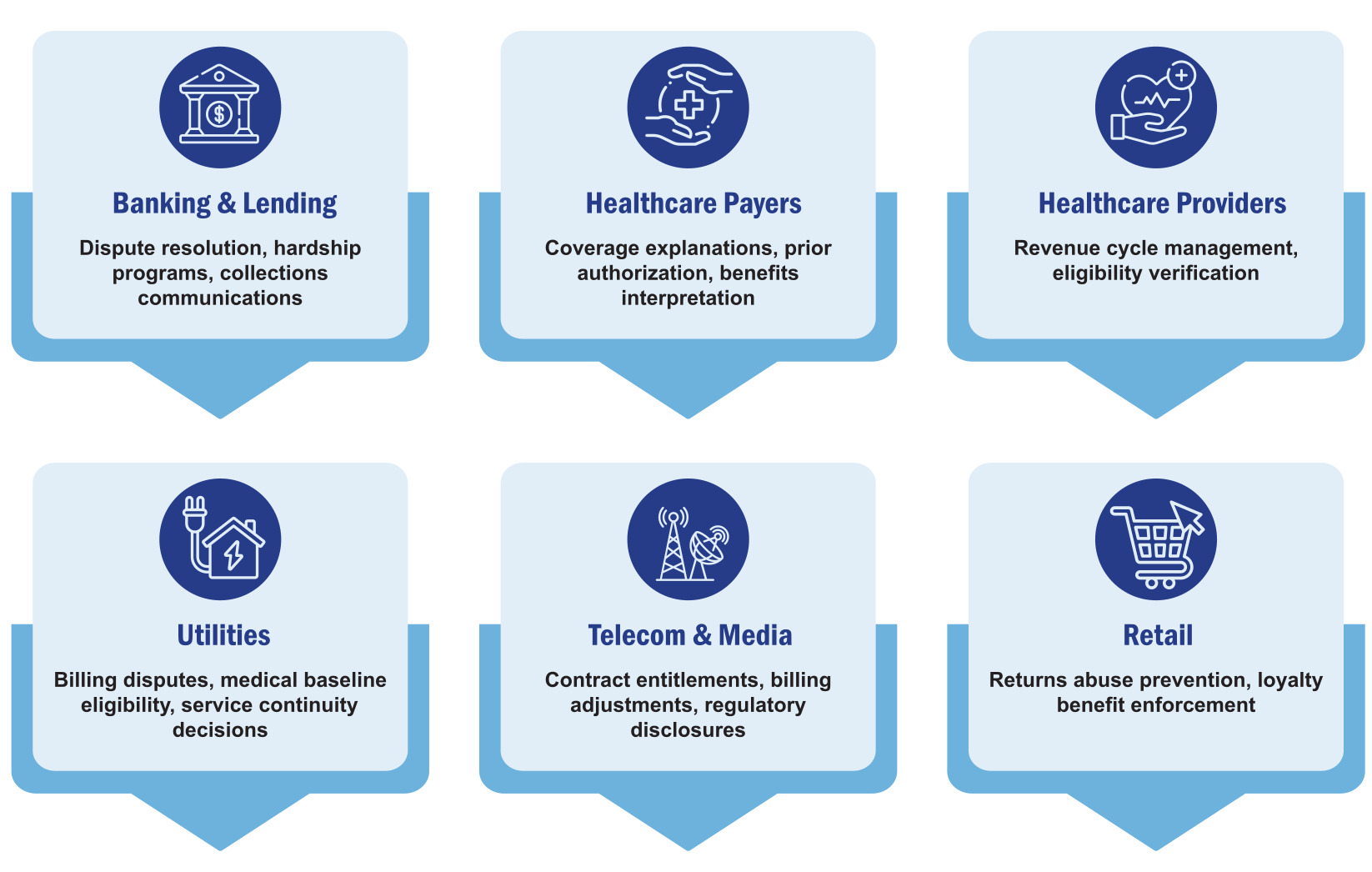
- Banking & Lending: dispute resolution, hardship programs, collections communications
- Healthcare Payers: coverage explanations, prior authorization, benefits interpretation
- Healthcare Providers: revenue cycle management, eligibility verification
- Utilities: billing disputes, medical baseline eligibility, service continuity decisions
- Telecom & Media: contract entitlements, billing adjustments, regulatory disclosures
- Retail: returns abuse prevention, loyalty benefit enforcement
Across these workflows, how a decision is made and explained matters as much as the outcome itself. Errors rarely self-correct; they cascade—triggering downstream denials, appeals, complaints, and regulatory scrutiny.
Accountability must remain defensible long after execution, to customers, auditors, and regulators reconstructing what happened and why. This is why operations leaders are cautious. In trust-critical environments, AI cannot simply assist; it must be governed at the moment of execution.
If there is a single use case that exposes why the control plane matters, it is prior authorization in healthcare. The complexity isn’t a lack of documentation—coverage rules, clinical policies, and regulatory requirements are deeply codified. The challenge is applicability.
A determination must reconcile benefit coverage rules, medical necessity criteria, plan-specific variations, federal and state regulations, and exception pathways. The risk profile also differs by decision type: an incorrect approval creates financial and audit exposure, while an incorrect denial triggers appeals, parity law scrutiny, and regulatory action.
Providers face their own complexity: documentation burden, inconsistent requirements, and revenue cycle disruption. AI can accelerate retrieval, but without embedded governance to validate applicability, track decision rights, and manage exceptions, it simply accelerates the rate at which incorrect determinations are made.
In a trust-critical workflow like prior authorization, speed without governance amplifies risk rather than reducing it.
Teams doing this work every day know how much judgment and nuance these workflows demand. Any AI that participates here has to reflect that lived expertise, not replace it.
Boards recognize the exposure. Disclosure of material AI risk in S&P 500 filings has surged from roughly one in ten companies to nearly three in four over two years [2].
The question is no longer whether AI creates institutional exposure, but whether governance capabilities exist to manage it.
What COOs Are Really Reacting To
In conversations with COOs, the reaction to AI in operations is not resistance, but restraint.
There is broad recognition that today’s tools are powerful, and that early productivity gains are real. The concern is more fundamental: whether the organization can stand behind AI-enabled decisions once they move from assistance into execution.
Most COOs recognize that their operating model was designed for human judgment, not machine participation. Authority is distributed, exceptions are managed through experience, and accountability is reconstructed after the fact. That model has worked for decades, but it doesn’t scale cleanly when AI becomes part of the decision loop.
What’s emerging is a quiet consensus: until judgment, accountability, and escalation are designed into operations (not layered on afterward), AI will remain bounded to the edges of the business. Not because leaders lack ambition, but because they understand the cost of getting it wrong.
Many teams tell me they’re excited about AI but cautious about crossing the threshold to execution. That hesitation is rational, and it’s why designing the control plane often becomes a shared effort between internal experts and partners who understand both the workflow realities and the AI.
Three Questions Every COO Should Answer Before Scaling AI
Before approving the next phase of AI rollout, every COO should be able to answer these three questions with confidence, not optimism:
If AI is becoming part of operational execution, governance is no longer a support function. It becomes a core operational capability, as essential to sustainable performance as the technology itself.
The emerging differentiator is not who has the most advanced models, but who can design and operate the control plane that governs them. That’s where partners who’ve lived these workflows can help translate what teams already know into something machines can govern.
The Divide That’s Already Forming
AI will not replace operations. It will expose how well operations are governed. This shift marks the most significant operating model redesign since workflow digitization.
The competitive divide ahead isn't between organizations that adopt AI and those that don't. It's between those that can trust AI decisions at the moment of execution and those that cannot.
Without a control plane: pilots multiply, production stalls, exceptions are managed informally, accountability is reconstructed only after failures surface.
With one: knowledge becomes authoritative, judgment is explicit, decisions are traceable by design. This discipline compounds into institutional resilience—not just efficiency.
Remember that silent room where no one could answer what happens when AI fails? The organizations that lead in the next decade will be the ones that treat the control plane as a first-class operational capability, often codesigned and operated with partners who understand how to translate your rules, policies, and accountability into machine-safe execution.
And if you’re navigating these questions now, I’d welcome a conversation—let’s build the control plane your operations deserve.
References:
- Challapally, A., Pease, C., Raskar, R., & Chari, P. (2025, July). State of AI in business 2025 (v0.1) [Preliminary findings from AI implementation research from Project NANDA]. MLQ.ai.
https://mlq.ai/media/quarterly_decks/v0.1_State_of_AI_in_Business_2025_Report.pdf
- Johnston, A. (2025, October 27). Generative AI shows rapid growth but yields mixed results. S&P Global Market Intelligence.
https://www.spglobal.com/market-intelligence/en/news-insights/research/2025/10/generative-ai-shows-rapid-growth-but-yields-mixed-results
Get In Touch
|
|
Exclusive Feature on Building the Tech Stack for the Future of Work |

Building the Tech Stack for the Future of Work: The UnBPO™ Playbook

Ritesh Idnani Chief Executive Officer & Managing Director, Firstsource
For 25 years, Business Process Outsourcing (BPO) meant one thing: doing work faster, cheaper, and better, and that often meant delivering your mess for less.
We moved work from high-cost locations to low-cost locations. We sold full-time equivalents. We competed on labor arbitrage. And it worked, for the last 25 years until the next evolution of the industry arrived in November 2022, when OpenAI launched ChatGPT.
The global BPO market during the last 25 years grew to approximately $415 billion in 2025 and is projected to further grow to $583 billion by 2030 [1]; however, this growth has been incremental, characterized by faster, cheaper, and more of the same. Meanwhile, generative AI, agentic workflows, and digital-native competitors have made one thing brutally clear: the old model of labor arbitrage and FTE pricing is on a slow burn.
I got my start in this industry in the mid-1990s, working with Citigroup's operations. Those were formative years. The industry itself was just taking shape as BP, GE, Citigroup, and other major players entered the outsourcing business, demonstrating that this sector could be transformative. But it also showed me how quickly any advantage based purely on cost arbitrage could become commoditized.
When I joined Firstsource in September 2023, the industry was at a crossroads. Clients were asking harder questions. Competitors were offering commodity solutions. And technology was advancing faster than our business models could adapt. The wake-up call wasn't a single moment; it was the accumulating weight of evidence that incremental improvement wouldn't cut it anymore.
We needed to burn down the old playbook and build something fundamentally different.
UnBPO™ is our response: not a rebranding, but a fundamental reimagining of outsourcing. AI-first, outcome-driven operations that create disproportionate value. It's about moving BPO from dying to exciting.
Why Must the Old Model Evolve?
For decades, BPOs operated on a pyramid model, with large pools of entry-level workers with thin expertise at the top. That worked for labor arbitrage. But when AI handles tier-1 inquiries and automation processes thousands of claims per hour, that pyramid crumbles.
The future is the diamond model: specialized expertise, continuous learning, and human-AI collaboration. We're not alone in this evolution; leading consulting firms like McKinsey are going through the same transformation [2]. They're moving from armies of junior analysts to smaller teams of specialized experts augmented by AI. The pattern is clear: depth beats breadth in an AI-enabled world.
We've moved thousands of our people from transactional roles to judgment-driven positions through hyper-personalized learning. The metric we want every employee to think about is "What value did you add to your customer today?"
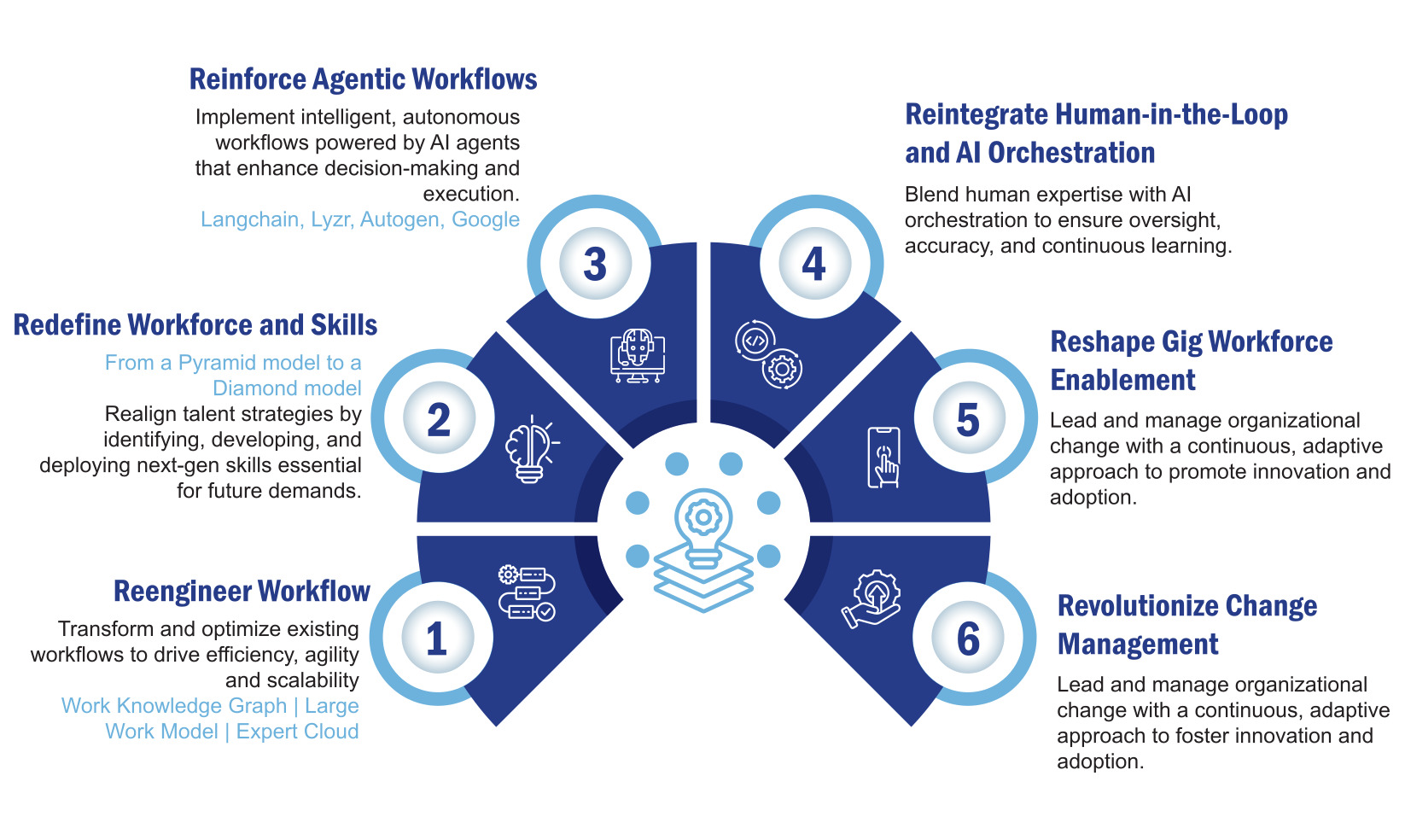
1. Reengineer Workflow: From Processes to Atomic Tasks
We're breaking down complex processes into modular, interoperable components. Instead of a 40-step process requiring weeks of training, we create atomic components that can be learned in days and recombined for different needs.
This isn't just about efficiency; it's about agility. When a client's business shifts, we can reconfigure workflows in days, not months. We can deploy new capabilities without retraining entire teams. We can test, learn, and iterate at speed.
Our approach to workflow engineering is guided by what we call "friction mapping": identifying pain points in the customer journey and then connecting the dots between process atomization and the right combination of technology and human intervention.
At the foundation of this sits what we call our intelligent context framework, our blueprint for capturing and structuring the "why" behind decisions, not just the "what." Traditional enterprise systems capture state, the outputs and final records, but not the decision context that shapes how work really gets done. Much of this lives as tribal knowledge: unwritten rules, expectations, and judgment calls sitting in people's heads, Slack threads, or informal escalations.
We're systematically capturing decision traces; the inputs, signals, rules applied, exceptions granted, escalations made, and human approvals so that over time the system learns institutional context as a first-class dataset. For customer support workflows, this means capturing how past tickets were escalated, which exceptions were granted under what conditions, which agents approved decisions in ambiguous cases, and what cross-system signals influenced resolution steps.
When we persist with this information, it becomes a searchable institutional memory, a context graph-like layer that lets AI understand not just rules, but how those rules have been interpreted and applied historically. We start with simpler activities like customer support because the context is bounded and structured. Over time, this framework creates a compound learning effect where precedent makes future decisions faster, more consistent, and preserves knowledge that would otherwise leave with individual employees.
2. Redefine Workforce and Skills: The Diamond Imperative
If we're serious about moving from pyramid to diamond, we need to fundamentally rethink skills, roles, and career paths.
At Firstsource, this starts with being honest about the displacement risk. AI will replace some jobs built on repetition and transaction processing. But it will also create entirely new categories of work: AI orchestrators, exception handlers, empathy-driven problem solvers, and domain specialists who bring judgment to complex situations.
Our job is to help our people navigate this transition.
We're also rethinking how we define "workforce." It's not just full-time employees anymore. With our recently launched Gigsourcing Platform, we're building an ecosystem that blends AI-powered virtual agents, domain expertise, and global freelance talent.
Critical to this workforce transformation is our UnBound platform, our internal learning ecosystem. It is purpose-built for our context. UnBound enables hyper-personalized, continuous learning at scale. It's how we're reskilling thousands of employees from transactional roles to judgment-driven positions, ensuring our workforce evolves as fast as our technology.
This creates workforce flexibility that can scale up or down based on client needs, access specialized skills on demand, and operate across time zones and geographies seamlessly.
The diamond model isn't about having fewer people; it's about having the right people doing higher-value work.
3. Reinforce Agentic Workflows: The AI-First Operating Model
Our AI philosophy is captured in three simple principles: data for AI, AI in everything, AI for everyone.
This simple framework guides every technological decision:
- Data for AI: Building data foundations that enable intelligent automation
- AI in everything: Embedding AI capabilities across all workflows, not as bolt-ons
- AI for everyone: Democratizing access so every employee can leverage AI tools
But here's what we've learned: AI doesn't work if you just bolt it onto existing processes. You need to redesign the work itself.
Today, agentic AI is at the core of our UnBPO™ transformation. We're deploying AI agents across our relAI™ suite of solutions, and we're seeing remarkable results.
We've built what we call the Agentic AI Studio, where we leverage emerging protocols like MCP (Model Context Protocol), A2A (Agent-to-Agent Protocol), ACP (Agent Communication Protocol), and ANP (Agentic Network Protocol) to create intelligent, interoperable systems. These aren't just buzzwords; they're the new language of digital operations: HTTP for the agentic web.
One of our most significant AI investments embodies our "inch wide, mile deep" philosophy: a domain-centric Language Model built specifically for the U.S. mortgage industry.
This isn't a generic AI model adapted for mortgage; it's a purpose-built Language Model trained on mortgage-specific knowledge, combining transformer architecture with advanced techniques like model blending. The result is an AI that understands the nuances of mortgage lending as deeply as an industry veteran.
Through our strategic partnership with Lyzr.ai, we're leveraging enterprise-grade AI agent orchestration that coordinates multiple AI agents across workflows with built-in security, compliance, and governance. Lyzr's platform enables us to build, deploy, and manage AI agents that run locally in air-gapped environments within our clients' own cloud infrastructure, ensuring complete data privacy and control.
Similarly, our partnership with AppliedAI enables us to automate complex, regulated enterprise processes end-to-end with human oversight and compliance built in. Together, these partnerships allow us to move from proof-of-concept to measurable business impact in weeks, not quarters.
4. Reintegrate Human-in-the-Loop: Augmentation Over Elimination
The future isn't human versus machine; it's human with machine.
Every agentic workflow has a deliberate role for human judgment. The question isn't "Can AI do this?" but "Where does human expertise add the most value?"
Trust is the core element here. In industries where decisions impact people's financial futures, health outcomes, or legal standing, trust isn't built by black-box algorithms; it's built by transparent systems with human accountability.
That's why human-in-the-loop isn't just a safety mechanism; it's a trust mechanism. When customers know a trained professional reviewed the AI's recommendation, when regulators see human oversight in audit trails, when employees understand they're validating rather than being validated, that's when AI adoption accelerates.
We're building copilots, not replacements. Our agents handle volume, speed, and consistency. Our human experts handle complexity, empathy, and ethical judgment. Together, they're unstoppable.
This philosophy extends to how we think about quality and compliance. In regulated industries like healthcare and financial services, human oversight isn't optional; it's the whole point. AI accelerates, but humans validate.
5. Reshape Gig Workforce Enablement: The Platform Economy
The traditional BPO model assumed that work happened in delivery centers with full-time employees. UnBPO™ assumes work happens anywhere, by anyone, at any time.
With our Gigsourcing Platform, we're creating a digitally intelligent, hyper-agile ecosystem that connects enterprises with specialized talent on demand. This isn't about replacing our employee base; it's about augmenting it with flexible capacity and niche expertise.
The platform includes AI-led matching, workflow orchestration, compliance-first onboarding, and automated payments. But what excites me most is the new operating model it enables: work gets disaggregated into tasks, sourcing gets diversified across talent pools, and enterprises can scale with precision instead of guesswork.
6. Revolutionize Change Management: Continuous Adaptation
If I've learned anything in my 28 years in this industry, it's that transformation isn't a project; it's a continuous capability.
The traditional change management playbook (big launch, intensive training, go-live date) doesn't work in a world where AI capabilities are evolving monthly, and client needs are shifting weekly. We need to build organizations that can learn, adapt, and evolve in real time.
We're moving from static training to continuous learning. From fixed roles to fluid responsibilities. From compliance mindsets to innovation mindsets. This requires leadership courage, transparent communication, and a willingness to admit when things aren't working.
The only way to drive continuous change is to create psychological safety: permission to experiment, fail fast, and learn faster.
How the Pillars Work Together
Here's what makes UnBPO™ powerful: these six pillars aren't separate initiatives. They're an integrated system where each element reinforces the others.
Let me show you how this works in practice across three real scenarios:
Mortgage Origination: We reimagined the entire customer journey, accounting for both happy paths and exception scenarios. Document-intensive processes are now intelligently intercepted and sorted to avoid inefficient manual touches. We've reskilled complex underwriting into a POD-based structure that achieves hyper-productivity. With generative AI-enabled underwriting assist solutions, interpretation of complex scenarios and knowledge dissemination of state-level compliance variations are significantly easier, with targeted SME reviews only where judgment truly matters.
Financial Crime Detection: When a payment is initiated from India to the US, our monitoring system throws an alert. The workflow proceeds through personality checks, name screening across watchlists, L1 alert validation for true matches, and L2 decision-making. Previously, teams primarily relied on L1 detection. Now we've built an AI-assisted L2 layer that recognizes patterns and supports human-in-the-loop closures, dramatically reducing false positives while maintaining compliance rigor.
Core Banking Services: We've taken the most active service banking requests and routed them to Conversational AI to avoid human intervention where possible. Simple workflows like password resets, IVR to OTP verification to password reset, now happen entirely through AI. For mortgage servicing, portions like payment methodology and interest-principal breakdowns are handled through assisted or conversational AI, freeing our experts to focus on complex customer situations requiring empathy and judgment.
You can't build agentic workflows without reengineering processes. You can't redefine workforce skills without understanding how gig platforms expand your talent pool. You can't integrate humans effectively without continuous change management.
This systems thinking is what differentiates transformation from tinkering.
What Can Other Businesses Learn from What We're Doing?
The question isn't whether to build this tech stack. It's how fast you can move.
Five lessons from our journey:
- Start with workflows, not technology: AI on broken processes creates expensive automation of bad work.
- Invest in people obsessively: Your workforce must evolve as fast as your technology.
- Blow up your business model: Outcome-based pricing will cannibalize traditional revenue. Do it to yourself first.
- Build for continuous change: One-time transformation leaves you behind immediately.
- Embrace ecosystems: Find partners and be honest about what you don't know.
The Bottom Line
Traditional BPO is dying. What's being born is far more valuable: human expertise, AI capabilities, and flexible talent combining to deliver previously impossible outcomes.
UnBPO™ is about augmentation over elimination, outcomes over outputs, continuous adaptation over static solutions.
The tech stack for the future isn't about the latest AI or the most offshore centers. It's about orchestrating humans, machines, and workflows for disproportionate value.
That's the future we're building.
References:
- Statista. (2025). Business process outsourcing – worldwide: Market forecast. Statista Market Insights. https://www.statista.com/outlook/tmo/it-services/business-process-outsourcing/worldwide/
- Times of India. (2026, January 10). McKinsey boss Bob Sternfels breaks down how AI is changing consulting jobs: Non-client-facing roles are shrinking and jobs that are growing are...
https://timesofindia.indiatimes.com/technology/tech-news/mckinsey-boss-bob-sternfels-breaks-down-how-ai-is-changing-consulting-jobs-non-client-facing-roles-are-shrinking-and-jobs-that-are-growing-are/articleshow/126461541.cms
Get In Touch
|
|

Foreword Beyond the Pilot: Why Transformation Requires Orchestration

Ritesh Idnani Chief Executive Officer & Managing Director, Firstsource
When we launched UnBPOTM earlier this year, we challenged the fundamental assumptions of our industry. The response was immediate: business leaders didn’t debate whether transformation was necessary; they asked how to actually make it happen.
That question, the gap between vision and execution, is what this edition explores.
I’m struck by how different industries are discovering the same truth. In financial services, banks realize that deploying AI in isolated pockets creates local efficiency but not enterprise intelligence. In business services, we’re finding that automation doesn’t eliminate human expertise; it reshapes where that expertise matters most.
These aren’t separate trends. They’re different expressions of the same shift: from optimizing individual processes to orchestrating entire ecosystems.
Most organizations can articulate where they need to go. They can demonstrate promising pilots. Yet transformation efforts stall before delivering sustainable value. The problem isn’t vision or technology, it’s mindset: the ability to think differently about how intelligence can be leveraged, to reimagine what’s possible when AI becomes the foundation of everything we do, to redesign workflows around human-AI collaboration, and to build organizations that learn and adapt continuously.
This edition explores transformation through three lenses: the strategic (understanding why traditional approaches fail), the operational (building systems that actually work), and the practical (seeing these principles applied in banking and financial services).
In Amar’s article, he shares a story that crystallized this shift for me. One of our recent hires, someone who joined to handle customer interactions, taught herself to code using AI and solved a client problem in days. This isn’t a miracle; it’s what happens when you create conditions for emergence: accessible tools, psychological safety, domain expertise, and clear problems to solve. It’s the AI-first mindset in action.
As you read, ask yourself: Are we optimizing or reimagining? Are we treating AI as a tool to improve what exists, or as a foundation to create entirely new value? Are we measuring efficiency gains or growth opportunities? What ecosystem do we need to succeed?
The organizations that figure out how to cultivate an AI-first mindset, to make AI their organizational operating system, to connect intelligence across the enterprise, to partner humans and AI effectively, and to adapt continuously, won’t just survive the next decade. They’ll define it.
Let’s build that future together.
Get In Touch
|
|
Exclusive Feature on Building the Tech Stack for the Future of Work |

Foreword The Translation Problem

Ritesh Idnani Chief Executive Officer & Managing Director, Firstsource
Here's what I keep hearing from leaders across industries: "We know AI works. We're just not sure we can trust it at scale."
That gap between what's possible and what's actually deployable is where most transformation efforts die. We can build impressive pilots, but production stalls. We can automate individual tasks, but complexity compounds faster than value. We produce brilliant research in labs, yet barely 5% ever reaches the real world.
The pattern is everywhere. It's not an innovation problem anymore. It's a translation problem.
This edition digs into what translation actually requires and why it breaks down at the same points. The articles here come from very different perspectives, but they're all wrestling with the same core challenge: how do you move from proof-of-concept to sustainable scale?
What strikes me most is how often the breakdown happens not because the technology fails, but because we're trying to scale the wrong thing. We pursue growth when we need scale. We add tools when we need to redesign work. We automate when we need to orchestrate.
I'm particularly grateful to Professor Shonali Krishnaswamy, Director of the Monash AI Institute and Associate Dean (Innovation) at Monash's Faculty of Information Technology, for contributing her perspective on the innovation value chain.
Our partnership with Monash is built on exactly this problem: how do you bridge world-class AI research with real-world deployment? Shonali's article captures something we see every day: breakthrough innovations stalling not because they don't work, but because the connective tissue between lab and market doesn't exist.
That's what translation infrastructure looks like: governance that works at execution speed, workflows designed for AI from the ground up, and partnerships that connect capability to deployment.
So, as you read, ask yourself: Are we building for translation, or just for innovation? Do we have the infrastructure that lets intelligence travel across our systems? Can we move from brilliant to deployed, or are we still just admiring the research?
Get In Touch
The UnBPOTM Quarterly | February 2026

Ritesh Idnani Chief Executive Officer & Managing Director, Firstsource
Foreword The Translation Problem
Here's what I keep hearing from leaders across industries: "We know AI works. We're just not sure we can trust it at scale." That gap between what's possible and what's actually deployable is where most transformation...
Read MoreFeatured Articles

Building the Tech Stack for the Future of Work: The UnBPO™ Playbook
For 25 years, Business Process Outsourcing (BPO) meant one thing: doing work faster, cheaper, and better, and that often meant delivering your mess for less.
Ritesh Idnani Chief Executive Officer & Managing Director, Firstsource

Why Scaling AI in Operations Without a Control Plane is a Risk, Not a Strategy
Here is the uncomfortable truth about AI in enterprise operations: the technology isn't the bottleneck. Governance is.
Kumaran Shanmuhan Chief Strategy Officer, Firstsource

3 Myths About Scaling CX with AI
AI is now deeply embedded in customer experience. Chatbots handle scale, agent assist tools support frontline teams, and analytics increasingly guide operational decisions. For most organizations, the question is no longer whether AI belongs in CX.
Sudha Bhat SVP, Customer Experience, Firstsource

When a Beam of Light Changed My Marketing Mindset
The world is pushing into our frame - new technology, new expectations, new behaviors, new competitors. We cannot stand at a respectful distance anymore. We must meet the moment. We must reach forward. We must break the frame of how we’ve always done things.
Harry Jose SVP, Marketing, Firstsource

Enabling AI Innovation at Scale Needs an Innovation Value-Chain
In October 2016, I followed Robert Frost’s advice of “The Road Not Taken” and left my familiar and comfortable universe of academic and public sector/government-funded R&D, and co-founded an AI/ML tech start-up called AiDA Technologies.
Professor Shonali Krishnaswamy Director, Monash AI Institute and Associate Dean Innovation, Faculty of Information Technology

Beyond Content: The Media Company as Community Platform
The media industry is facing its most profound transformation since the invention of the printing press. Traditional content distribution models are crumbling as AI reshapes how people discover and consume information.
Tij Nerurkar SVP - Global Head - Education Technology
Let me know when the next edition launches!
Get In Touch

The Learning Revolution Demands New Operations

EdTech has moved beyond digitizing traditional classrooms. Today's educational platforms serve millions of learners simultaneously, delivering micro-learning modules, conducting real-time assessments, and providing instant feedback across global time zones.
Students expect Netflix-level personalization in their learning journeys. Educators need data-driven insights to improve outcomes. Institutions require seamless operations that scale from hundreds to millions of users without compromising quality.
Legacy educational support systems break under modern demands. Processes built for term-based enrollment cycles can't handle continuous learning environments where students start courses daily and progress at individual paces.
Firstsource transforms EdTech operations by eliminating bottlenecks that limit growth and student success. Your platform's potential shouldn't be constrained by operational limitations.
Acquisition & Lead Management
Lead generation requires sophisticated targeting across multiple digital channels. Converting prospects to enrolled students involves complex application management, communication workflows, and enrollment processes that vary by program type.
Student Lifecycle Complexity
Students need personalized support from inquiry through graduation and career placement. Traditional support models can't scale across diverse learner needs, cohort timelines, and varying engagement patterns throughout the learning journey.
Content & Technology Integration
Content production, localization, and instructional design require specialized expertise. Integrating learning technology services with existing platforms while maintaining quality and accessibility standards presents ongoing challenges.
Omnichannel Support Demands
Students expect seamless support across voice, email, text, social media, and chat. Managing consistent experiences while transferring context between channels requires sophisticated coordination and unified desktop capabilities.
Data & Analytics Utilization
Learning analytics exists across multiple platforms without unified insights. Converting data into actionable engagement strategies and personalized learning pathways requires advanced analytical capabilities and behavioral modeling.
Cost Management Pressures
Balancing personalized support with cost-effective operations becomes challenging at scale. Traditional staffing models struggle with fluctuating support volumes and specialized expertise requirements across different educational domains.
The UnBPO™ Educational Transformation
Student Acquisition & Marketing
Content marketing, campaign optimization & analytics, social media operations, brand safety, lead generation through website activity capture, outreach based on target learner personas, lead qualification, and comprehensive learner application management from prospect to enrollment.
Learning Technology Services
Content production and localization, instructional design services, content transformation, learning technology platform development, unified omnichannel desktop for seamless request transfer across all communication channels, with 360-degree customer interaction views.
Student Support & Engagement
Learner support from onboarding to placement, learner engagement analytics, data-driven targeted engagement strategies based on customer profiles and aging buckets, empowering learners to design their own solutions based on changing situations.
Content Operations
Large-scale content creation, upgradation, and data conversions for online and offline publishers, specialized instructional design, accessibility compliance, and multi-format content optimization across learning platforms and delivery methods.
Analytics & Intelligence
Learner activity data analysis, behavior shaping, performance coaching, propensity-to-pay modeling, learning pathway identification, on-ramp assessment, and deep learning insights for continual pathway refinement and operational performance improvement.
Administrative Excellence
Vendor onboarding, procurement management, finance and accounting support, payroll processing, supply chain optimization, digital mailroom services, and intelligent process automation across all back-office functions.
UnBPO™ Solutions in Action
Student Acquisition & Marketing
Content marketing, campaign optimization & analytics, social media operations, brand safety, lead generation through website activity capture, outreach based on target learner personas, lead qualification, and comprehensive learner application management from prospect to enrollment.
Learning Technology Services
Content production and localization, instructional design services, content transformation, learning technology platform development, unified omnichannel desktop for seamless request transfer across all communication channels, with 360-degree customer interaction views.
Student Support & Engagement
Learner support from onboarding to placement, learner engagement analytics, data-driven targeted engagement strategies based on customer profiles and aging buckets, empowering learners to design their own solutions based on changing situations.
Content Operations
Large-scale content creation, upgradation, and data conversions for online and offline publishers, specialized instructional design, accessibility compliance, and multi-format content optimization across learning platforms and delivery methods.
Analytics & Intelligence
Learner activity data analysis, behavior shaping, performance coaching, propensity-to-pay modeling, learning pathway identification, on-ramp assessment, and deep learning insights for continual pathway refinement and operational performance improvement.
Administrative Excellence
Vendor onboarding, procurement management, finance and accounting support, payroll processing, supply chain optimization, digital mailroom services, and intelligent process automation across all back-office functions.
Real outcomes delivered for EdTech clients

Healthcare University
- 2X revenue growth over the next 5 years
- Niche Healthcare Subject Matter Experts onboarded for curriculum design
- 30% TCO savings, 30% faster processing times

Leading Education & Assessment Organization
- 5% reduction in total cost of operations (TCO), from $6M to $3M
- Global operations setup for scoring and evaluation with blended workforce
- 24/7 proctor and score exams worldwide

Leading UK EdTech Company
- Document forgery detection solution for the financial evidence process
- 20-30% fraud reduction with scalable solutions
- Custom Fraud Detection Solution implementation

Operational Excellence Metrics
- 30% reduction in competency-building costs through active behavior shaping
- $1M targeted cost savings over three years through voice call deflection
- 50% acceleration in hiring ramp efficiency through learning pathway identification

Student Experience Improvements
- 99.5% customer satisfaction scores consistently delivered
- 100% lead to contact ratio with improved student experience
- 10% increase in conversion through technology partnerships

Technology & Content Results
- $2.94M volume of pages processed for publishers
- 25% compression in learning cycle time
- 20% improvement in CSAT through digital intervention solutions


Transform Your EdTech Operations Today
Focus on what you do best—educational content and delivery for your learners. When you partner with Firstsource for UnBPO™, your students meet their lifelong learning objectives while you receive super-charged returns on your investment.
Our experience spans thousands of students across collective and individual learning journeys, delivering both data-driven insights and cost-effective experiences that scale with your growth.
Ready to separate your core educational mission from surrounding operational complexity?
UnBPO™ with us. Build a lifetime of learning for your students and sustainable value for your organization.

 Download Now