

|
|
Exclusive Feature on Building the Tech Stack for the Future of Work |

Building the Tech Stack for the Future of Work: The UnBPO™ Playbook

Ritesh Idnani Chief Executive Officer & Managing Director, Firstsource
For 25 years, Business Process Outsourcing (BPO) meant one thing: doing work faster, cheaper, and better, and that often meant delivering your mess for less.
We moved work from high-cost locations to low-cost locations. We sold full-time equivalents. We competed on labor arbitrage. And it worked, for the last 25 years until the next evolution of the industry arrived in November 2022, when OpenAI launched ChatGPT.
The global BPO market during the last 25 years grew to approximately $415 billion in 2025 and is projected to further grow to $583 billion by 2030 [1]; however, this growth has been incremental, characterized by faster, cheaper, and more of the same. Meanwhile, generative AI, agentic workflows, and digital-native competitors have made one thing brutally clear: the old model of labor arbitrage and FTE pricing is on a slow burn.
I got my start in this industry in the mid-1990s, working with Citigroup's operations. Those were formative years. The industry itself was just taking shape as BP, GE, Citigroup, and other major players entered the outsourcing business, demonstrating that this sector could be transformative. But it also showed me how quickly any advantage based purely on cost arbitrage could become commoditized.
When I joined Firstsource in September 2023, the industry was at a crossroads. Clients were asking harder questions. Competitors were offering commodity solutions. And technology was advancing faster than our business models could adapt. The wake-up call wasn't a single moment; it was the accumulating weight of evidence that incremental improvement wouldn't cut it anymore.
We needed to burn down the old playbook and build something fundamentally different.
UnBPO™ is our response: not a rebranding, but a fundamental reimagining of outsourcing. AI-first, outcome-driven operations that create disproportionate value. It's about moving BPO from dying to exciting.
Why Must the Old Model Evolve?
For decades, BPOs operated on a pyramid model, with large pools of entry-level workers with thin expertise at the top. That worked for labor arbitrage. But when AI handles tier-1 inquiries and automation processes thousands of claims per hour, that pyramid crumbles.
The future is the diamond model: specialized expertise, continuous learning, and human-AI collaboration. We're not alone in this evolution; leading consulting firms like McKinsey are going through the same transformation [2]. They're moving from armies of junior analysts to smaller teams of specialized experts augmented by AI. The pattern is clear: depth beats breadth in an AI-enabled world.
We've moved thousands of our people from transactional roles to judgment-driven positions through hyper-personalized learning. The metric we want every employee to think about is "What value did you add to your customer today?"
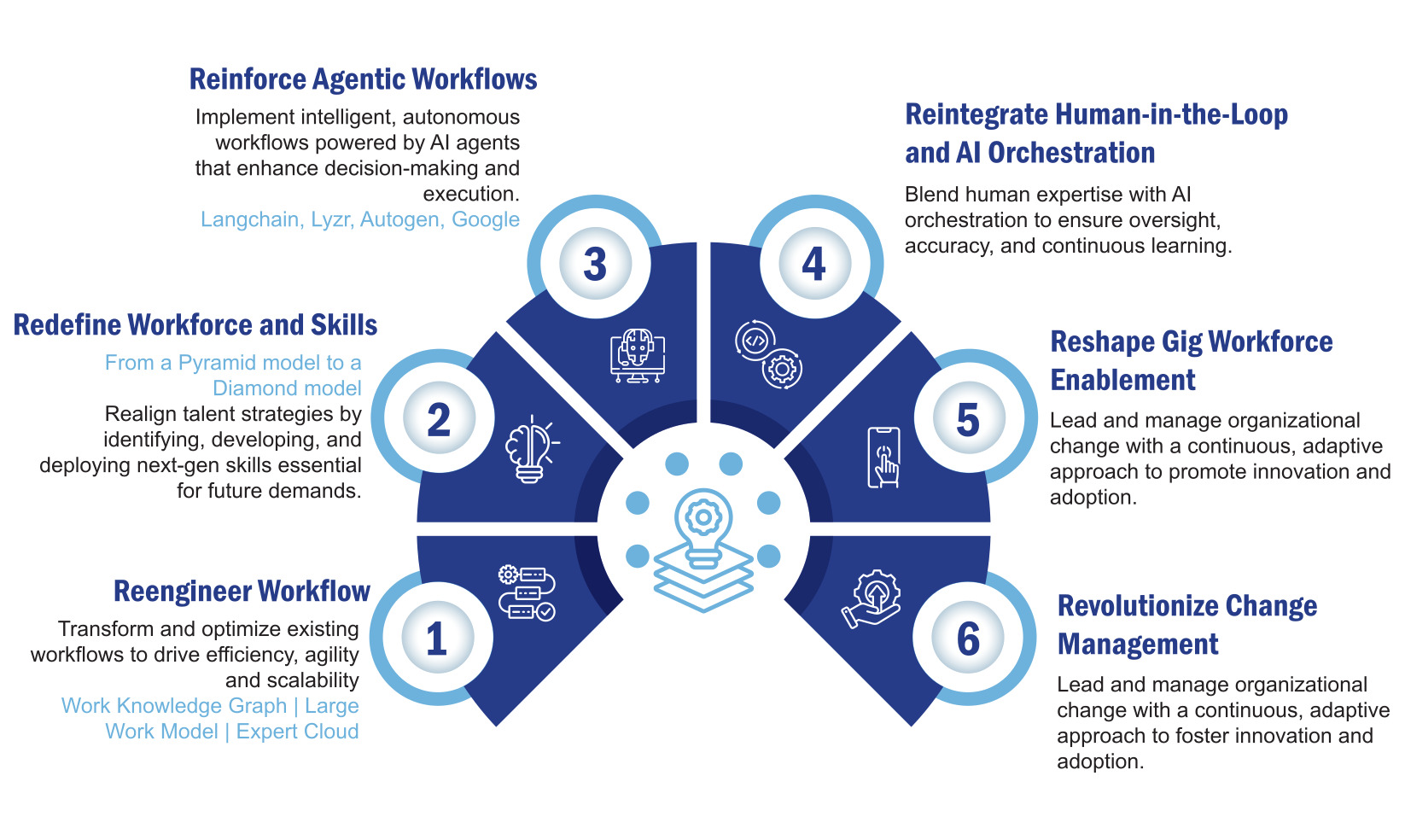
1. Reengineer Workflow: From Processes to Atomic Tasks
We're breaking down complex processes into modular, interoperable components. Instead of a 40-step process requiring weeks of training, we create atomic components that can be learned in days and recombined for different needs.
This isn't just about efficiency; it's about agility. When a client's business shifts, we can reconfigure workflows in days, not months. We can deploy new capabilities without retraining entire teams. We can test, learn, and iterate at speed.
Our approach to workflow engineering is guided by what we call "friction mapping": identifying pain points in the customer journey and then connecting the dots between process atomization and the right combination of technology and human intervention.
At the foundation of this sits what we call our intelligent context framework, our blueprint for capturing and structuring the "why" behind decisions, not just the "what." Traditional enterprise systems capture state, the outputs and final records, but not the decision context that shapes how work really gets done. Much of this lives as tribal knowledge: unwritten rules, expectations, and judgment calls sitting in people's heads, Slack threads, or informal escalations.
We're systematically capturing decision traces; the inputs, signals, rules applied, exceptions granted, escalations made, and human approvals so that over time the system learns institutional context as a first-class dataset. For customer support workflows, this means capturing how past tickets were escalated, which exceptions were granted under what conditions, which agents approved decisions in ambiguous cases, and what cross-system signals influenced resolution steps.
When we persist with this information, it becomes a searchable institutional memory, a context graph-like layer that lets AI understand not just rules, but how those rules have been interpreted and applied historically. We start with simpler activities like customer support because the context is bounded and structured. Over time, this framework creates a compound learning effect where precedent makes future decisions faster, more consistent, and preserves knowledge that would otherwise leave with individual employees.
2. Redefine Workforce and Skills: The Diamond Imperative
If we're serious about moving from pyramid to diamond, we need to fundamentally rethink skills, roles, and career paths.
At Firstsource, this starts with being honest about the displacement risk. AI will replace some jobs built on repetition and transaction processing. But it will also create entirely new categories of work: AI orchestrators, exception handlers, empathy-driven problem solvers, and domain specialists who bring judgment to complex situations.
Our job is to help our people navigate this transition.
We're also rethinking how we define "workforce." It's not just full-time employees anymore. With our recently launched Gigsourcing Platform, we're building an ecosystem that blends AI-powered virtual agents, domain expertise, and global freelance talent.
Critical to this workforce transformation is our UnBound platform, our internal learning ecosystem. It is purpose-built for our context. UnBound enables hyper-personalized, continuous learning at scale. It's how we're reskilling thousands of employees from transactional roles to judgment-driven positions, ensuring our workforce evolves as fast as our technology.
This creates workforce flexibility that can scale up or down based on client needs, access specialized skills on demand, and operate across time zones and geographies seamlessly.
The diamond model isn't about having fewer people; it's about having the right people doing higher-value work.
3. Reinforce Agentic Workflows: The AI-First Operating Model
Our AI philosophy is captured in three simple principles: data for AI, AI in everything, AI for everyone.
This simple framework guides every technological decision:
- Data for AI: Building data foundations that enable intelligent automation
- AI in everything: Embedding AI capabilities across all workflows, not as bolt-ons
- AI for everyone: Democratizing access so every employee can leverage AI tools
But here's what we've learned: AI doesn't work if you just bolt it onto existing processes. You need to redesign the work itself.
Today, agentic AI is at the core of our UnBPO™ transformation. We're deploying AI agents across our relAI™ suite of solutions, and we're seeing remarkable results.
We've built what we call the Agentic AI Studio, where we leverage emerging protocols like MCP (Model Context Protocol), A2A (Agent-to-Agent Protocol), ACP (Agent Communication Protocol), and ANP (Agentic Network Protocol) to create intelligent, interoperable systems. These aren't just buzzwords; they're the new language of digital operations: HTTP for the agentic web.
One of our most significant AI investments embodies our "inch wide, mile deep" philosophy: a domain-centric Language Model built specifically for the U.S. mortgage industry.
This isn't a generic AI model adapted for mortgage; it's a purpose-built Language Model trained on mortgage-specific knowledge, combining transformer architecture with advanced techniques like model blending. The result is an AI that understands the nuances of mortgage lending as deeply as an industry veteran.
Through our strategic partnership with Lyzr.ai, we're leveraging enterprise-grade AI agent orchestration that coordinates multiple AI agents across workflows with built-in security, compliance, and governance. Lyzr's platform enables us to build, deploy, and manage AI agents that run locally in air-gapped environments within our clients' own cloud infrastructure, ensuring complete data privacy and control.
Similarly, our partnership with AppliedAI enables us to automate complex, regulated enterprise processes end-to-end with human oversight and compliance built in. Together, these partnerships allow us to move from proof-of-concept to measurable business impact in weeks, not quarters.
4. Reintegrate Human-in-the-Loop: Augmentation Over Elimination
The future isn't human versus machine; it's human with machine.
Every agentic workflow has a deliberate role for human judgment. The question isn't "Can AI do this?" but "Where does human expertise add the most value?"
Trust is the core element here. In industries where decisions impact people's financial futures, health outcomes, or legal standing, trust isn't built by black-box algorithms; it's built by transparent systems with human accountability.
That's why human-in-the-loop isn't just a safety mechanism; it's a trust mechanism. When customers know a trained professional reviewed the AI's recommendation, when regulators see human oversight in audit trails, when employees understand they're validating rather than being validated, that's when AI adoption accelerates.
We're building copilots, not replacements. Our agents handle volume, speed, and consistency. Our human experts handle complexity, empathy, and ethical judgment. Together, they're unstoppable.
This philosophy extends to how we think about quality and compliance. In regulated industries like healthcare and financial services, human oversight isn't optional; it's the whole point. AI accelerates, but humans validate.
5. Reshape Gig Workforce Enablement: The Platform Economy
The traditional BPO model assumed that work happened in delivery centers with full-time employees. UnBPO™ assumes work happens anywhere, by anyone, at any time.
With our Gigsourcing Platform, we're creating a digitally intelligent, hyper-agile ecosystem that connects enterprises with specialized talent on demand. This isn't about replacing our employee base; it's about augmenting it with flexible capacity and niche expertise.
The platform includes AI-led matching, workflow orchestration, compliance-first onboarding, and automated payments. But what excites me most is the new operating model it enables: work gets disaggregated into tasks, sourcing gets diversified across talent pools, and enterprises can scale with precision instead of guesswork.
6. Revolutionize Change Management: Continuous Adaptation
If I've learned anything in my 28 years in this industry, it's that transformation isn't a project; it's a continuous capability.
The traditional change management playbook (big launch, intensive training, go-live date) doesn't work in a world where AI capabilities are evolving monthly, and client needs are shifting weekly. We need to build organizations that can learn, adapt, and evolve in real time.
We're moving from static training to continuous learning. From fixed roles to fluid responsibilities. From compliance mindsets to innovation mindsets. This requires leadership courage, transparent communication, and a willingness to admit when things aren't working.
The only way to drive continuous change is to create psychological safety: permission to experiment, fail fast, and learn faster.
How the Pillars Work Together
Here's what makes UnBPO™ powerful: these six pillars aren't separate initiatives. They're an integrated system where each element reinforces the others.
Let me show you how this works in practice across three real scenarios:
Mortgage Origination: We reimagined the entire customer journey, accounting for both happy paths and exception scenarios. Document-intensive processes are now intelligently intercepted and sorted to avoid inefficient manual touches. We've reskilled complex underwriting into a POD-based structure that achieves hyper-productivity. With generative AI-enabled underwriting assist solutions, interpretation of complex scenarios and knowledge dissemination of state-level compliance variations are significantly easier, with targeted SME reviews only where judgment truly matters.
Financial Crime Detection: When a payment is initiated from India to the US, our monitoring system throws an alert. The workflow proceeds through personality checks, name screening across watchlists, L1 alert validation for true matches, and L2 decision-making. Previously, teams primarily relied on L1 detection. Now we've built an AI-assisted L2 layer that recognizes patterns and supports human-in-the-loop closures, dramatically reducing false positives while maintaining compliance rigor.
Core Banking Services: We've taken the most active service banking requests and routed them to Conversational AI to avoid human intervention where possible. Simple workflows like password resets, IVR to OTP verification to password reset, now happen entirely through AI. For mortgage servicing, portions like payment methodology and interest-principal breakdowns are handled through assisted or conversational AI, freeing our experts to focus on complex customer situations requiring empathy and judgment.
You can't build agentic workflows without reengineering processes. You can't redefine workforce skills without understanding how gig platforms expand your talent pool. You can't integrate humans effectively without continuous change management.
This systems thinking is what differentiates transformation from tinkering.
What Can Other Businesses Learn from What We're Doing?
The question isn't whether to build this tech stack. It's how fast you can move.
Five lessons from our journey:
- Start with workflows, not technology: AI on broken processes creates expensive automation of bad work.
- Invest in people obsessively: Your workforce must evolve as fast as your technology.
- Blow up your business model: Outcome-based pricing will cannibalize traditional revenue. Do it to yourself first.
- Build for continuous change: One-time transformation leaves you behind immediately.
- Embrace ecosystems: Find partners and be honest about what you don't know.
The Bottom Line
Traditional BPO is dying. What's being born is far more valuable: human expertise, AI capabilities, and flexible talent combining to deliver previously impossible outcomes.
UnBPO™ is about augmentation over elimination, outcomes over outputs, continuous adaptation over static solutions.
The tech stack for the future isn't about the latest AI or the most offshore centers. It's about orchestrating humans, machines, and workflows for disproportionate value.
That's the future we're building.
References:
- Statista. (2025). Business process outsourcing – worldwide: Market forecast. Statista Market Insights. https://www.statista.com/outlook/tmo/it-services/business-process-outsourcing/worldwide/
- Times of India. (2026, January 10). McKinsey boss Bob Sternfels breaks down how AI is changing consulting jobs: Non-client-facing roles are shrinking and jobs that are growing are...
https://timesofindia.indiatimes.com/technology/tech-news/mckinsey-boss-bob-sternfels-breaks-down-how-ai-is-changing-consulting-jobs-non-client-facing-roles-are-shrinking-and-jobs-that-are-growing-are/articleshow/126461541.cms
 Download Now