

|
|
Orchestrating AI Across the Enterprise |

Beyond Outsourcing: Cultivating an AI-First Mindset in the Age of Disruption

Amar Akatrai SVP, Strategic Initiatives, Firstsource
I still remember the day I interviewed for my first job. It was at a large office near the airport, where an HR representative and an Operations leader sat across a desk, asking me why I was suited for a customer service role supporting a U.S.-based travel industry client. My answer was simple but honest: my mother is an English teacher, my father is a travel agent, and I possess the skills needed for the job. To my surprise, just minutes later, I was handed an offer letter.
The BPO industry has come a long way in the last 20 years. The high-value work we do today demands human skills like problem- solving, creativity, and relationship-building. It’s no longer just about who we hire; it’s about how work is assigned, which skills are prioritized, and how we enable continuous evolution. I recently came across a quote by Andrej Karpathy, former Senior Director of AI at Tesla: “Soon the most valuable skill won’t be coding, it will be communicating with AI.”
The harsh reality facing leaders today isn’t whether AI will disrupt their industry; it’s whether they’ll lead the transformation or be left behind. AI adoption has surged from 50% in 2022 to 78% in 20241, while the BPO market reached over $300 billion in 2024 and is forecasted to exceed $525 billion by 20302. Yet here’s the uncomfortable truth: only 26% of companies have developed the necessary capabilities to move beyond proofs of concept and generate tangible AI value3.
The FLUX Reality: Why Traditional Models Are Failing
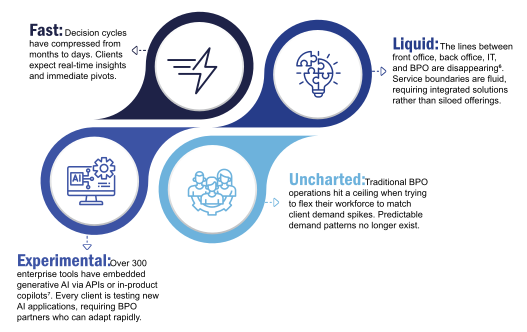
We’re operating in what we call a FLUX reality—Fast, Liquid, Uncharted, and Experimental. Business models shift overnight, customer expectations surge, and legacy systems buckle under pressure. Traditional BPO approaches weren’t designed for this velocity.
The technological shifts we’re witnessing today are dissolving barriers such as cost, complexity, and geography. The democratization of AI is transforming how we think about scale, agility, and innovation. AI is no longer a distant promise; it’s a present-day catalyst reshaping operational models, customer engagement, and workforce dynamics. The axis is shifting from labor arbitrage to technology arbitrage.
While the transformation brings challenges, including workforce transitions that have affected thousands of jobs, the data tells a more complete story of evolution rather than elimination. The key is proactive adaptation rather than reactive resistance.
The Disproportionate Returns of AI-First Transformation
Traditional transformation curves deliver incremental benefits of 25-30%8. But AI-first approaches are generating disproportionate returns if you’re willing to think like a startup instead of an enterprise.
For our customers, the value proposition is now multi-dimensional, not just limited to operational efficiencies, but extending to scalability, enhanced customer experience, and cost optimization that reframes percentage metrics as multipliers.
The pattern is clear from what we’ve been able to achieve for our customers
- A major U.S. health plan operating across 20 states uses Firstsource’s AI co-pilots to guide agents through claims processing, providing context-specific instructions and real-time decision explanations while incorporating continuous feedback loops⁹
- Firstsource’s AI-based coaching solutions helped educate employees on cultural nuances, geography, and business applications through simulated customer interactions, dramatically reducing training time while improving quality scores¹⁰
- For mortgage servicing clients, Firstsource’s AI co-pilots accelerated the underwriting process by collating and validating information from multiple customer documents— cutting processing time from several days to just a few hours¹¹
What do these winners have in common? They didn’t try to automate their existing processes—they re-imagined the processes that created the problems in the first place.
Years ago, I led a team of Champion Change Managers who delivered a large digital transformation project for a UK telecom service provider. This was when digital transformation was just becoming mainstream and AI was on the horizon. The fundamentals remain the same; momentum often matters more than flawless execution. The principle of progress over perfection must be embraced. It’s about defining “good enough” standards for each project, delivering fast, and refining through iterative cycles.
The Human-AI Paradox: Skills Evolution, Not Elimination
The workforce impact story is more nuanced than the headlines suggest. By 2025, AI might eliminate 85 million jobs but create 97 million new ones, resulting in a net gain of 12 million jobs¹². The Philippines BPO sector exemplifies this paradox: 135,000 jobs were added in 2024, with the industry on track for an additional 1.1 million jobs by 2028¹³
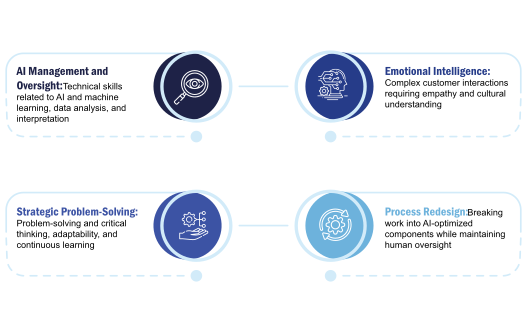
But there’s a critical skills gap emerging. Companies face a significant supply challenge: a shortage of employees equipped with technical skills or who can work with artificial intelligence¹⁴. The skills in demand include:
This transformation isn’t theoretical—it’s already happening in ways that would have seemed impossible just two years ago.
A few months ago, something happened that crystallized everything I’ve been talking about.
One of our recent hires—someone who joined us to handle customer interactions- taught herself to code using AI. Not in a formal training program. Not with months of preparation. She had a client problem to solve, opened a conversation with an AI coding assistant, and built a working solution in a matter of days.
When our technical team reviewed what she’d created, they were stunned—not because it was perfect, but because it worked. It was functional, deployable code created by someone who’d never written a line of code before. We took it to the client, and the conversation shifted immediately. What started as a discussion about process improvement became a conversation about what’s now possible.
This wasn’t a one-time anomaly. It’s a pattern we’re seeing emerge across our teams. People hired for their empathy, communication skills, and problem-solving instincts are now augmenting those capabilities with technical execution. The barrier between “I see the problem” and “I can build the solution” has collapsed.
Twenty years ago, I got hired because I had the basic skills needed for the job. . Today, we’re watching people advance because they learned to choreograph AI, not replacing their human judgment but amplifying it in ways that were unimaginable even two years ago.
This is the UnBPO™ reality: when you combine domain expertise with accessible AI tools, you don’t just optimize existing processes—you unlock entirely new capabilities. The question isn’t whether your workforce can adapt. It’s whether your organization is creating the conditions for this kind of emergence to happen.
To operationalize this shift at scale—to move from organic emergence to systematic transformation, we need a framework that aligns vision with execution.
The UnBPO™ Framework: From Vision to Execution
I often encounter questions like: Why do AI conversations thrive in boardrooms but get lost in the messy middle? Why isn’t AI scaling across markets and industries? Why can’t we move beyond pilots? My response is that the challenge isn’t just technological, it’s organizational. To operationalize this shift, we need a framework that aligns vision with execution.
Based on Firstsource’s UnBPO™ approach and industry best practices, successful AI transformation requires a structured framework:
1. Anchor AI Strategy in Business Outcomes
At Firstsource, we’re building the UnBPOTM framework, which anchors AI strategy in business outcomes. We’re translating our AI-first strategy into use cases that resonate across functions— HR, Marketing, Finance, and more. We use storytelling to demonstrate how AI solves real, tangible problems, not just abstract ones—and we anchor this vision in everyday language.
2. Build Technology-First Partnerships
Our focus is on solving deeply embedded inefficiencies across industries, whether it’s fragmented workflows, manual interventions, or legacy systems that slow down transformation. We call this a Symphony of Partnerships, where we co-create with specialized technology partners to accelerate delivery. We share partner success stories internally and externally to build trust and momentum. Partners play an integral role in making the UnBPOTM framework successful.
There is a fundamental business model mismatch between building AI-native products and running a BPO¹⁶. Frame “build vs. buy” as “build with” co-create with technology partners who understand both AI capabilities and industry constraints.
3. Navigate the Implementation of “Messy Middle”
Despite 69% of C-suite leaders investing in GenAI a year ago, 47% of companies report slow progress in building GenAI tools. Navigating the messy middle requires agile rituals like stand-ups and retrospectives to surface blockers early. Creating cross-functional pods to own execution layers and ensuring psychological safety are key to success. Defining clear roles and outcomes, while allowing room for experimentation, encourages teams to raise flags without fear of judgment.
Success requires:
- Agile sprint methodologies with weekly retrospectives
- Technical debt tracking and dedicated remediation time
- Psychological safety to surface implementation blockers early
Closing the vision-action loop by showing progress against strategic goals is essential. Celebrating small wins reinforces momentum and alignment.
4. Scale Through Modular Architecture
Breaking operations into interoperable, intelligent components enables real innovation and scalable growth¹⁸. Design systems for evolution, not perfection.
Communicate openly about trade-offs, build review checkpoints to catch critical issues, and balance speed with quality by prioritizing high-impact tasks. Break work into short cycles, refine based on feedback, align key stakeholders early, and protect critical areas like compliance, security, and customer content. The result? We not only delivered revenue gains in the millions but also became early disruptors in that vertical.
The Path Forward: Five Critical Choices
A recent piece in Harvard Business Review posed a provocative question: as AI reshapes the consulting landscape, will it render consultants obsolete, or elevate their strategic value? My perspective is shaped by a recent UnBPO™ session with our CX Consulting Leader, whose team exemplifies how AI can be a catalyst for reinvention rather than replacement.
Over the past 12 months, her team has not only adapted to the shifting macro landscape but thrived within it—future-proofing their capabilities while deepening relevance through multi-threaded client relationships. Their approach is rooted in anticipatory design, building CX processes with an AI-First mindset and proactively defining the Future of Work.
They’ve embraced technology arbitrage, leveraging a diverse AI partner ecosystem—from hyperscalers to niche domain platforms—to unlock immediate value. This has been matched by a deliberate reskilling effort, ensuring the team is fluent in emerging technologies and platform capabilities.
Organizationally, they’ve dismantled traditional hierarchies in favor of cross-functional pods that span business units, all aligned to a singular goal: delivering measurable business outcomes for clients.
The path forward requires balancing innovation with empathy, automation with human insight, and transformation with trust.
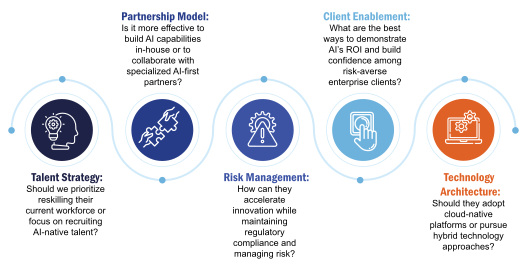
We as leaders face five strategic choices we need to make in the next 12 months:
Bottom Line: The Transformation Imperative
The BPO industry is heading for deep secular disruption as significant advances in both generative and agentic AI are driving the labor-first business model to one of software-first value creation²².
Organizations that embrace an AI-first mindset, like Firstsource’s UnBPO™ approach, will capture disproportionate value. Those clinging to traditional labor arbitrage models risk becoming irrelevant as clients increasingly expect the speed, accuracy, and scalability that only AI-augmented operations can deliver.
For enterprise leaders, the mandate is clear: embrace AI not just as a tool, but as a catalyst for sustainable growth and workforce evolution.
The question isn’t whether AI will transform the way we work; it’s whether your organization will lead that transformation or be consumed by it. The window for proactive change is narrowing, but for those who act decisively, the potential for sustainable competitive advantage has never been greater.
The future isn’t just about doing things differently; it’s about thinking differently. It’s cultivating the mindset.
References
- G2 Learning Hub, “Global AI Adoption Statistics: A Review from 2017 to 2025” (2025)
- Andreessen Horowitz, “Unbundling the BPO: How AI Will Disrupt Outsourced Work” (2025)
- Boston Consulting Group, “AI Adoption in 2024: 74% of Companies Struggle to Achieve and Scale Value” (2024)
- Firstsource Solutions, “UnBPO™: A Bold Redefinition of Business Process Outsourcing” (2025)
- Founders Forum Group, “AI Statistics 2024–2025: Global Trends, Market Growth & Adoption Data” (2025)
- Firstsource Solutions, “UnBPO™” website (2025)
- Firstsource Solutions, “AI in Business Process Management: Transitioning from Hype to Impact” (2024)
- Ibid.
- Ibid.
- National University, “131 AI Statistics and Trends for (2024)” (2024)
- PS Engage, “Future Proofing the Philippine BPO Industry in the Age of Artificial Intelligence (AI)” (2025)
- Ibid.
- Firstsource Solutions, “UnBPO™: A Bold Redefinition of Business Process Outsourcing” (2025)
- Andreessen Horowitz, “Unbundling the BPO: How AI Will Disrupt Outsourced Work” (2025)
- Founders Forum Group, “AI Statistics 2024–2025: Global Trends, Market Growth & Adoption Data” (2025)
- Firstsource Solutions, “Agentic AI Studio Launches by Firstsource” (2025)
- Hypersense Software, “Key Statistics Driving AI Adoption in 2024” (2025)
- Ibid.
- Coherent Solutions, “2025 AI Adoption Across Industries: Trends You Don’t Want to Miss” (2025)
- Firstsource Solutions, “UnBPO™: A Bold Redefinition of Business Process Outsourcing” (2025)
- AI Is Changing the Structure of Consulting Firms, Harvard Business Review (2025)
- Andreessen Horowitz, “Unbundling the BPO: How AI Will Disrupt Outsourced Work” (2025)

 Download Now