

|
|
Orchestrating AI Across the Enterprise |

Overcoming the AI Value Paradox: A Pragmatic Take to AI Value Creation

Jimit Arora CEO, Everest Group
Walk into any boardroom today and you’ll hear the same buzzwords: generative AI, agentic AI, productivity, transformation. The energy is palpable. Leaders see AI as the next big unlock. Yet behind the excitement is a more sobering statistic: most AI efforts are failing.
The majority of companies are still pouring millions into pilots that never leave the lab. Which raises two questions: why are so many AI initiatives stuck at the proof-of-concept stage? And more importantly, how can enterprises actually design for success?
I’ve come to believe the answer isn’t more pilots, more hype, or more technology. The answer is reframing how we think about value. It means treating AI as a long game.
And that comes down to three convictions:
- AI is not a technology sprint. In reality, AI is a value marathon.
- Enterprises must build Systems of Execution that eliminate hidden enterprise debt and scale impact.
- Leaders need to start with a clear view of the future and work backwards.
These convictions aren’t abstract principles; they’re the difference between getting stuck in experimentation and creating lasting reinvention. Let’s start with the first.
Conviction 1: AI is a value marathon
Every transformation era in services has unfolded slowly. Outsourcing in the 1980s. Offshoring in the 2000s. Digital in the 2010s. Each era spanned a decade or more, with leaders experimenting, scaling, and course-correcting along the way.
AI marks the beginning of a fourth era: the reinvention era. Unlike past shifts, this one is being accelerated by the pace of AI model progress. But acceleration doesn’t eliminate the need for endurance. In fact, like the eras before it, this is a value marathon – one that requires persistence and patience as benefits compound over time.
We need to keep reminding ourselves that real progress takes years, not months. It has been more than 15 years since public cloud emerged, and many enterprises are still in the early stages of adoption. Nearly 40 years after the first global capability center (GCC) opened in Bangalore, companies continue to evaluate and launch GCCs for the first time. Reinvention takes time.
However, here’s the catch: everyone expects AI to deliver results in months. Spoiler alert: it won’t. Reinvention is slow, difficult, and cumulative, which is why most leaders struggle with it.
Conviction 2: The AI Value = Systems of Execution + A3 - PTSD
Capturing value from AI requires more than deploying a model or buying a tool. It means we are on a journey to build Systems of Execution powered by an A-cubed construct – automation, generative AI, and agentic AI working together.
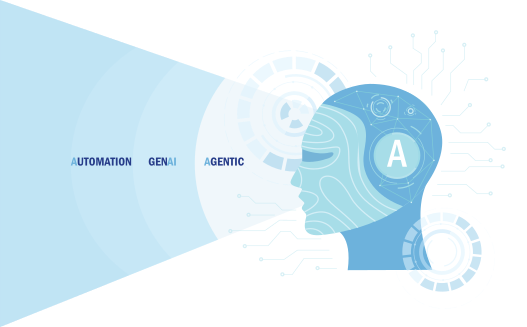
Think of A-cubed not as three separate tools but as a progression of intelligence layers that build on each other.
- Automation establishes the foundation by handling rules- based, repetitive processes with speed and consistency, leveraging deterministic machine learning models. It eliminates friction in workflows and creates the predictable backbone enterprises can trust.
- Generative AI sits on top of automation, introducing creativity, language understanding, and pattern recognition. Where automation executes the known knowns, generative AI handles the unstructured middle ground – summarizing, drafting, interpreting, and bridging gaps in knowledge.
- Agentic AI brings the final layer: autonomy. Agentic systems can sense goals, make decisions, and act in dynamic environments, often coordinating across both automation and generative AI. In other words, they don’t just generate or execute – they orchestrate, autonomously.
When combined together, automation handles the routine, generative AI expands the frontier of knowledge work, and agentic AI ties them together into adaptive, goal-driven execution. The synergy is what moves enterprises from incremental efficiency to scalable reinvention.
But before enterprises can harness A-cubed, they have to confront the hidden drag of what we call PTSD – process debt, technology debt, skills debt, and data debt.
These forms of organizational debt are easy to ignore but impossible to escape:
- Process debt: Outdated, inefficient workflows that no algorithm can fix
- Technology debt: Legacy platforms that make integration costly and brittle
- Skills debt: Teams unprepared to design, supervise, and adapt AI-driven systems
- Data debt: Fragmented, low-quality, or inaccessible data that undermines every model
To truly capture value from AI, enterprises must avoid and eliminate these forms of debt. And the sequence matters: start with process reinvention, ensure the data structures are harmonized, ensure the right skills and capabilities are in place, and only then bring in technology.
Consider how this preparation might play out inside a large enterprise. For instance, a global bank may begin by tackling process debt – redesigning loan origination workflows constrained by manual reviews. Next, it could address data debt by harmonizing customer records spread across legacy systems. From there, it might invest in reskilling underwriters to overcome skills debt, enabling them to supervise and guide AI-driven scoring tools. Finally, it could reduce technology debt by modernizing the core lending platform so automation, generative AI, and agentic AI can plug in seamlessly.
Many of these efforts fail because companies take a technology- first approach and then expect value to appear as if by magic. Fixing PTSD is not glamorous, but it is foundational.
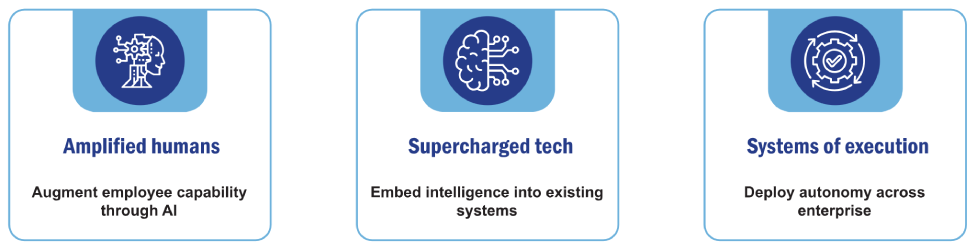
Once the debt is addressed, enterprises can unlock three modes of AI execution. Not through one silver bullet, but through evolving channels:
- Amplified humans
- Supercharged tech
- Systems of execution
When you enable everyone through AI, your employee pool becomes a group of amplified humans who can deliver higher productivity. At the same time, enterprises need supercharged tech – existing systems infused with intelligence. Most software companies are already embedding AI into ERPs, CRMs, and cloud platforms, turning today’s tech stacks into something smarter by default. Together, amplified humans and supercharged tech help close gaps in technology and skills, solving for the “T” and “S” of PTSD.
But what about PTSD as a whole? That’s where the third element comes in: Systems of Execution. These orchestration layers sit above systems of record, engagement, and insight to create autonomy. They don’t just analyze or recommend – they execute. And even if humans get distracted or platforms drift, Systems of Execution keep enterprises aligned to their goals.
AI Will Permeate Organizations via Three Modes
In practice, a System of Execution looks less like a single product and more like an orchestration fabric. For example:
- A customer service team might use automation to route tickets, generative AI to draft responses, and agentic AI to decide whether to escalate, close, or trigger a refund – all running continuously without human touchpoints in the loop.
- In supply chain, automation handles inventory updates, generative AI analyzes external signals (like weather or demand spikes), and agentic AI autonomously shifts shipments to prevent disruption.
- In finance, automation reconciles transactions, generative AI interprets anomalies, and agentic AI recommends or even initiates corrective actions in line with governance rules.
All three channels matter. But the pinnacle is Systems of Execution. AI has been disappointing thus far because people aren’t recognizing that if they’re truly seeking autonomy, they must invest in creating Systems of Execution using the A-cubed approach – automation, generative AI, and agentic AI – to achieve something greater, including adaptability and agency at scale. This is where true reinvention begins.
Conviction 3: Start with the future and THEN create the new Operating Models and Partnerships
The companies that succeed don’t just experiment – they decide where they’re headed. They think in terms of scenarios: what does evolution look like for us, and what does reinvention look like? Then they align on a future state (we call it a Futurecast) and work backward to build the roadmap (we call it the Backcast). What’s most important is that each company will have its own journey. So, as an enterprise, you need to consider your journey, your future state. Yes, let’s be informed about what other industries are doing and what other companies in your industry are doing. However, it’s crucial to align on where YOU want to go.
This third conviction is about translating that future-back vision into action. To get there, enterprises must fundamentally rethink how work gets done, how partnerships are structured, and how success is measured.
At Everest Group, we work with many clients to build distributed workforces, select locations, and determine work placement. In a fluid, execution-first environment, the structure, skills, and role of internal functions and constructs like GBS and GCCs must evolve. The image below highlights the important operating model transformations required to enable this shift – showing how enterprises must move from the “then” to the “now.”
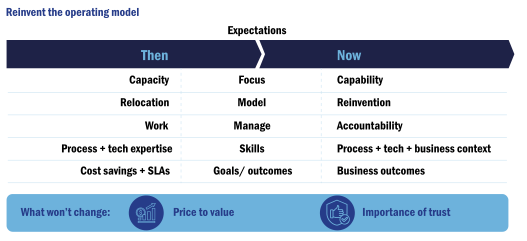
It’s no longer enough to relocate the work. Enterprises need to reinvent the work. That means adding business context to process and tech skills, and measuring outcomes not just by cost and SLAs but by competitiveness and business impact.
This shift also changes how we partner. Who we buy from, what we buy, how we decide, how we select, and how we measure performance – all of it is being rewritten.
We’re seeing a new set of rules take shape in how enterprises approach sourcing and partnerships:
- The supply landscape of tomorrow will look different from what it does today – those segments are no longer distinct categories.
- Enterprises will buy people, technology, and specialization as a bundle, not as standalone line items.
- The selection process is no longer the domain of a single sourcing team. It requires joint decision-making across business, IT, and procurement.
- Companies now juggle thousands of SaaS suppliers alongside a handful of strategic partnerships. They should be thinking about how to optimize for both.
- Contracts need to be more flexible, measuring outcomes rather than inputs, and moving beyond multi-year lock-ins.
The AI value paradox is about endurance, discipline, and clarity of vision. Enterprises that embrace these convictions can move beyond stalled pilots and hype, unlocking real reinvention and sustainable business impact.
This article was contributed by Everest Group

 Download Now