

|
|
Exclusive Feature on Building the Tech Stack for the Future of Work |

Enabling AI Innovation at Scale Needs an Innovation Value-Chain

Professor Shonali Krishnaswamy Director, Monash AI Institute and Associate Dean Innovation, Faculty of Information Technology
In October 2016, I followed Robert Frost’s advice of “The Road Not Taken” and left my familiar and comfortable universe of academic and public sector/government-funded R&D, and co-founded an AI/ML tech start-up called AiDA Technologies.
I had spent many years working with and leading R&D teams, demonstrating the power and potential of AI and Machine Learning to several industry partners, including Banking, Insurance, Payments, Healthcare, Transportation, Telco, and Aerospace. In my mind, I thought, well, we know what problems these sectors face, we are research experts in Machine Learning and Data Science, how hard can it be to take all that knowledge and make a difference in the real-world?
It turned out to be a much, much harder task than I ever could have imagined. I had to unlearn, learn, and re-learn several things in my journey from research and development of methods/algorithms with demonstration prototypes, to building highly scalable, reusable AI/ML products that worked 24x7 for several clients.
Along the way, with a strong dose of reality checks, AiDA developed a disruptive AI product for health insurance claims processing and real-time Fraud, Waste, and Abuse (FWA) detection that processes approximately 75% of Singapore’s individual Health Insurance Claims today.
In 2023, we were acquired by Asia’s largest Life and Health Insurer, AIA. One of the most important learnings for me was that the challenge to take AI research and innovation to the real world required sustained and significant software engineering effort.
Universities are recognized as foundational pillars of innovation systems—generating new knowledge, building advanced skills, and underpinning long-term economic and societal progress. Most research creates value indirectly and cumulatively, typically through workforce capability building and subsequent innovation flowing into enterprises, and gradual development of new technologies, standards, regulations, and policies.
Yet OECD (Organisation for Economic Co-operation and Development) evidence consistently shows that while research excellence is widespread, there remains a gap in that only a relatively small percentage of innovation gets translated to create direct commercial and/or societal impact within typical evaluation timeframes [1, 2, 3]. AI and deep-tech research are thriving, but translational impact is not keeping pace.
Universities are producing breakthrough algorithms, models, and systems at unprecedented speed (in 2025, top-tier AI conferences such as NeurIPS published around 3,000 research papers, having received an astonishing 30,000 plus papers) [4], yet only a fraction of this work ever reaches real-world deployment at scale.
The result is a widening gap between what our research systems are capable of producing and what economies and societies are actually getting used to. This is why innovation at scale has become the defining challenge for AI and deep tech.
For every dollar of university AI research that fails to commercialize, there's both the direct loss (due to the research funding gap) and the massive opportunity cost (the innovations that could have transformed industries). Thus, AI breakthroughs that don't translate represent enormous lost acceleration.
The question is no longer whether we can invent powerful technologies, but whether we can repeatedly and responsibly deploy them in organizations at scale. In other words, how can AI and deep tech innovations create impact at scale, and how can the journey from “lab to market” be seamlessly facilitated? These questions have now emerged as institutional challenges.
The approach that we have taken at the Monash University AI Institute to address this serious challenge is to first understand why high-quality AI research is not having the immediate impact that it should in the real world.
The Translation Gap: Where AI Research Gets Stuck
Even if the innovation addresses a critical organizational need/challenge, translation is inhibited by on-the-ground challenges of adoption of the innovation in enterprises due to several reasons detailed below.
- Lack of Engineering Capacity: The problem is not a science or innovation problem; it is an engineering/systems problem. The journey from a cutting-edge, innovative AI algorithm/model to an AI solution that works 24x7 in the real world requires significant engineering. A simple analogy is that the AI innovation is like a car engine, but that engine can only be used if there are seats, a gearbox, a steering wheel, and the list goes on. The engine is critical, but it is not the car! Monash University AI research focuses on the long and arduous process of building state-of-the-art engines but lacks experience as well as the engineering skills/resources to develop the car.
- Enterprise Integration is non-trivial: Following the development of even a sophisticated AI solution (that encompasses the core AI innovation), there is still a further step to integrate the solution into an organizational workflow through complex and non-trivial software integration (involving, in many cases, core legacy systems). This is well and truly beyond the remit of academic research, and in fact, there are no incentives for executing delivery through enterprise integration.
- Model Testing is not Systems Testing: AI research focuses on testing the model performance in terms of typical AI metrics for efficacy. Typically, research papers will publish results from out-of-time/out-of-sample testing of the model. However, in a fully functioning system, it is essential to go beyond to perform system integration and user acceptance testing as well as other non-functional testing, such as pen-tests, performance tests, application/code scans for vulnerabilities, etc.
Maintenance and Support: Beyond various levels of maintenance and support that would be expected for a production-deployed system, for AI systems, further MLOps functionalities will be required to continuously auto-tune the model based on new data as well as user feedback, while also ensuring that the model meets business metrics for the specific application/solution.
The challenges of adoption are not merely technical, as listed above.There is a clear need to recognize the need for distribution channels to create large-scale adoption beyond a limited number of deployments. Academic institutions are geared towards creating innovations but are not sales organizations with access to markets. In fact, this is clearly not the remit of academic institutions and researchers.
The Innovation Value Chain: A Framework for Scale
Creating commercial and real-world impact lies in creating an innovation value chain, as shown below. The innovation value chain recognizes that academic institutions must focus on the core science and innovation of AI methods/algorithms, while partnering with organizations that have strong software engineering/solution delivery capabilities and access to the market.
The impossible-to-cross bridge between the producers of knowledge/innovation, and the enterprise receptacles that need this innovation is overcome through the innovation value chain.
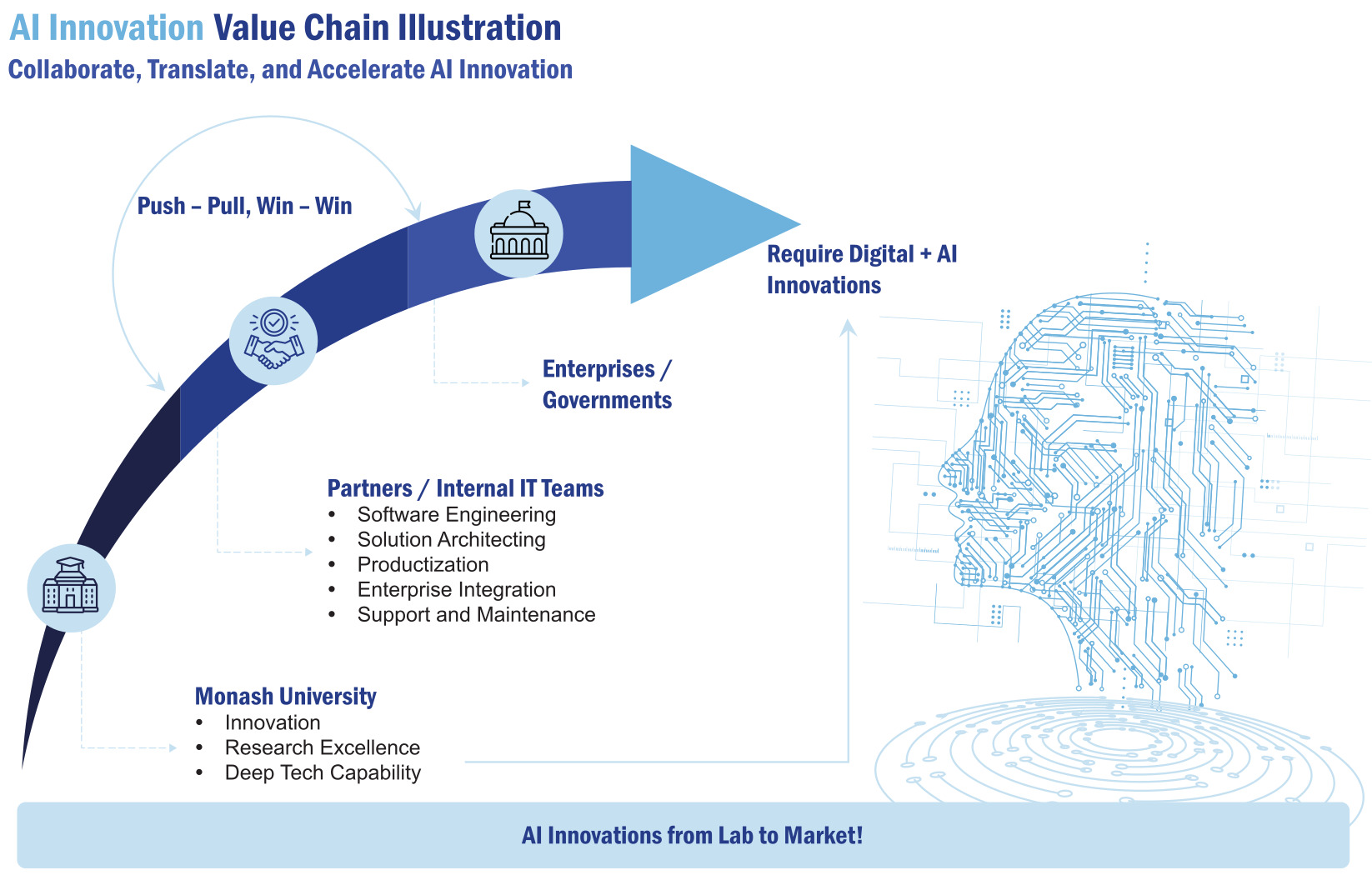
The innovation value chain leverages the mutual strengths of university research as a bedrock of research and development of breakthrough innovations. Scientists and academics focus on their core competence of working developing novel AI/ML techniques/algorithms/systems. For example, researchers at Monash University’s Centre for Learning Analytics have developed, evaluated, and published award-winning techniques/systems for early identification of “at-risk” students in university subjects [5]. However, adoption of these methods at scale across the university requires pilot testing at scale across multiple subjects, beyond research validation.
Furthermore, successful pilot testing needs to be followed by deployment through a traditional IT integration process. Finally, while these steps enable the research to move from lab to one real-world use, the true benefits of innovation at scale happen when the successfully tested and deployed techniques can be taken to market, beyond a single institution. Thus, the innovation value chain needs researchers, working with domain/application experts, working with IT architects and software/data engineers, and finally a go-to-market channel partner who can help to truly scale the innovation.
The innovation value chain is but a high-level construct that addresses some of the challenges of enabling AI innovations to flow from lab to market at scale. There are always significant challenges in specific use cases and details. While this illustration assumes a linear directionality, in many cases, it can start from the solution partner identifying a sector-level need for innovation, and in some cases, the research algorithms/methods may need some customization and configuration to address the actual requirements. Nevertheless, establishing the innovation value chain through trusted partnerships that are mutually beneficial is a critical step in creating translation pathways that integrate research and scientific innovation, with deployment and delivery capabilities.
Moving from Isolated Excellence to Coordinated Ecosystems
The evidence is clear. Despite unprecedented AI research output, 30,000+ papers submitted to NeurIPS alone, we face a widening gap between innovation and impact. Fewer than 5% of university AI technologies reach commercial deployment, representing billions in lost economic value and societal impact [6]
DeepMind's prediction of 2.2 million new materials has resulted in fewer than 800 synthesized materials [7]. The pattern repeats across every domain: brilliant research, limited deployment.
The innovation value chain offers a practical framework for addressing this challenge. By explicitly connecting three critical components, academic research, engineering delivery, and market access, it acknowledges what individual institutions cannot achieve alone while creating pathways for what partnerships can accomplish together.
Implementation Requires Institutional Change
Academic institutions must extend their mission beyond knowledge creation to include knowledge deployment. This does not mean abandoning fundamental research but rather establishing formal translation partnerships as core institutional practice.
Industry organizations must recognize that innovation increasingly originates outside their walls. Rather than viewing universities as competitors or service providers, successful firms will position themselves as deployment engines—transforming academic breakthroughs into scalable solutions.
Government funding bodies need evaluation frameworks that reward translation alongside discovery. Current metrics incentivize publications over deployments, creating misaligned incentives throughout the innovation pipeline.
Solution delivery partners represent the critical middle layer. Organizations that master both technical understanding and enterprise integration can build sustainable businesses by bridging the gap between academic innovation and market deployment.
The innovation value chain is not a complete solution; no single framework could be. Specific implementations will vary by domain, institution, and geography. Challenges around intellectual property, incentive alignment, and resource allocation remain substantial.
The fundamental insight stands that translation at scale requires coordinated ecosystems, not isolated excellence. Mission-oriented collaboration between academia, industry (and potentially government) can help to bring about a shift in innovation, creating real-world impact at scale, moving from isolated excellence to coordinated ecosystems. The institutions that build these partnerships first, connecting research brilliance with delivery capacity and market access, will define the next era of technological advancement. The choice is not whether to act, but how quickly to begin.
References:
- Paunov, C., Borowiecki, M., & El-Mallakh, N. (2019, September). Cross-country evidence on the contributions of research institutions to innovation (OECD Science, Technology and Industry Policy Papers, No. 77). OECD Publishing. https://www.oecd.org/content/dam/oecd/en/publications/reports/2019/09/cross-country-evidence-on-the-contributions-of-research-institutions-to-innovation_7caf2fbf/d52d6176-en.pdf
- OECD. (2010). The OECD innovation strategy: Getting a head start on tomorrow. OECD Publishing. https://wbc-rti.info/object/document/7380/attach/Innovation_Strategy_-_Getting_a_Head_Start_on_Tomorrow_en1.pdf
- Kumpf, B., & Jhunjhunwala, P. (2023). The adoption of innovation in international development organizations: Lessons for development co-operation (OECD Development Co-operation Working Papers, No. 112). OECD Publishing. https://www.oecd.org/content/dam/oecd/en/publications/reports/2023/06/the-adoption-of-innovation-in-international-development-organizations_cbb5e055/21f63c69-en.pdf
- NeurIPS Program Committee Chairs. (2025, September 30). Reflections on the 2025 review process from the program committee chairs. NeurIPS Blog. https://blog.neurips.cc/2025/09/30/reflections-on-the-2025-review-process-from-the-program-committee-chairs/
- Gašević, D., Jovanović, J., Pardo, A., & Dawson, S. (2018). Early warning system as a predictor for student performance in higher education blended courses. Studies in Higher Education, 44(11), 1900–1911. https://research.monash.edu/en/publications/early-warning-system-as-a-predictor-for-student-performance-in-hi/
- Njoroge, J. (2025, August 15). The university AI commercialization gap. Insights by Dr. Jean. https://insightsbydrjean.com/the-university-ai-commercialization-gap/
- Google DeepMind. (2023, November 29). Millions of new materials discovered with deep learning. https://deepmind.google/blog/millions-of-new-materials-discovered-with-deep-learning/

 Download Now