

|
|
Exclusive Feature on Building the Tech Stack for the Future of Work |

3 Myths About Scaling CX with AI

Sudha Bhat SVP, Customer Experience, Firstsource
Why Most CX Transformations Stall After Early Success
AI is now deeply embedded in customer experience. Chatbots handle scale, agent assist tools support frontline teams, and analytics increasingly guide operational decisions. For most organizations, the question is no longer whether AI belongs in CX.
Yet many CX transformations stall soon after early success.
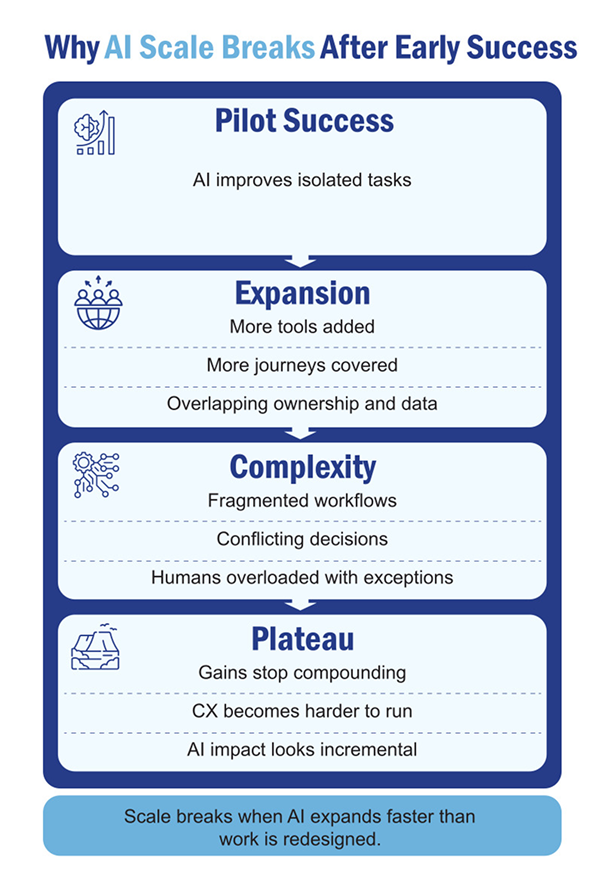
Early pilots deliver results. Leaders expand coverage. More use cases go live. Then momentum slows. Complexity rises. The gains that once felt transformative begin to look incremental.
This slowdown is often mistaken for a technology problem. It is not.
AI works. What breaks down is how organizations attempt to scale it. CX leaders often see strong early gains, such as improved digital containment or agent productivity, but those gains diminish as AI expands faster than operating models evolve. What looks impressive at the pilot stage quietly plateaus as journeys become interconnected and decisions begin to cascade across the system.
This shift mirrors changes playing out across industries, where value is moving away from transactions and toward systems designed around people, participation, and outcomes.
Before examining the myths that shape this behavior, it is important to understand where most CX scaling efforts go off track.
When Growth Becomes the Wrong Goal
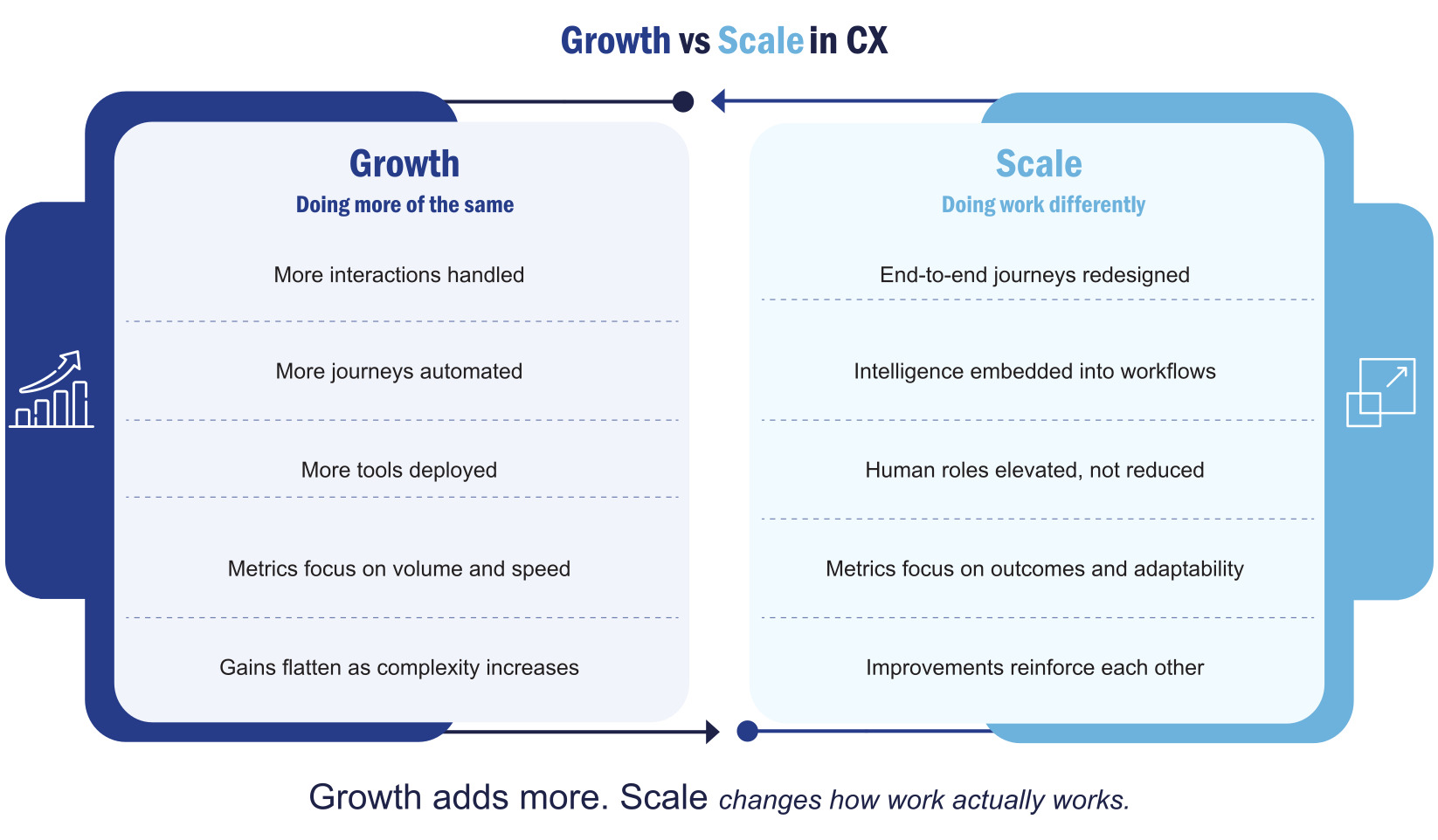
Many CX organizations treat growth and scale as the same thing. They are not.
Growth is about doing more. More interactions handled. More journeys covered. More automation deployed. Scale is about doing differently. It shows up when improvements in one part of the system reinforce others instead of creating friction elsewhere.
AI exposes this difference very quickly. Used narrowly, it accelerates tasks. Used systemically, it forces changes in how work flows, how decisions are made, and how accountability is distributed across CX.
Industry research consistently reflects this gap. While most CX leaders report strong ambition around AI adoption, only a small percentage succeed in scaling AI meaningfully across the enterprise. The issue is rarely access to tools. It is the absence of redesign at the level of work, roles, and governance.
Most CX transformations stall because they pursue growth while avoiding that redesign. In several CX programs, conversational automation scales well initially, but costs and handle time rise elsewhere as exception handling, ownership, and decision-making across journeys remain unchanged. Growth looks strong, but scale breaks because the underlying work was never redesigned.
Myth 1: Scaling Means Adding More Tools
When organizations think about scale, the instinct is expansion. More bots. Broader automation. Additional features rolled out across channels. This approach delivers quick wins, but it rarely sustains momentum.
Tool-led scaling improves individual tasks rather than the system as a whole. One AI improves containment. Another speeds up agents. A third scores quality. Each creates value in isolation, but the gains do not reinforce one another. Over time, complexity increases faster than impact, leaving teams managing more technology without seeing proportional improvement.
The earliest signal that tool-led scaling has reached its limit is not performance decline, but rising decision friction, where teams spend more time aligning tools, metrics, ownership, and hand-offs than changing how work actually flows.
What actually scales is work design.
When AI is embedded into end-to-end CX workflows rather than layered on top, intelligence travels with the interaction itself. Decisions move closer to the moment they matter. Hand-offs reduce. Outcomes improve without adding friction. Scale comes from redesigning how work flows across CX, not from stacking capabilities.
Myth 2: AI-Led Growth Comes from Replacing Humans
Another limiting assumption is that AI-driven CX success is primarily about reduction. Fewer agents. Leaner teams. Lower cost per interaction.
The most scalable CX models do not remove humans. They keep them in the loop and move them closer to decisions that matter. In more mature CX environments, roles such as journey owners and real-time operations leaders become critical, ensuring AI-driven actions align with experience outcomes rather than isolated efficiency gains.
As AI absorbs repetitive work, human roles move up the value chain. Agents focus on exceptions, complex conversations, and moments that directly influence retention or revenue. Team leaders rely less on backward-looking reports and more on predictive signals. Analysts spend less time producing dashboards and more time shaping decisions.
This shift matters because scale introduces volatility. Demand spikes. Policy changes. Customer behavior evolves. CX organizations that rely purely on automation struggle to adapt. Those that elevate human judgment alongside AI absorb change more effectively.
AI scales CX fastest when it amplifies human judgment rather than attempting to replace it.
Myth 3: If AI Works in One Process, It Works Everywhere
A solution that performs well in one CX journey is often expected to extend smoothly into others. What works in billing should work just as well in onboarding, retention, or claims. When it does not, teams assume the technology has reached its limits.
More often, the constraint is orchestration.
Scaling AI across CX requires shared data foundations, clear decision boundaries between humans and AI, and governance that spans journeys rather than individual tools. Without this, AI remains locally successful but structurally fragile. Pilots do not fail because AI cannot scale. They fail because the organization around them does not evolve fast enough to support scale.
AI does not scale itself. Enterprises scale around it.
What Real Scale Looks Like in CX
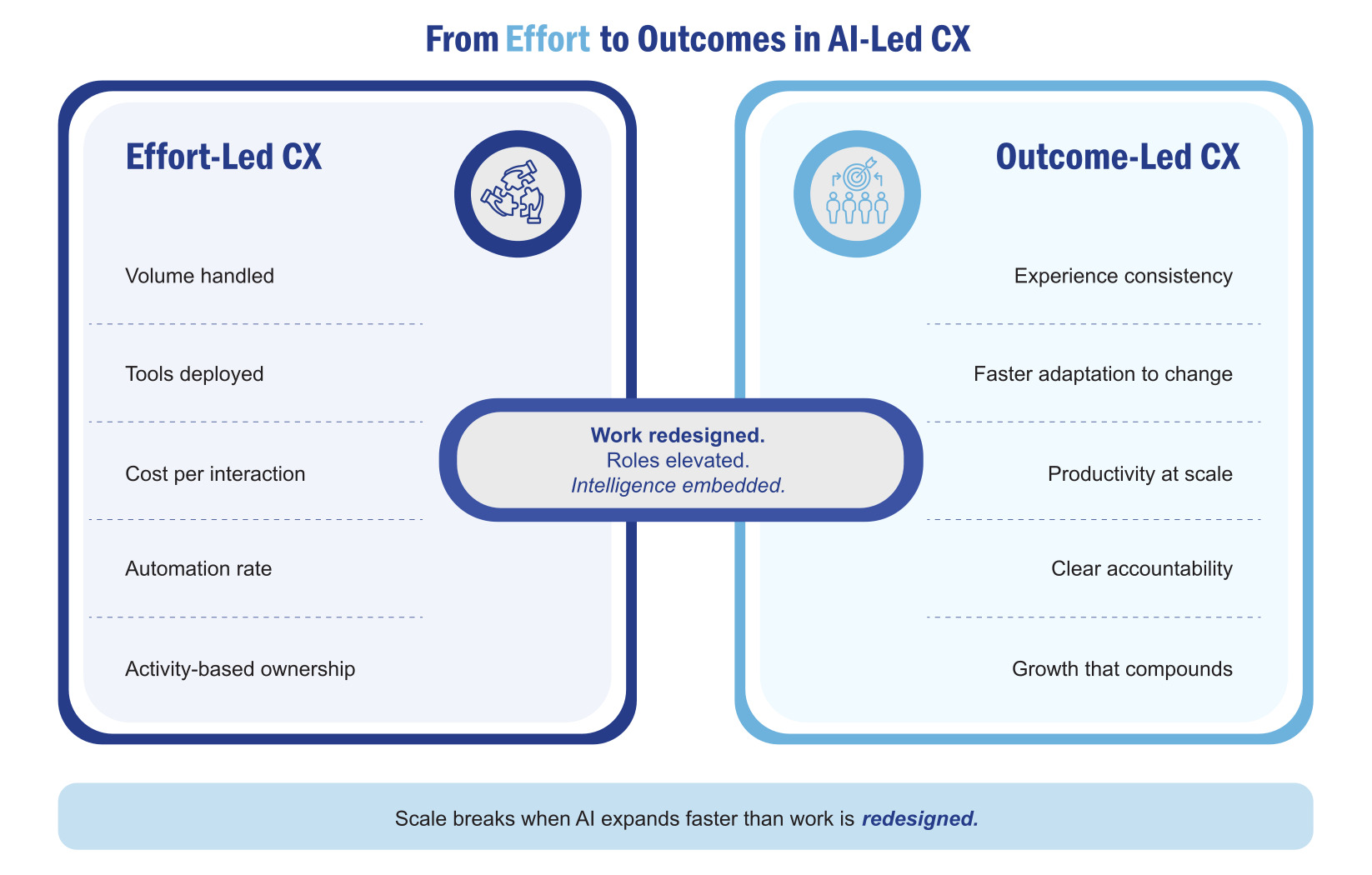
When AI truly scales in CX, the shift is visible well before metrics are reported. Work is organized differently. Journeys are designed end to end rather than optimized in fragments. Intelligence is embedded directly into workflows instead of being pushed into dashboards after the fact. Ownership becomes clearer, with humans accountable for outcomes rather than activity.
Success is no longer measured by how much work AI absorbs, but by what the CX organization can now do differently. Faster adaptation. More consistent experiences. Better alignment between cost, experience, and growth. This is where scale stops being linear and begins reinforcing itself.
The UnBPO™ View: Scaling Outcomes, Not Effort
From an UnBPO™ perspective, this shift is fundamental. AI-led CX only scales when the focus moves from effort to outcomes.
That means moving beyond metrics such as volumes handled or tools deployed and toward value created across customer journeys. In one large benefits administration transformation, this required rethinking multiple member journeys together rather than optimizing isolated touchpoints. AI was embedded across conversational IVR, chat, agent assist, and quality within redesigned workflows and clear ownership models.
The impact showed up where it mattered most. Productivity improved meaningfully, cost-to-serve reduced, and experience consistency increased as escalations and hand-offs came down across journeys.
The organizations that scale are not the ones with the most AI deployments. They are the ones that redesign work, elevate decision-making, and build intelligence into the fabric of CX operations. That is where growth stops being incremental and AI begins delivering real leverage.
Scaling the Right Thing
AI will continue to improve. Tools will get smarter, and capabilities will expand. But CX growth will remain limited unless organizations change what they are actually scaling.
The leaders who succeed will not be the ones who deploy the most AI, but the ones who redesign work, elevate human judgment, and align intelligence to outcomes. That is when AI stops being an efficiency lever and starts becoming a growth engine for CX.

 Download Now